Mobile App Metrics for Training and Capability Planning
Mobile team leads make training investment decisions every year, often from incomplete evidence. The mobile app engagement metrics that inform those decisions split cleanly into two groups: metrics from your team's own analytics stack, and metrics from outside-in evidence about what the market is actually building. Both feed different capability planning decisions. This article covers which metrics matter, where the numbers actually come from, and how the resulting evidence supports training programme investment for mobile teams, agencies, enterprise mobile functions, consultancies, and product companies.
I have been building and shipping mobile apps professionally since 2010, first at Coderus and now with Appnalysis, where we read what mobile apps ship as outside-in evidence. That work has put me in a lot of conversations with mobile team leads making training and capability investment decisions across agencies, enterprise mobile functions, consultancies, and product companies. One pattern comes up consistently: the sheer volume of what is happening in mobile tech makes those decisions genuinely hard, and most teams are making them from incomplete evidence.
Mobile tech moves at a pace that exceeds what any team can properly evaluate. New SDKs launch weekly. New frameworks emerge quarterly. New AI features are being integrated across app categories at rates that even experienced practitioners struggle to track. Compliance requirements shift across jurisdictions. Platform policies change multiple times a year. The training and capability investment decision (what should our team learn next, what capabilities should we build, what should we deprioritise) is being made against a moving target that most teams do not have the visibility to properly assess.
This article covers the mobile app engagement metrics that inform those decisions, where the numbers actually come from, and how the resulting evidence supports training programme investment. This is mobile-specific capability planning and skills gap analysis, adapted from the wider learning and development discipline for the specific realities mobile teams face. The article is written for mobile team leads, engineering managers, agency practice leads, enterprise mobile programme managers, consultancy practice heads, and product company leadership who make training investment decisions with real budget consequences. The audience is broad because the capability planning problem is genuinely shared across those roles even though the specific decisions differ.
What Mobile Team Leads Typically Do to Make Capability Decisions
The honest picture across audience types is that mobile capability decisions are typically made from limited evidence.
Agency practice leads decide capability investment from a mix of senior partner intuition, recent project post-mortems, client demand signals, and occasional conference or training investment. When a client asks for a capability the agency does not have, the practice lead has to decide whether to build the capability internally, partner, or decline the work. That decision is often made under time pressure with limited market visibility.
Enterprise mobile programme managers decide capability investment through annual planning cycles that combine platform vendor guidance, analyst reports where budget permits, internal skills audits against an established competency framework, and business unit demand. The planning cycle typically produces a training programme that reflects last year's understanding of what capabilities matter, applied against next year's actual requirements.
Consultancy practice heads decide capability investment based on client engagement patterns, senior consultant recommendations, and the practice's positioning strategy. The decisions shape which practice areas the consultancy expands, which specialisations to acquire through hiring, and which to build through structured training.
Product companies making mobile capability decisions typically split between build, acquire, and partner options. The decision depends on how central the capability is to the product's differentiation, how quickly the capability needs to be operational, and how the labour market for that specific skill is trending.
Across all four audience types, the common pattern is that decisions are made with limited visibility into what the mobile market is actually doing today. Vendor reports describe categories at high level. Analyst briefings summarise trends. Conference talks name specific technologies. Peer conversations produce anecdotal signal. What is genuinely missing from most capability planning workflows is systematic evidence about what shipping apps are actually adopting, which technologies are getting traction versus which are generating discussion without adoption, and which patterns are emerging in specific categories or jurisdictions.
Industry reports from Sensor Tower, Adjust, AppsFlyer, data.ai, and similar sources are genuinely useful for understanding how tech categories have been performing, but they are backward-looking by design. A quarterly report published in October covers Q2 data. A state-of-mobile report published in December summarises the year that is ending. For training and capability planning specifically, that lag matters. Training investment decisions made from Q2 data in October are decisions made from a stale picture of what capabilities the market is actually rewarding today. The reports are not wrong, but they describe history rather than the present. Outside-in evidence about what shipping apps are doing right now produces a different quality of signal for capability planning specifically, complementary to the industry reports rather than replacing them.
Outside-in evidence provides that current-state layer, and it changes what capability planning can produce.
The Mobile App Metrics Worth Benchmarking
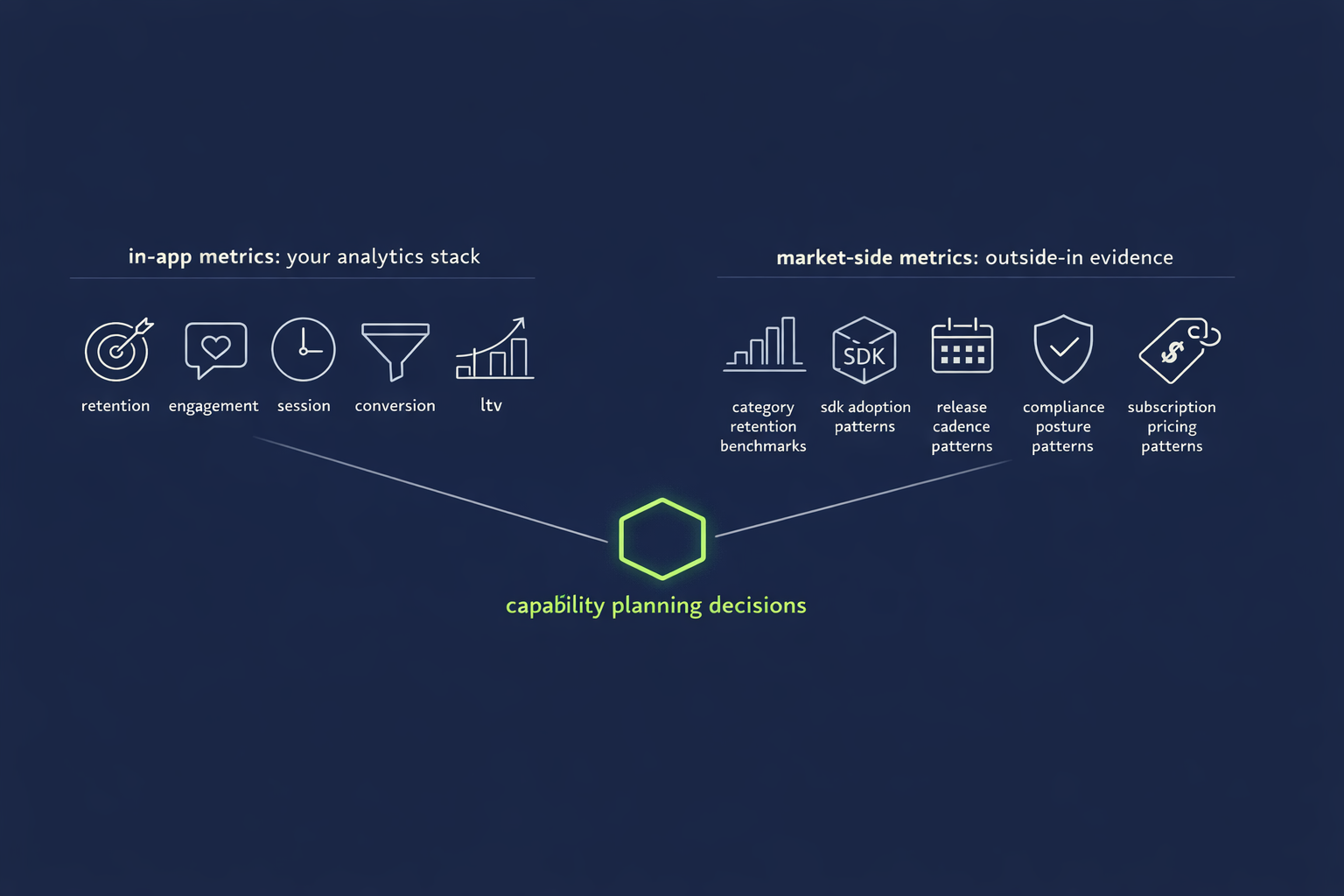
The metrics worth benchmarking for capability planning and capability building split explicitly into two groups by where the numbers come from. That split matters because the two groups inform different capability decisions, and skills gap analysis for a mobile team requires evidence from both. Mixing them produces the confused thinking that generic metrics content encourages.
In-app metrics come from your team's analytics stack. These are the metrics your team already has visibility into through Amplitude, Mixpanel, Firebase, Adjust, AppsFlyer, Singular, or whatever analytics tooling your team uses. In-app metrics tell you how your team's current technology choices are performing for the apps you are shipping today. Retention curves show whether your product architecture supports the user behaviour you designed for. Engagement metrics show whether your feature choices match user expectations. Session metrics show whether your onboarding and activation flows work. Conversion metrics show whether your subscription or purchase paths convert at the rate your business model requires. These are performance signals about your existing capability applied to your existing product.
Market-side metrics come from outside-in evidence about what other apps are doing. These are the metrics your team cannot see through your own analytics stack because they require visibility into apps you did not build. Category-level retention benchmarks (what retention rates typical apps in your category achieve based on inferred user behaviour patterns) require sampling apps beyond your own. SDK adoption patterns across your category require reading what shipping apps actually bundle. Release cadence patterns require tracking multiple apps across time. Compliance posture patterns require reading multiple apps' Data Safety and privacy declarations. Subscription pricing patterns require observing multiple apps' store listings across time. These are context signals about the market your team's capability operates within.
The two groups feed different capability decisions. In-app metrics feed decisions about optimising the capability you already have. Market-side metrics feed decisions about which new capabilities to develop or which existing capabilities to invest more in. A team looking only at in-app metrics can optimise their current output but cannot see whether their current output is competitive against what the market is doing. A team looking only at market-side metrics can see what the market is doing but cannot see how their own capability is performing against it. Both groups matter, and the capability planning decision needs evidence from both.
One discipline worth naming explicitly: cite specific numbers to source, or omit them. No invented benchmarks. Most benchmarking content in the mobile space uses invented or unattributed numbers ("60% of apps in your category have X retention rate") that readers have no way to verify. Those numbers are almost always either genuine but stolen from a paid report without attribution, or generic guesses. Either way, they damage the credibility of any capability decision that relies on them. If your source for a specific number is a legitimate published report, cite it. If your source is a general observation without a specific published number, describe the pattern without attaching a specific figure. That discipline produces evidence that survives scrutiny from the readers most likely to check.
Product Benchmarking for Mobile Teams
Product benchmarking is one input to the wider capability planning workflow, and for the training and capability lens specifically it produces evidence about what capabilities the market is actually rewarding versus what capabilities your team is currently investing in. The discipline itself is not new. What has changed is the ability to do it systematically across many apps at reasonable cost.
For capability planning specifically, product benchmarking answers a specific question: what are shipping apps in your category actually doing that your team is not, and what capability investment would close that gap. Feature parity comparisons show where category leaders have capability that the team lacks. Onboarding flow patterns show where the team's current UX capability produces different results from what category leaders achieve. Subscription structure patterns show where the team's monetisation capability sits relative to category norms. Integration patterns show where SDK and technical capability differs. Cross-platform parity shows where the team's platform-specific capability is stronger on one side than the other.
Each observation gives capability planners specific investment cases rather than generic sense that they should probably improve. A team that discovers category leaders have restructured their onboarding to skip a specific friction point has a specific UX capability investment case. A team that discovers competitors are shipping a specific integration pattern their team has not adopted has a specific technical capability investment case. Product benchmarking against the training and capability lens produces these specific investment cases directly.
The wider methodology of product benchmarking (how to select comparison apps, how to structure the comparison framework, how to weight different observations) is covered more thoroughly in adjacent content on competitor benchmarking and product planning workflows. This article's focus is the training and capability planning application of product benchmarking evidence rather than the methodology itself.
Mobile App KPIs and How They Connect to Capability Decisions
Mobile app KPIs are the specific measurable outcomes that capability decisions ultimately need to move. Different capability investments produce measurable effects on different KPIs, and the honest planning discipline is to name which capability investment expects to move which KPI before the investment is made.
The core mobile app KPIs that capability decisions typically target: retention (day 1, day 7, day 30, and longer-term cohort retention), engagement (daily active users versus monthly active users, session frequency, session depth, and the wider set of user engagement metrics that measure how users actually interact with the app over time), monetisation (conversion rate to paid, average revenue per user, lifetime value), performance (crash rate, ANR rate, app load time, key screen render times), and satisfaction (app store ratings, review sentiment, developer response rates). Industry benchmarking against these KPIs across similar apps in the same category provides the context that determines whether the team's current performance is genuinely a capability gap or already competitive.
There is a two-sided way to read these KPIs through the training and capability lens specifically. On one side, traditional KPIs work as a scorecard for how well existing capability is applied. If retention is high, the team's product and engagement capability is delivering results against the current product. If monetisation is low, the team's subscription flow capability is not producing the expected outcome. Read this way, KPIs measure the effectiveness of existing capability rather than pointing to capability that needs building. Training investment against a KPI that is already competitive is probably not the highest-leverage decision.
On the other side, low usage metrics on specific features or technologies produce interpretation questions that matter for capability decisions. If your team shipped an AI feature and users are not using it, that low usage KPI can be read two ways: as a failure of the underlying tech or SDK (the capability was built but the tech itself does not deliver), or as an opportunity signal (the market is not yet ready for it, the implementation missed what users actually want, or the feature needs different framing to gain traction). The interpretation determines whether the capability planning response is to invest more in making the capability work, invest in a different capability entirely, or accept that the capability was built for a market that has not materialised.
Both interpretations require market context that outside-in evidence provides. A low usage KPI on a feature that peer apps in the category are also failing to gain traction on suggests a broader market timing issue rather than a team capability issue. A low usage KPI on a feature that peer apps in the category are successfully engaging users with suggests a specific implementation gap that capability investment could close. The KPI alone cannot distinguish these two cases. Market context can.
When a team plans training investment, the honest question is which KPIs the investment expects to move, whether the team's current capability against that KPI is genuinely a constraint, and whether the interpretation of specific low-usage signals points to opportunity or write-off. A team whose retention is competitive but whose monetisation lags category benchmarks should probably invest in monetisation capability rather than retention capability. A team whose performance is genuinely poor should probably invest in mobile engineering fundamentals rather than adding new features. A team whose AI feature usage is low while peer apps show growing engagement should probably invest in either implementation improvement or a specific capability the peers have that they lack. Making these connections explicit before the training investment happens produces materially better capability decisions than investing in whatever capability the team's existing enthusiasm points toward.
Mobile App Performance Metrics and Category Benchmarks
Beyond the core KPIs, mobile app performance metrics deserve specific attention because performance is often the invisible capability gap that undermines everything else. Category-level performance benchmarks (typical app load times, crash rates, ANR rates for apps in specific categories) require sampling across the category rather than looking at any single app. App retention benchmarks similarly require category context because absolute retention numbers vary meaningfully by category and use case.
Performance capability tends to receive less deliberate training investment than feature capability because performance work is less visibly rewarding. Users notice new features and adopt them. Users do not usually notice performance improvements consciously, but they notice performance failures immediately. A team whose performance metrics are quietly lagging category benchmarks may be losing users continuously without any clear signal about what capability investment would close the gap.
Outside-in evidence about category performance patterns gives capability planners the context to prioritise performance capability investment appropriately. A team that discovers their app load times are two seconds longer than category median has a specific capability gap to address. A team that discovers their crash rate is meaningfully above what similar-complexity apps in their category achieve has a specific investment case for testing capability. These are the kinds of specific investment cases that generic performance advice cannot produce because they require category context.
Watching What Shipping Apps Are Actually Adopting
The mobile tech developments worth investing in training for are the ones getting genuine adoption across shipping apps, not the ones getting talked about at conferences or in vendor pitches. The distinction matters because the two categories overlap only partially. Some technologies generate substantial discussion and get adopted widely. Some generate substantial discussion but fail to gain adoption. Some get adopted widely with limited discussion. Some genuinely important patterns emerge from adoption before discussion catches up.
Outside-in evidence about what shipping apps are actually adopting produces a different signal than conference talks and vendor briefings. When a new SDK genuinely takes hold in a category, the pattern shows up in the SDK footprints of shipping apps within that category over subsequent releases. When a new framework fails to gain traction, the pattern is that adoption clusters at a small number of early apps and then does not spread. When a new pattern emerges organically, the pattern shows up as multiple apps independently arriving at similar approaches without an obvious industry conversation driving it.
For capability planning, this evidence layer matters because it reduces the cost of bad training experiments. Teams have historically made capability investment decisions partly through experimentation (try a new SDK on a project, see whether it works, invest in the capability if it does). That experimentation is genuinely how learning happens, but it is expensive when it does not pan out. Failed experiments cost time, morale, integration debt, and opportunity. Outside-in evidence about market adoption reduces the surface area of experimentation needed by showing which technologies are demonstrably gaining traction versus which are generating discussion without adoption. Teams can focus their experimentation on the technologies with market signal rather than testing everything to see what sticks.
Business USP as the Filter for Which Market Signals Matter
Not every trending technology is worth every team's investment. The team's specific business USP shapes which market signals should drive capability decisions and which should be observed but not acted on. This is the filter that keeps capability planning focused rather than reactive to every industry conversation.
A team's business USP might be specific vertical expertise (health, fintech, retail, education, gaming), specific technical stack specialisation (native iOS, Flutter, React Native, specific backend platforms), specific compliance surface (HIPAA-covered apps, PCI-DSS-covered apps, GDPR-first apps, children-facing apps), specific client type (enterprise, SME, consumer, government), or specific delivery model (in-house build, agency delivery, white-label, template-based). Each USP shapes which market signals are relevant to that team's capability planning.
For an agency specialising in fintech mobile apps, a market signal about new AI features in social apps is interesting context but not a capability investment driver. The same signal about new AI features in fintech apps specifically is a capability investment prompt because it is directly relevant to the agency's USP. For an enterprise mobile team maintaining a HIPAA-covered app, a market signal about new advertising SDK patterns is irrelevant because their app cannot use advertising SDKs. A market signal about new privacy-preserving SDK patterns in HIPAA-adjacent apps is highly relevant.
The USP filter matters because without it, capability planning becomes reactive to every industry signal and produces uneven results. With it, capability planning focuses training investment on the market signals that align with the team's specific competitive position, which produces coherent capability development over time rather than a scattered pattern of half-adopted skills.
The Percentage-Match Reality Plus Two Use Cases
Capability matching against market signals is not binary. Most matches are partial, and decisions about pursuing partial matches are legitimate business decisions. The resulting capability picture reads like a skills matrix for the mobile team, showing where the team's capability level meets, exceeds, or falls short of what specific market signals would require. A team might have 80% of the capabilities needed for a specific opportunity and need to build or partner for the remaining 20%. A team might have 60% match on the technical stack for an emerging market signal but 100% match on the compliance surface. A team might have 100% match on the vertical but be missing a specific SDK or framework skill. Outside-in evidence supports partial-match assessment rather than just binary fit, and the partial-match reality is what capability planning actually navigates.
Two use cases show how the percentage-match reality plays out in practice.
Use case one: agencies and consultancies matching skills to client opportunities. An agency looking at potential client opportunities uses outside-in evidence about the prospective apps' current state (SDK footprint, compliance posture, technical patterns) to assess how well the agency's existing capabilities match what the app would need. The match is rarely 100%. The agency then decides whether the partial match is worth pursuing given the specific gap size, whether the gap could be closed through partnership, or whether the opportunity is a better fit for a different agency. This decision is made with better evidence than the traditional approach of accepting client work first and discovering capability gaps during delivery.
Use case two: enterprise and product teams identifying capability gaps and technology adoption trends. An enterprise mobile team looking at their internal capability against what shipping apps in their category are actually adopting can see specific gaps that would otherwise take months of experimentation to identify. If category leaders have adopted a specific SDK pattern that the team has not, that is a specific capability planning prompt. If category challengers are diverging on a specific approach, that reveals a strategic choice the team should make deliberately. If new entrants in the category are using approaches the established players have not adopted, that is early signal about where the category is moving. Each of these findings gives the team a specific capability investment case rather than a generic sense that they should probably learn something.
Both use cases share the same underlying pattern: outside-in evidence about what other apps are actually doing, filtered through the team's business USP, produces specific capability investment cases with the percentage-match reality named explicitly. That is materially more useful for training programme planning than either generic "future of mobile" content or purely internal capability audits.
Skills Gap Analysis for Mobile Teams: Putting It Together for Training Decisions
This section is the article's central framework: how mobile teams should conduct skills gap analysis using the metrics groups and evidence types described in the sections above, and how the resulting gap picture translates into specific training investment decisions. The workflow works whether you are running the analysis for the first time or refreshing an existing capability planning cycle, and it doubles as onboarding material for new team members because it makes explicit the reasoning that senior capability planners typically apply implicitly.
How to Conduct a Skills Gap Analysis for a Mobile Team
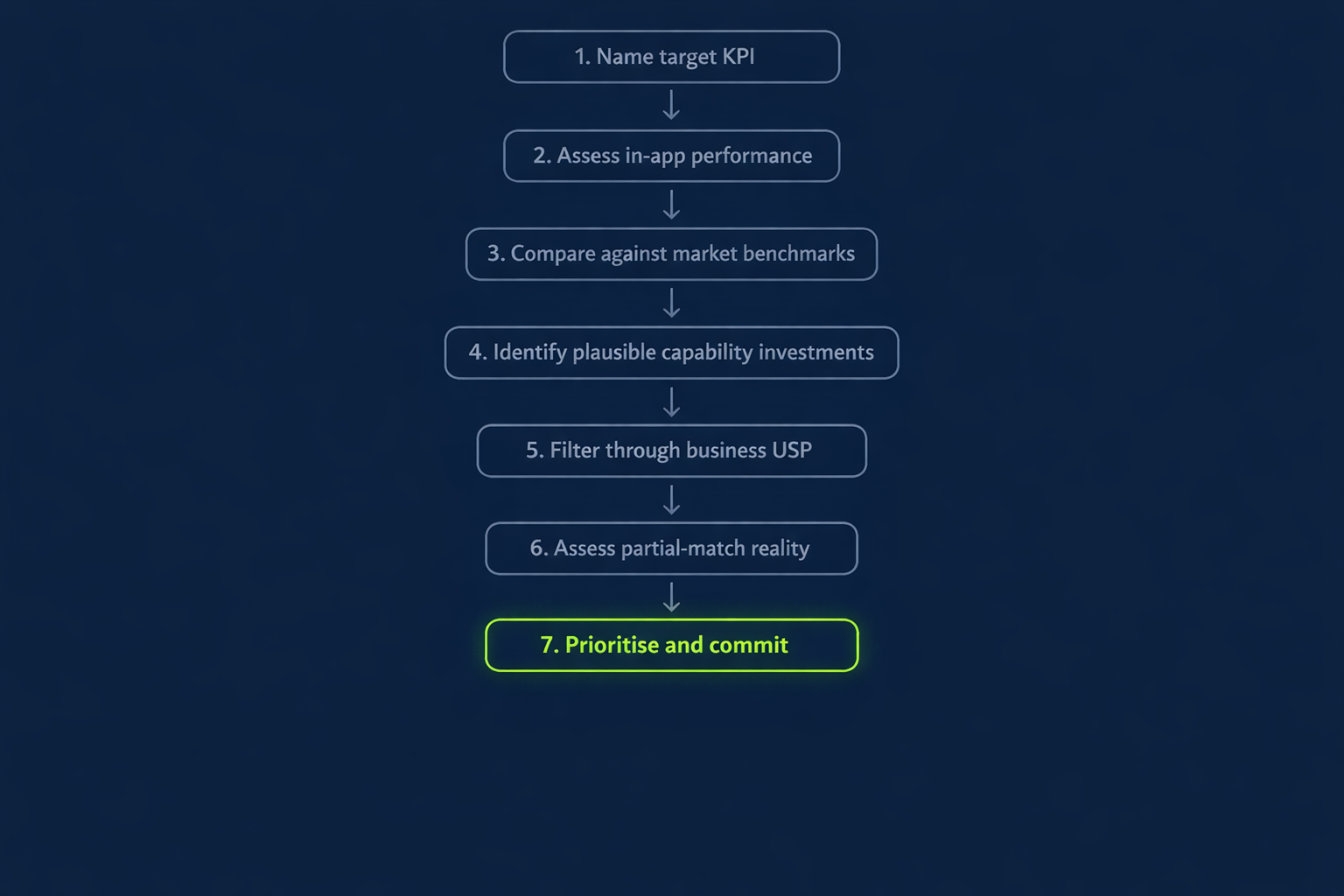
The workflow that turns metrics benchmarking into training programme decisions has a specific shape when both the in-app and market-side evidence groups are used together. This is skills gap analysis applied to mobile teams: assess where the team's current capability stands, compare against what the market is doing, identify the gap, and prioritise the investment that closes it. The steps below work as a repeatable process rather than a one-off exercise.
Start with the KPI you want to move. A team that wants to improve retention starts with retention metrics. A team that wants to improve monetisation starts with monetisation metrics. Naming the target KPI explicitly at the start of capability planning prevents the drift toward training programmes chosen for their perceived interest rather than their expected impact.
Assess in-app performance against the target KPI. The team's own analytics stack tells them how their current capability is performing on that KPI. This is the baseline that any capability investment expects to improve.
Compare against market-side benchmarks for the same KPI. Outside-in evidence about what shipping apps in the same category achieve on that KPI provides the context that determines whether the team's current performance is a real capability gap or already competitive. This is where the honest evidence discipline matters most: cite specific benchmarks to source, or describe the pattern without attaching invented numbers.
Identify which capability investments could plausibly move the KPI. This step names the specific training programmes, hiring decisions, tooling investments, or partnership arrangements that would address the identified gap. Different capability investments have different expected effects, and the honest planning discipline is to name the expected effect before making the investment.
Filter through business USP. Not every capability investment fits every team's positioning. The USP filter selects which of the plausible capability investments align with the team's competitive position.
Assess partial-match reality. Most capability investments produce partial rather than complete gap closure. Naming the expected partial match honestly prevents overpromising the impact of a training programme.
Prioritise and commit. With the target KPI named, the gap assessed, the plausible investments identified, the USP filter applied, and the partial-match reality acknowledged, the team can make training investment decisions with materially better evidence than the alternative of investing in whatever capability the team's existing enthusiasm points toward.
The workflow doubles as onboarding material for new team members because it makes explicit the reasoning that senior capability planners typically apply implicitly. A new practice lead, engineering manager, or programme manager can follow this workflow to produce defensible capability decisions from their first planning cycle rather than needing years to develop the intuition.
How Appnalysis Fits Into Capability Planning
Appnalysis is Bloomberg for mobile apps. Serious mobile capability planning has needed an aggregated intelligence layer for years, and the fragmented state of mobile market evidence has held the discipline back. Appnalysis produces that layer for mobile the way Bloomberg produces it for financial markets: aggregating signals that were previously scattered, giving practice leads and capability planners a workable interface to interrogate them, and making systematic capability planning possible at speeds that manual research cannot match.
For capability planning work specifically, two categories of Appnalysis output matter.
App Store Intelligence covers the market-side evidence layer described throughout this article: release cadence and version notes across categories, Data Safety and privacy label declaration patterns, permission scope patterns, review sentiment and developer response patterns, store standing changes over time, and subscription pricing patterns. Most capability planning questions can be answered from this layer, particularly questions about category positioning, compliance posture patterns, and the pace of change in specific mobile categories.
App Intelligence covers the deeper technology adoption layer: SDK inventory verification across categories, subprocessor mapping from shipped SDKs, and deep permission analysis for compliance-adjacent questions. Capability planning questions that require specific technology adoption evidence (which SDKs are actually shipping in the category, which frameworks are gaining traction, which integration patterns are emerging) benefit from this tier.
One thing worth naming about what Appnalysis does not do. It does not replace in-app analytics tools (Amplitude, Mixpanel, Firebase, Adjust, AppsFlyer, Singular, or whatever your team uses). It does not replace formal training programme design or internal capability audits. It does not replace hiring decisions or partnership evaluations. It contributes the specific dimension of outside-in market evidence that most capability planning workflows have not previously had access to at reasonable cost. Capability planners who combine outside-in market evidence with their existing analytics stack and internal planning workflows produce materially better capability decisions than either source alone would enable. Competitor benchmarking sits within this evidence surface too, though it is a separate discipline covered more directly in other articles in this cluster.
For teams using AI-assisted planning workflows (Claude Code, Cursor, or other agents with MCP configured), Appnalysis is available as a knowledge specialist that agents can query directly during capability planning work. That pattern is covered in more depth in Your AI Coding Agent Only Sees Half the Picture.
Try the Workflow on Your Own Capability Planning
The fastest way to see whether outside-in market evidence closes a meaningful gap in your capability planning is to try it on a specific decision you are currently working through. Bring a specific KPI you want to move, a specific capability investment you are considering, or a specific category positioning question you are trying to answer.
For market-side evidence at the continuous cadence capability planning needs (release patterns, Data Safety declarations, category positioning changes, subscription pricing patterns) the App Store Intelligence tier is designed for this.
For deeper technology adoption evidence (SDK inventory, subprocessor mapping, deep permission analysis) the App Intelligence tier provides the specific depth that technology adoption questions require.
- Try a question in /ask
- The Appnalysis platform
- Appnalysis pricing
Frequently Asked Questions
Related Reading
- Mobile Thought Leadership Research: What Changes When You Read the Apps - the sibling article in the content-and-research cluster
- Technical Due Diligence Checklist: Mobile Apps, No Source - how outside-in evidence supports transaction-time capability assessment
- Vendor Risk Assessment for Mobile SDKs Without Waiting on the Vendor - the vendor-facing application of similar evidence workflows
- Compliance Comparison: What Mobile App Security Testing Cannot Cover - the compliance-facing application in the governance cluster
- Your AI Coding Agent Only Sees Half the Picture - how Appnalysis works with AI-assisted planning workflows via MCP