Thought Leadership Content and Research for Mobile Apps
Sapio Research ranks top-three for "thought leadership content" by teaching readers how research-driven thought leadership works, from a research firm's position. This article does the same from the outside-in evidence position, using a real query on mental health app privacy as the worked example throughout, with the playback available to run yourself.
I have been building and shipping mobile apps professionally since 2010, first at Coderus and now with Appnalysis, where we read what mobile apps ship as outside-in evidence. That work has changed my view of thought leadership content on mobile in a specific way I want to be honest about.
Mobile thought leadership has been getting thinner for the past few years. Not because writers are worse. Because the source material got harder to gather. Vendor reports moved behind sales gates. Analyst previews stopped being freely shareable. Store APIs tightened. Third-party analytics data became less transferable after privacy changes. The result is that a lot of what publishes as mobile thought leadership now leans on the same handful of Sensor Tower and data.ai excerpts, some vendor case studies, and educated guesses about what other apps in the category are doing. It reads as thin because it is thin.
What outside-in evidence adds to mobile thought leadership research is direct visibility into what apps actually ship. Not what vendors say they ship. Not what analyst reports summarised from vendor briefings. Not what press releases claim. What the app package contains, what the store metadata declares, what the developer's release history reveals, what the review body shows. That evidence layer has always existed for anyone willing to do the manual work of downloading apps, reading packages, and cross-referencing. What has changed is that the workflow for gathering it at scale has become an hour of work rather than weeks.
There is also a data volume dimension worth naming. The mobile app market is not moving at Formula 1 rates per individual app (though some are), but the total volume of apps entering the market, updating, adding features, changing SDK footprints, and shifting compliance postures produces a data volume that exceeds what manual research approaches can track. The analyst trying to keep up manually falls behind. The analyst with tooling that processes the volume stays current. That accumulation of data points across the market is a real force shaping what mobile thought leadership research now requires, even before considering how any specific app or category is evolving.
This article is about how that workflow shift changes what mobile thought leadership research can genuinely produce. I use a real research example throughout: a query on privacy and compliance across mental health and meditation apps, which we ran on Appnalysis and made available as a playback anyone can rerun for free without registering. The specific example is the demonstration. The point is the workflow.
This is founder-voice content on how mobile research actually works now, not a piece of primary research about mental health apps. The mental health category is the worked example that makes the workflow tangible. If you produce thought leadership content, marketing content, or analyst content about mobile apps and markets, the article is about the specific change in your research process that outside-in evidence enables.
Thought Leadership Strategy for Mobile in 2026
What wins the SERP for thought leadership content matters because it shapes what a thought leadership strategy for mobile should actually produce. Sapio Research ranks top-three US and top-two UK for "thought leadership content" with an explainer on how research-driven thought leadership works, written from Sapio's position as a research firm. The Sapio page does not lead with their own datasets. It leads with their expertise about how research-driven thought leadership operates, and the reader trusts the expertise because Sapio does the work daily.
That is the shape of thought leadership that wins in 2026. Not "here is our dataset" as the article. Explainers on how the work actually operates, authored by people who do the work. The reader learns something about how research or analysis is done, and trusts the explainer because the author's credibility is demonstrable in the writing itself. Good thought leadership examples across categories share this shape, and thought leadership marketing programmes that produce content this way tend to outperform programmes that produce vendor-briefing generalities dressed as thought leadership.
A lot of what makes mobile thought leadership genuinely valuable is hidden behind USPs and competitive positioning. Vendors do not publish their strategic decisions. Product teams do not disclose their SDK choices. Compliance postures are not shared publicly. The writer or analyst who produces substantive mobile content is effectively doing detective work: piecing a picture together from indirect signals like what shipped, what changed between releases, what the SDK footprint implies, what the store metadata reveals over time. That detective work is difficult, and it is why serious mobile analysts have historically depended on either exceptional access (relationships with specific vendors and analyst firms) or exceptional patience (weeks of manual research). This is exactly why I describe Appnalysis as Bloomberg for mobile apps.
The parallel goes deeper than aggregation. Bloomberg terminal users research company filings, map out how suppliers relate to the company they are analysing, and form subjective observations about how the operational picture, supplier relationships, and regulatory posture affect the company's competitive position and share price. Mobile analysts working with Appnalysis do structurally similar work. They research app packages (the mobile equivalent of company filings), map out how SDKs and their subprocessors relate to the app (the mobile equivalent of supplier relationships), and form subjective observations about how the SDK footprint, compliance posture, and product choices affect the app's user retention, subscription performance, category positioning, and competitive advantage. Same shape of work, different specific outputs, both producing analysis that source material alone cannot produce. The parallel is imperfect (mobile source material is less regulated and less standardised than financial disclosure) but the structural pattern is genuinely the same.
For mobile thought leadership specifically, that shape has a genuinely fresh angle available because most existing mobile content follows the older pattern of vendor-report excerpts and educated guesses. Content that explains how outside-in evidence changes mobile research, and shows the change with worked examples, is genuinely differentiated because nobody else is doing it. The evidence layer is available now in a way it was not three years ago, and the writers who understand how to use it produce content that stands out.
Thought leadership strategy for mobile in 2026 should build around three specific shifts. For mobile teams running thought leadership marketing programmes at scale, these shifts also change what makes editorial investment produce returns rather than becoming another content marketing overhead.
First, the source material has changed. Vendor reports and analyst summaries still exist but they are increasingly generic and expensive. Outside-in evidence about what apps actually ship is now accessible at scale. Content that leans on the new sources produces observations that the vendor-report content cannot match.
Second, the audience has changed. Readers of mobile thought leadership content have gotten more sophisticated. They can spot generic vendor-briefing content quickly. They reward content that produces specific findings backed by traceable evidence, and they discount content that reads as recycled talking points.
Third, the AI reference layer has changed. When a reader asks an AI assistant for information about mobile app patterns, the AI increasingly cites content it can verify against source material. Thought leadership content backed by specific outside-in evidence is more likely to be cited by AI assistants than content that leans on vendor-briefing generalities. That citation layer will matter more over the next few years as AI-mediated discovery grows.
The Research Workflow Before and After Outside-In Evidence
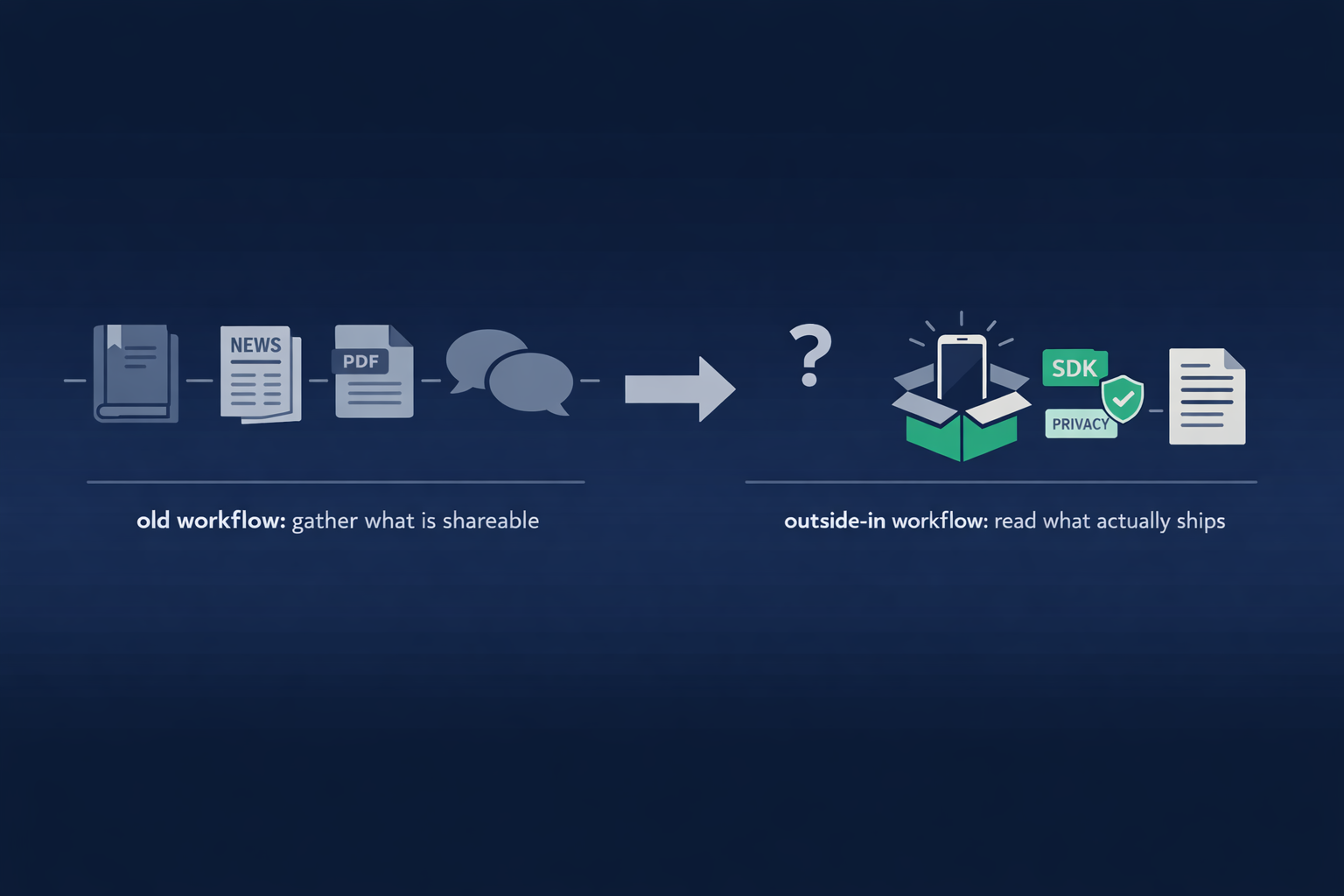
The mobile thought leadership research workflow used to look like this. Start with a question about a category or pattern. Gather what vendor reports say about that category (usually needs a sales conversation to access anything substantive). Read industry press coverage of the leading apps in the category. Look at the apps' own marketing materials. Talk to a few people in the category if you have contacts. Draft the piece around what you have gathered, with a lot of hedging because the evidence you have does not really support strong claims. Ship. Move on.
The output of that workflow is often what you see as mobile thought leadership content now. Directional observations. Some category positioning. Some quotes from named vendors. Some analyst-report data points. A conclusion that gestures at where the category is heading. Adequate content but rarely surprising, because the source material does not enable surprising findings.
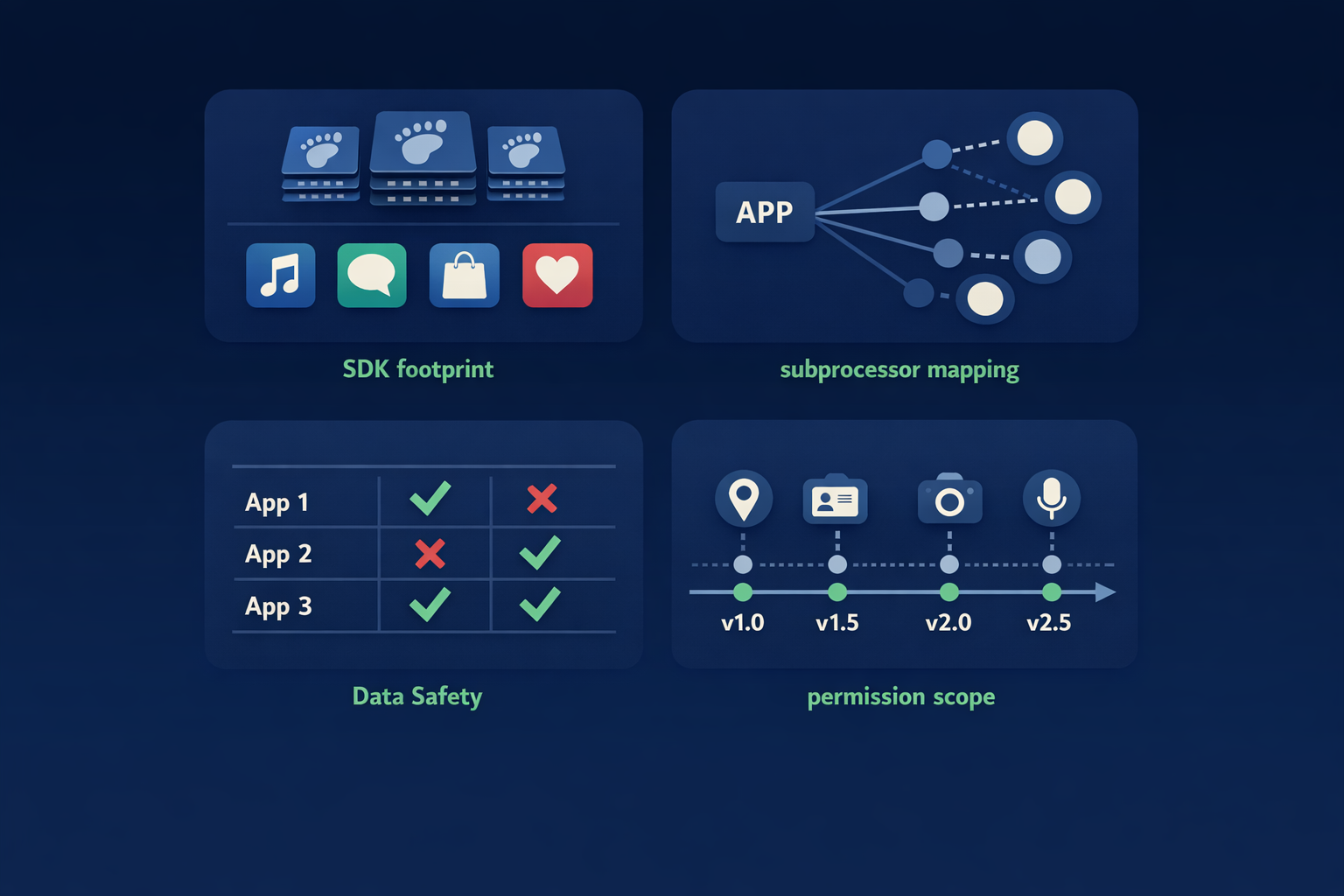
The workflow with outside-in evidence looks different. Start with the same question. Add a specific step: read the app packages of the apps in the category directly. Read their release histories. Read their Data Safety and privacy label declarations. Read their review clusters for patterns. Compare declared behaviour against SDK-implied behaviour. Look for specific things: SDK footprint patterns, subprocessor mapping gaps, permission scope changes across versions, declaration divergence between the app and the privacy notice. Then draft the piece around what the evidence actually shows.
The output is genuinely different because the source material genuinely differs. Instead of "meditation apps are increasingly using analytics tools" (which everyone knows and could guess), you can produce "eight of the top ten meditation apps ship a specific set of four analytics SDKs; three of them declare all four in their Data Safety sections, five declare three, and two declare only one". That observation is specific, testable, and produces genuine thought leadership because it names something readers did not know and could not have guessed.
To be clear, this is not a claim that outside-in evidence produces thought leadership by itself. It produces specific findings that the writer then has to interpret, contextualise, and turn into content that means something to readers. The evidence layer changes what raw material is available for that interpretation work, but the interpretation work still requires the writer's judgement and expertise. A writer who understands the mobile industry, the specific category, and the compliance or product context can turn outside-in evidence into thought leadership content that lands. A writer without that context can produce data-heavy content that reads as reports rather than thought leadership.
Worked Example: Privacy and Compliance Across Mental Health and Meditation Apps
To make the workflow tangible, here is a real research question run through the outside-in evidence process. The question: what do Data Safety and privacy declarations across the top mental health and meditation apps look like when you read the store declarations directly, and where do declarations diverge between iOS and Android for the same app.
The findings from this query illustrate what specific observations the workflow produces. One note on framing before the findings: this is intelligence analysis of the apps and their compliance choices, not commentary on the users these apps serve. Mental health apps operate in a sensitive space where users are often in vulnerable states, and that context matters for the app teams building the products. It also matters that outside-in evidence work on this category treats the apps and the teams as the subjects of analysis rather than the users as objects of study. Appnalysis is intelligence on the apps, not commentary on the people using them.
The query examined five specific apps in the category: Calm, Headspace, Balance, Insight Timer, and Wysa, on both iOS and Android in the UK store. The findings covered three dimensions accessible from store-surface evidence at the App Store Intelligence tier. Deeper analysis of the specific SDKs each app ships and the subprocessor implications of those SDKs sits at the App Intelligence tier, which is a separate query path.
Thought Leadership Examples: What Specific Findings Look Like
Data Safety declaration variation within the category. The five apps declare materially different collection and sharing patterns even though they operate in the same category with broadly similar functionality. Calm iOS declares Usage Data and Diagnostics only. Headspace iOS declares a wide range including Contact Info, Health and Fitness data, Location, User Content, Search History, Identifiers, Purchases, Usage Data, and Diagnostics, all linked to the user. Balance iOS declares Contact Info, Health and Fitness data, User Content, Search History, and Usage Data linked to the user, plus Contacts, Identifiers, and Diagnostics not linked. Insight Timer iOS declares that no data is collected. Wysa iOS declares Identifiers, Usage Data, and Diagnostics, none linked to the user. Five apps, five materially different declaration positions on iOS alone. That variation is a category positioning signal worth understanding for anyone writing about the mental health and meditation app market.
Cross-platform declaration divergence for the same app. The sharpest finding from the query is that several apps declare very different data collection on iOS versus Android under the same brand. Balance on iOS declares extensive collection across multiple linked-to-user categories; Balance on Android declares no data collection at all. Insight Timer on iOS declares that no data is collected; Insight Timer on Android declares sharing a wide range of data with third parties, including diagnostics, location, messages, app activity, financial info, and personal info. Calm iOS declares Usage Data and Diagnostics; Calm Android declares Name and Email. Same app names on each pair, opposite declaration positions across platforms. This divergence pattern is not something a reader would expect, and it raises legitimate questions about how declarations were completed on each platform, whether declarations reflect different implementations across platforms, or whether the declarations diverge from what the apps actually do at runtime. Any of those explanations is genuine thought leadership content because the divergence is verifiable and the underlying reason is not obvious.
Regulatory context and how apps position against it. The five apps operate under different age ratings on iOS versus Android (typically 12+ on iOS and PEGI 3 on Android), which brings different child safety regulation obligations on each platform. All five are subject to GDPR for personal data collection where applicable. Under UK MHRA guidance, all five position as wellness products rather than medical devices, which is a specific compliance positioning choice that keeps them outside the stricter medical device regime. That positioning choice matters because it shapes what compliance framework the app team commits to and what regulatory conversations they need to be ready for. Anyone writing about the mental health app category needs to understand this framework because it explains why the apps are structured the way they are.
These findings are illustrative examples of the workflow's output. They are not the article's central point. The point is that this specific quality of finding is what the workflow enables. Anyone writing thought leadership on mental health apps, privacy compliance, mobile app data handling, or the cross-platform declaration divergence pattern can now produce observations at this level of specificity rather than relying on generic category descriptions. Deeper analysis at the SDK footprint and subprocessor level is available through the App Intelligence tier for readers whose research question requires that depth.
The Query That Produced This: Playback Available
The specific Appnalysis query that produced the findings above is available as a playback. You can run the same query yourself at https://info.appnalysis.com/ask?example=61 without signing up or registering. The playback returns the same output we saw when the query originally ran, so what you see matches what this article describes.
Running the playback produces two things worth naming for your own thought leadership research work. First, it gives you the specific findings we drew on for this article, at the same level of detail we worked from. Second, it demonstrates the mechanism concretely. You see what outside-in evidence about a mobile app category actually looks like as an output, which is often more informative than reading about the workflow.
If you produce thought leadership content on any mobile category, the same shape of query works for your category. Substitute the category and the specific research question you care about, and the workflow produces equivalent findings for your work. The playback is the demonstration, not the tool itself.
What Thought Leadership Research on Mobile Looks Like Now
The shift I have described is not about producing more thought leadership content or producing it faster. It is about producing thought leadership content that says something specific enough to be worth reading.
The mobile thought leadership content that stands out in 2026 shares three characteristics. First, it produces observations that are specific rather than directional. Not "meditation apps are increasingly using AI features" (which everyone knows) but "eight of the top ten meditation apps have added AI features in the past twelve months, with three specific patterns of implementation". Second, it backs those observations with traceable evidence the reader could verify. Third, it draws on source material that is not the same handful of vendor reports everyone else has access to.
Outside-in evidence enables all three. Specific observations because the evidence supports specificity. Traceable evidence because the source material is what apps actually ship publicly. Distinct source material because most content still relies on vendor briefings.
There is also a structural shift raising the proof requirement for thought leadership content generally, not just mobile. AI-mediated discovery changes the economics of content in a specific way: when a reader asks an AI assistant for information, the AI is increasingly evaluating specific claims against source material it can verify. Directional observations that traditional readers accepted as authority signals no longer carry the same weight when the audience is AI-mediated. Specific claims backed by traceable evidence carry weight because they can be verified. The writers who produce evidence-backed content now build citation authority that compounds as AI-mediated discovery grows. The writers who continue producing generic content find their content increasingly invisible to AI-mediated discovery even if it still ranks in traditional search. That shift matters more for mobile thought leadership specifically because most existing content still leans on vendor-briefing generalities, which produces a genuine window for writers who move to evidence-backed content to build citation authority in a space that competitors have not yet occupied.
That said, the workflow does not do the interpretation for you. Reading app packages and getting the raw findings is one step. Turning those findings into content that lands with your specific audience is a separate step that requires your judgement, your understanding of the category, and your sense of what the audience will find useful. Writers who understand the mobile industry can turn outside-in evidence into thought leadership content that lands. Writers without that context can produce dense data reports that read as data rather than as insight.
The change I would name specifically is that outside-in evidence removes the excuse. Thought leadership on mobile that was thin because the source material was hard to gather can now be substantive. The writers and analysts who move to the new source material will produce content that stands out. The ones who do not will find their content increasingly generic against a set of peers who are working with better inputs.
How Appnalysis Fits Into a Thought Leadership Research Workflow
Appnalysis is Bloomberg for mobile apps. That is the shortest way I have found to describe what we built and why it exists. Serious mobile analysis has needed an aggregated intelligence layer for years, and the fragmented state of mobile source material has held the whole discipline back. Appnalysis produces that layer for mobile the way Bloomberg produces it for financial markets: aggregating signals that were previously scattered, giving analysts and researchers a workable interface to interrogate them, and making serious analysis possible at speeds that manual research cannot match.
For thought leadership research work specifically, two categories of Appnalysis output matter.
App Store Intelligence covers the continuous outside-in evidence layer: release cadence and version notes, Data Safety and privacy label declarations, permission requests as declared at store level, review patterns and sentiment shifts, developer response behaviour, and store standing changes over time. Most thought leadership research questions can be answered from this layer, particularly questions about category trends, positioning shifts, compliance posture patterns, and the pace of change in specific mobile categories.
App Intelligence covers the deeper package-level evidence: SDK inventory verification, subprocessor mapping from shipped SDKs, deeper permission analysis, and data flow verification against declared handling. Thought leadership research questions that require the specific technical detail (which SDKs are shipping, what the subprocessor implications are, how declarations divergence from SDK-implied behaviour) benefit from this tier.
One thing worth naming about what Appnalysis does not do. It does not replace vendor research reports, analyst briefings, or category conversation with the people building the apps. It contributes a specific layer of outside-in evidence that most thought leadership content has not yet learned to use. Writers and researchers who combine outside-in evidence with the traditional sources produce content that is materially stronger than either source alone would enable.
For teams using AI-assisted research workflows (Claude Code, Cursor, or other agents with MCP configured), Appnalysis is available as a knowledge specialist that agents can query directly during research work. That pattern is covered in more depth in Your AI Coding Agent Only Sees Half the Picture.
Try the Playback and Run Your Own Question
The mental health app research which was used.
For your own research questions, the App Store Intelligence and App Intelligence tiers give you the capability described throughout this article for any mobile category.
Frequently Asked Questions
Related Reading
- Technical Due Diligence Checklist: Mobile Apps, No Source - the transaction-time application of outside-in mobile evidence
- Vendor Risk Assessment for Mobile SDKs Without Waiting on the Vendor - the ongoing-monitoring application
- Compliance Comparison: What Mobile App Security Testing Cannot Cover - the compliance-verification application
- Everyone Talks About Technical Debt. Nobody Talks About Legal Debt - the wider argument for visibility layers in mobile
- Your AI Coding Agent Only Sees Half the Picture - how Appnalysis works with AI-assisted research workflows via MCP