App intelligence as an agent: what it means for AI workflows
By mid-2026, over 10,000 MCP servers have been published and the protocol has been integrated into Claude, ChatGPT, Cursor, Gemini and Visual Studio Code. Most of them are data pipes. Appnalysis is something different.
If you have used Appnalysis, you have probably thought of it as a specialist data source. A place to query mobile intelligence that other tools cannot reach. A layer that sits between you and the App Store ecosystem.
That framing is understandable. It is also incomplete.
Appnalysis is an Agent. Understanding the difference between a data source and an Agent matters significantly for how you use it, what you can build with it, and why it behaves differently from anything else you might connect to Claude or ChatGPT via MCP.
What an Agentic Loop Actually Is
Before explaining what Appnalysis does internally, it helps to be precise about what an Agent actually is. The term gets used loosely enough in 2026 to mean almost anything, so it is worth being specific.
An Agent is not a tool that responds to queries with stored data. An Agent runs a loop. It observes the input, thinks about what it means and what sub-tasks it implies, plans the steps needed to produce a reliable answer, calls whatever tools it needs at each step, evaluates the results, and synthesises an interpreted response.
The architecture that underlies every genuinely agentic system has three layers: Tools, Files and Memory at the top, which are the resources an Agent can reach into. The Agent itself in the middle, which is the orchestration layer that decides what to do. And the Language Model at the bottom, running observe, think, plan continuously as the Agent works through the problem.
What distinguishes a true Agent from a sophisticated API call is that control flow is internal. The Agent decides its own sequence of steps. It is not executing a predefined query and returning rows. It is reasoning about how to answer, what to check, what to cross-reference, and whether the result is good enough before it responds.
This is what Appnalysis does. Every time.
Where Most People Assume Appnalysis Sits
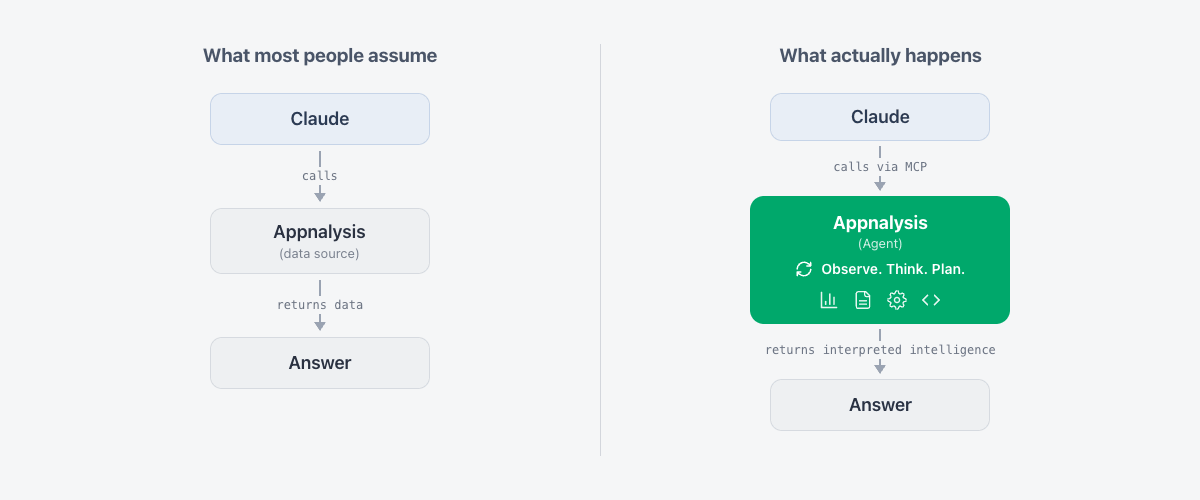
When developers and product teams first encounter Appnalysis via MCP, the natural mental model is straightforward. Claude is the Agent. Appnalysis is a Tool in the Tools box, like a calculator, a search function, or a database query. I am adding a data source to my agentic stack.
That mental model produces a reasonable workflow. Ask Claude a mobile intelligence question. Claude calls Appnalysis. Appnalysis returns data. Claude reasons over it and produces an answer.
This is a useful starting point. But it undersells what is actually happening, and it leads teams to underuse what Appnalysis can genuinely do.
The passive Tool model assumes Appnalysis receives a query and returns matching records. What actually happens is fundamentally different.
What Appnalysis Actually Does
When a question arrives at Appnalysis, whether from a user typing directly into Ask Appnalysis, from Claude via an MCP call, or from any other connected LLM, Appnalysis runs its own internal agentic loop.
It breaks the question into sub-tasks. It queries its own internal data sources: the App Store and Play Store pipelines, its regulatory knowledge base, its SDK and binary analysis database, device volume data, developer documentation. It reasons over the results with mobile domain intelligence that has been built and maintained specifically for this purpose. It cross-references signals that no single data source would contain. And it returns an interpreted answer, not raw data, but a synthesised response grounded in multiple sources of mobile evidence.
A concrete example makes this clearer than any description.
In a real conversation, someone asked: "What are the common privacy permissions requested by the top 10 most downloaded buy-now-pay-later apps in the UK iOS App Store?"
A data source would have returned a list of apps and their declared permissions. What Appnalysis returned was something different. It identified the top BNPL apps by actual download ranking. It retrieved each app's developer-declared privacy labels in detail: data collected, data linked to user identity, data shared with third parties, tracking declarations. It then reasoned across that data and surfaced a finding that required genuine cross-referencing to produce. Four out of five of these apps carry a 4+ age rating, which automatically brings them under the scope of the ICO Children's Code, a regulatory exposure most compliance teams would never think to check for a financial services app.
That finding was not in any database. It was the product of an Agent reasoning across multiple signals simultaneously. A data pipe would never have produced it. A general-purpose LLM without Appnalysis's data would not have had the underlying evidence to find it.
That is what Appnalysis does internally.
Agent Calling Agent: The Architecture
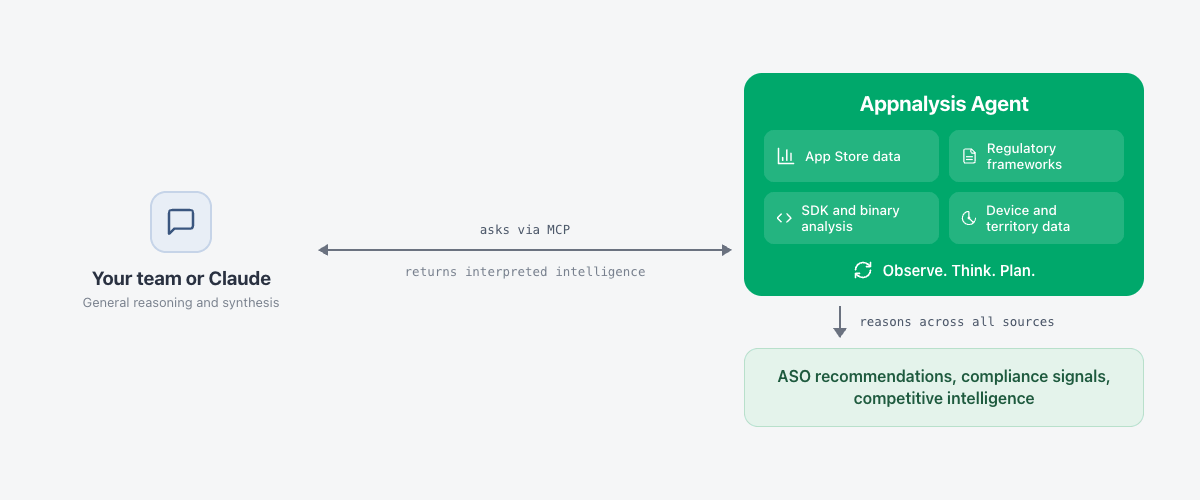
Once you understand that Appnalysis runs its own agentic loop, a more interesting architecture becomes visible.
When Claude calls Appnalysis via MCP, two agentic loops are running simultaneously. Claude is observing, thinking and planning at the general reasoning layer. Appnalysis is observing, thinking and planning at the mobile intelligence layer. Neither is doing the other's job. Neither could.
This is what the AI infrastructure community calls Agent-to-Agent communication. It is increasingly understood as the architecture that makes specialist AI genuinely useful at scale. Rather than one general-purpose Agent trying to do everything, specialist Agents handle the domains they understand deeply, and general-purpose Agents orchestrate and synthesise.
A second real example shows what this looks like in practice.
Someone asked for a live ASO analysis of Monzo, one of the UK's best-known neobanks. Claude tried to answer directly, hitting JavaScript rendering limits, rate limits and sandbox restrictions at every turn. The data simply was not accessible. With Appnalysis connected via MCP, the same question became a single query. Appnalysis ran its loop: queried live UK iOS Finance chart data, retrieved Monzo's current listing copy and release cadence across 90 days, pulled competitor listings for HMRC, Lloyds and Revolut from the top 3 positions above Monzo. It returned structured, interpreted intelligence. Claude then ran its own loop, reasoning over that intelligence to produce revised title and subtitle copy, a prioritised keyword field, release note variants, and a specific gap opportunity that neither Revolut nor Lloyds was exploiting. Two Agents. Two loops. One answer neither could have produced alone.
The practical implication is important. When you connect Appnalysis to your LLM via MCP, you are not adding a data source to your stack. You are adding a specialist Agent that already understands the mobile ecosystem deeply: its regulatory frameworks, its technical signals, its competitive dynamics. It reasons across all of them before handing interpreted intelligence back to your primary LLM.
Why This Matters for Teams Building Agentic Workflows
In 2026, over 10,000 MCP servers have been published. The protocol has been integrated into Claude, ChatGPT, Cursor, Gemini, Microsoft Copilot and Visual Studio Code. Most of those MCP servers are data pipes. They connect a tool to an LLM and return records in response to queries.
What distinguishes a domain-intelligent Agent from a data pipe is whether the MCP server reasons before it responds. Most do not. They surface data efficiently. They do not interpret it.
For mobile teams, compliance teams, investors and agencies operating in the app ecosystem, this distinction has a direct practical consequence. A data pipe will tell you what permissions Klarna declares. Appnalysis will tell you what those permissions mean, which regulatory frameworks apply, and what the competitive implications are for your own app's positioning. That is a different order of value. It is the difference between having data and having intelligence.
It also means that Appnalysis gets more useful as your agentic workflows become more sophisticated. A simple lookup query benefits from any data source. A complex multi-step analysis, whether that is competitive benchmarking, compliance mapping or cross-market comparison, benefits specifically from an Agent that can handle the mobile reasoning layer internally, leaving your primary LLM to focus on synthesis, communication and decision support.
A reasonable question at this point is whether a capable developer could build the same thing. The MCP protocol is open. Some underlying data is publicly accessible. A motivated team could get partway there on chart rankings and listing copy.
What is not easily replicated is the interpretation layer. Appnalysis didn't start as a data platform. It grew out of more than 20 years of hands-on app delivery at Coderus, a UK software agency building real apps for real clients across iOS, Android, automotive, IoT and embedded. That experience is what shapes how Appnalysis reads evidence today. When it surfaces a permission declaration, an SDK choice, or a release cadence pattern, it knows what each signal implies for a roadmap, a pitch, an architecture choice, or a compliance review, because those calls have been made on live client work. It doesn't just list SDKs. It explains what the technology choice signals about the team behind the app. It doesn't just surface monetisation data. It explains how it shapes the competitive position.
Building the first version of the data infrastructure is achievable. Building the interpretation layer, grounded in two decades of real-world mobile delivery across sectors and territories, and maintaining it as the ecosystem changes, is the part that takes considerably longer. The question is not whether it is possible to build. It is whether it is the best use of your team's time.
How to Connect Appnalysis to Your Agent
Appnalysis connects to any MCP-capable AI client. Step-by-step setup guides with current screenshots are available for the two most common environments:
Not ready to configure MCP yet? Ask Appnalysis works directly in your browser with no setup required. Paste your question and see the Agent respond.
What to Ask Once Connected
Once Appnalysis is connected to your LLM, the questions you can ask go significantly beyond what most teams initially expect. Here are four examples that demonstrate the Agent's reasoning capability rather than just its data retrieval.
Cross-market competitive intelligence
What Appnalysis does internally: queries live chart data for both markets simultaneously, identifies the finance category subset, cross-references app presence across both charts, and returns a named list with category context and chart positions. The answer requires three separate data queries reasoned together, not a single lookup.
Compliance signal detection "What are the privacy permissions requested by the top BNPL apps in the UK iOS App Store, and which regulations apply?"
What Appnalysis does internally: identifies the BNPL category by App Store taxonomy and chart position, retrieves developer-declared privacy labels for each app, cross-references age ratings against applicable regulatory frameworks (GDPR, PECR, ICO Children's Code, Apple ATT), and returns per-app findings with regulatory mapping. It surfaces the Children's Code exposure from age rating combined with data collection scope, a finding no single data source would contain.
ASO competitive analysis "Analyse Monzo's App Store listing against its top 3 competitors in the UK iOS Finance chart and identify keyword gaps and release note opportunities."
What Appnalysis does internally: retrieves Monzo's current chart position and full listing copy, identifies the top 3 competitor apps by live chart ranking, retrieves their full listing copy and release cadences, and returns a structured competitive comparison. Your LLM then produces the ASO recommendations from that intelligence.
Technical and investment signals: "What SDKs does [competitor app] use and what does that signal about their current product investment priorities?"
What Appnalysis does internally: runs binary analysis on the app, identifies third-party SDK composition, cross-references against its knowledge base of SDK categories and typical use cases (analytics, advertising, payments, security, machine learning), and returns an interpreted signal about where the competitor is building capability. A data source returns a list of SDKs. Appnalysis returns what they mean.
Go Deeper
Set up your connection:
- How to connect Appnalysis to Claude: step-by-step guide with screenshots for Claude.ai and Claude Desktop
- How to connect Appnalysis to ChatGPT: step-by-step guide with screenshots
See the Agent in action:
- How to Use Appnalysis and Claude for ASO Work: the full two-prompt ASO workflow with a live Monzo example
- We Asked Claude to Answer a Simple App Store Question: the first case study showing the data wall Claude hits without Appnalysis
- We Asked Claude a BNPL Privacy Question: the compliance case study, including the Children's Code finding described in this article
Understand the architecture:
- Why Claude, ChatGPT and Gemini Still Struggle With Some Questions: the structural explanation behind why specialist Agents matter
- Appnalysis MCP Documentation: technical reference for all MCP-capable clients
Learn more about Appnalysis
Explore how Appnalysis turns mobile app intelligence into evidence-backed answers:
- Try Ask Appnalysis in your browser
- How Appnalysis connects via MCP
- The Appnalysis platform
- Appnalysis pricing
- For agencies
- For product teams
How this fits with other app intelligence tools
For a wider view of how app intelligence tools compare on data model, interpretation and price, see app intelligence tools compared.