AI & App Store Data: How Appnalysis MCP Fills the Gap
A real conversation that shows why AI assistants struggle with mobile intelligence — and what fixes it
This isn't a hypothetical.
Everything that follows happened in a real conversation between a product professional and Claude, Anthropic's AI assistant, on a Sunday afternoon in June 2026.
No setup. No staged failure. No artificial constraints.
Just someone trying to get a straightforward answer to a question that product teams ask every week.
The Question
"Which neobanks are currently ranked in the Top 100 in the UK iOS App Store but haven't broken the Top 100 in the US yet?"
It's a useful question. The kind a fintech product manager, a venture analyst, or a mobile agency strategist might ask before a Monday morning meeting.
It feels like exactly the kind of thing a modern AI assistant should handle instantly.
Here's what actually happened.
Attempt 1: Web Search
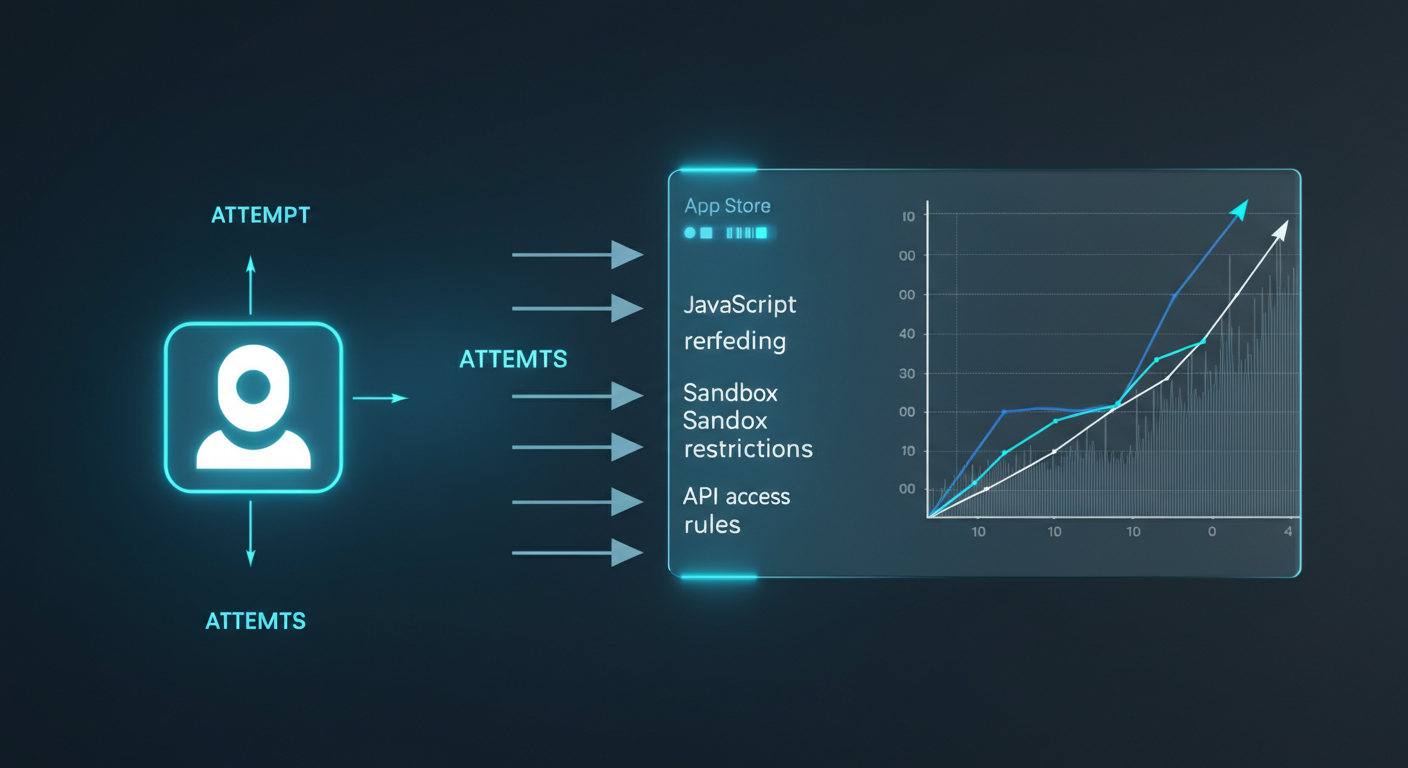
Claude searched the web. App Store chart pages returned results — but only the top 25 apps. The remaining 75 positions are loaded dynamically by JavaScript. A web crawler, including the tools available to AI assistants, sees only a partial page.
Claude identified Revolut at #15 and Monzo at #19 from what was visible. Beyond that, the chart was invisible.
Result: Incomplete. 25 positions out of 100.
Attempt 2: Apple's RSS API
Apple publishes a JSON feed of the full top 100 at a known URL. Claude knew about it. Claude tried to fetch it directly.
Blocked. Anthropic's web fetch infrastructure requires URLs to appear in prior search results before they can be accessed directly. The RSS API endpoint doesn't surface that way.
Result: Blocked entirely.
Attempt 3: Build a Widget
Claude built an interactive artifact — a small browser-based tool that would fetch both the UK and US top 100 directly from Apple's RSS API and do the neobank comparison in real time.
The widget rendered. It ran. It returned nothing.
Artifacts in Claude.ai run in a sandboxed environment with outbound network restrictions. The fetch calls couldn't reach Apple's servers.
Result: Silent failure. No data returned.
Attempt 4: Prompt Refinement
At this point, the natural instinct is to try a better prompt. Perhaps the question was too broad. Perhaps a different framing would unlock a better approach.
Several variations were tried:
"Can you search specifically for UK iOS finance chart data and cross-reference with US finance charts?"
Claude searched again. Same partial pages. Same 25 results. The prompt changed. The data wall didn't.
"Try approaching this differently — look for third-party sources that publish the full App Store top 100."
Claude found review sites and app ranking aggregators. Results were inconsistent, outdated, or covered only the top 10. None provided a reliable full top 100 for both markets simultaneously.
"What if you break this into two separate searches — UK top 100 first, then US top 100 — and compare the results?"
Claude tried. The UK search returned the same partial chart. The US search returned a different partial chart. Comparing two incomplete datasets produces an incomplete comparison.
Result: Better prompts. Same missing data.
Attempt 5: Honest Admission
After five attempts across different strategies, Claude said this:
"Appnalysis is the right tool for this. I've been fighting against my own limitations trying to work around it."
A straightforward question — the kind asked in product meetings every day — had consumed multiple attempts, produced partial data, and ultimately couldn't be answered with confidence.
The question wasn't hard.
The data simply wasn't accessible.
The Same Question. Asked to Appnalysis.
The answer, in seconds:
Of the 201 apps from the Top Free Finance charts in the UK and US that were analysed, 4 neobanks are present in the UK Top 100 but not in the US Top 100:
- Monzo Bank — Mobile Banking (iOS and Android, UK)
- Starling — Mobile Banking (iOS and Android, UK)
- Zopa Bank — Mobile Banking (iOS and Android, UK)
- Tide Business Current Account — (Android, UK)
Source: Appnalysis Gold
No workarounds. No partial data. No apology about chart rendering limitations.
Why This Keeps Happening
This wasn't a Claude problem specifically. The same sequence would unfold with ChatGPT, Gemini, Copilot, or any other AI assistant.
The limitation isn't intelligence. It's access.
App Store charts are JavaScript-rendered. AI web crawlers see only partial pages. Direct API calls are blocked by sandbox restrictions. And even where data is technically accessible, it arrives without the structure, history, and context needed to make it genuinely useful.
This is what we mean when we talk about invisible data walls.
They aren't always security barriers. More often they are technical barriers — the gap between what a human can see in a browser and what an AI assistant can actually access and reason over.
No amount of better prompting solves a missing data problem. You cannot instruct an AI into seeing information it cannot reach.
This is why the formula for useful AI is increasingly understood as:
AI = Reasoning + Context
The reasoning is already remarkable. The constraint is context — what the model can actually see.
What Changes With MCP
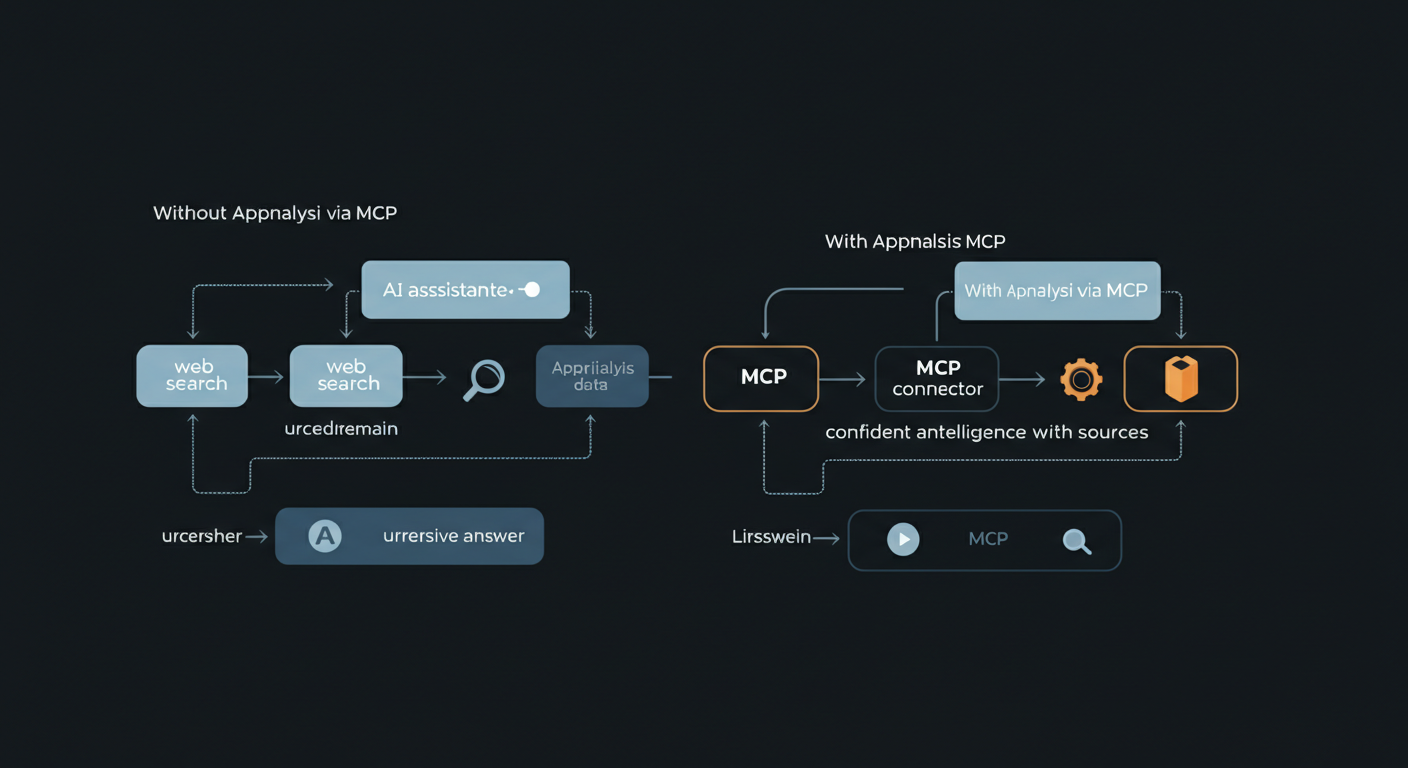
The Model Context Protocol (MCP) provides a standard way for AI assistants to connect directly to specialist data sources rather than relying solely on public web search.
When Appnalysis is connected to Claude via MCP, that same question — which neobanks are in the UK top 100 but not the US? — becomes a single query answered with structured, current, evidence-backed data.
Not a workaround. Not a partial answer scraped from a partially rendered page.
A direct connection to maintained mobile intelligence, surfaced through a conversational interface.
The AI doesn't become smarter. It becomes better informed. And a better-informed AI gives meaningfully better answers. What sits on the other end of that connection matters too. Appnalysis is not a database returning rows. It is a mobile intelligence Agent that reasons over the question, cross-references its own sources, and returns an interpreted answer. Two agentic loops, working together.
The Bigger Point
What happened in this conversation wasn't unusual. It happens constantly, across every industry, with every AI assistant.
The questions that matter most to businesses — competitive benchmarking, cross-market comparisons, SDK adoption tracking, regulatory mapping, historical trend analysis — all depend on data that isn't freely available through public web search.
These aren't reasoning problems. They are data access problems.
And data access problems require data access solutions — not better models, not better prompts, but structured connections between AI reasoning and the specialist information organisations actually need.
That is precisely what MCP was designed to enable. And it is precisely why Appnalysis built its intelligence platform around it.
Go Deeper
This article is the experience. The thinking behind it is spread across four pieces worth reading alongside it:
- Why Claude, ChatGPT and Gemini Struggle With Some Questions — the clearest explanation of why data access, not intelligence, is the real constraint
- What app intelligence tools actually observe, how the mobile intelligence landscape is structured, and where the real decision value lies
- Mobile App Competitor Analysis: A Step-by-Step Guide — a practical framework for turning app intelligence into better decisions
- Appnalysis vs Sensor Tower — how evidence-first intelligence differs from estimated market intelligence, and when you need both
Try It Yourself
The fastest way to understand the difference is to ask Appnalysis a question your AI assistant couldn't answer.
Not a demo. Not a sales call. Just a question — and an answer grounded in evidence.
Related reading
- Why Claude, ChatGPT and Gemini Still Struggle With Some Questions
- How to Get Full App Store Top 100 Data
- Mobile App Competitor Analysis: A Step-by-Step Guide
- App intelligence as an agent: what it means for AI workflows — what is actually happening on the Appnalysis side of the MCP connection shown in this case study
Learn more about Appnalysis
Explore how Appnalysis turns mobile app intelligence into evidence-backed answers:
Published by Appnalysis. Mobile intelligence for the agentic age.