App Store and AI Compliance Roadmap for Mobile Apps
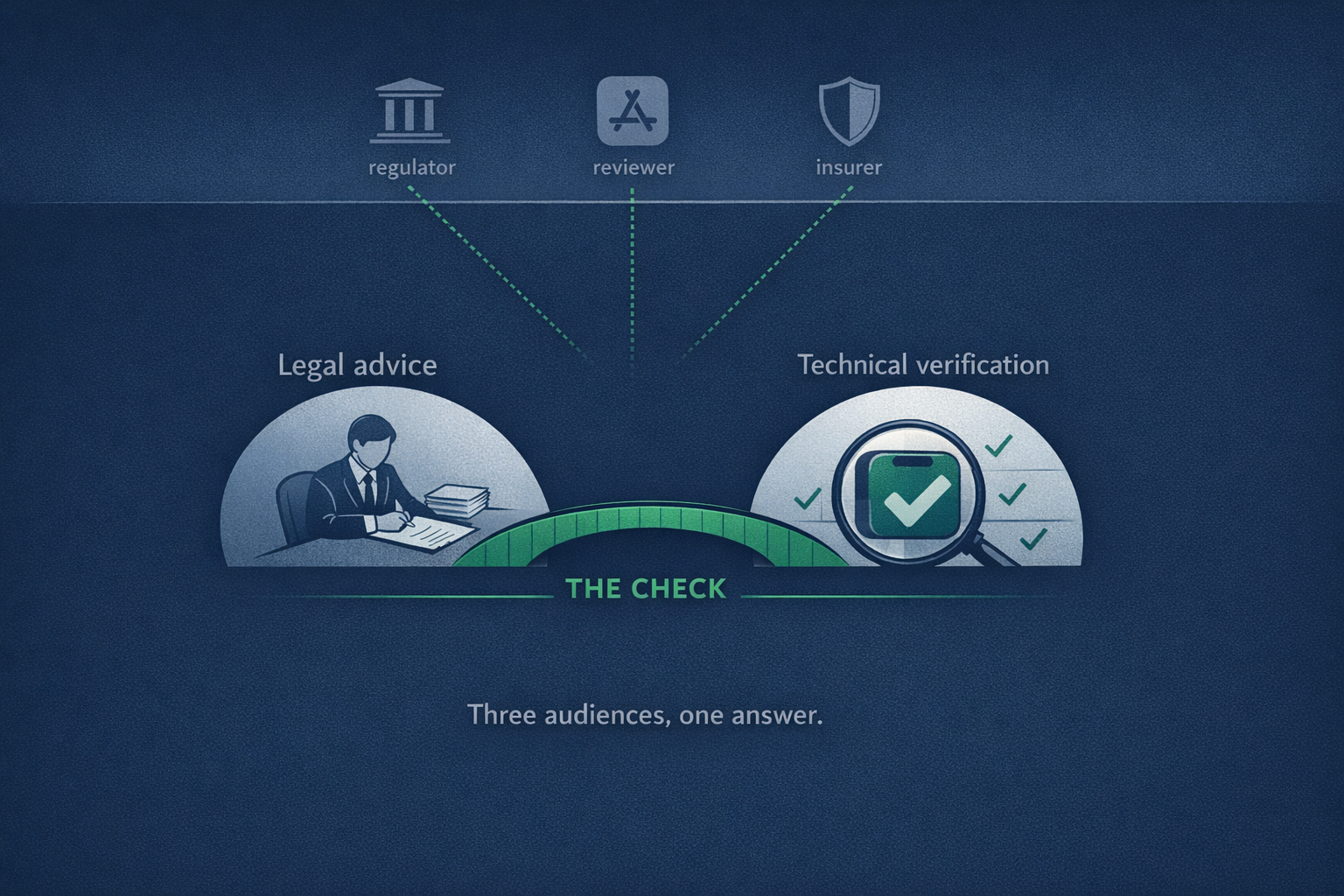
Legal advice tells you what your app should declare. It cannot tell you whether it does. This is the check that goes between the two, and increasingly three audiences are looking for evidence it happens.
If you have built a mobile app, had one built for you, or you advise anyone who has, you have almost certainly come across the same wall of legal considerations. Privacy policies. Terms of service. GDPR. Data Safety declarations for Android. App Privacy labels for iOS. Intellectual property protection. Accessibility. If you have looked at all, you will have found the standard UK legal-content pieces on this territory. Some of them are useful. Some are excellent. You now roughly know what your app should be declaring. Some readers of this article will already have paperwork drafted and in place. Others will not, or will have grabbed a generic template off the internet without checking whether it maps to what their app actually does. Both starting points are covered by what follows.
How well those declarations match what your app is actually doing right now, though, is a different question. And that question gets harder to answer the larger and more complex the organisation around the app becomes.
A founder shipping their own app has at least some chance of holding both halves in their head, at least in principle. An agency-client relationship splits the halves across two teams and a contract. An enterprise organisation splits them across half a dozen functions, external suppliers, and years of contract turnover, and any of those splits can produce a gap that no single person in the organisation is placed to see. This article is the compliance roadmap that lets you check both halves against each other, and how it fits alongside the legal advice you already have, rather than replacing it. Whether you are a founder, an agency owner, a general counsel, a head of digital at a mid-market business, an operations manager who inherited the store credentials, or the lawyer or insurance broker sitting across the table from any of these people, the argument applies to you.
Where App Store Compliance and Legal Advice Drift Apart
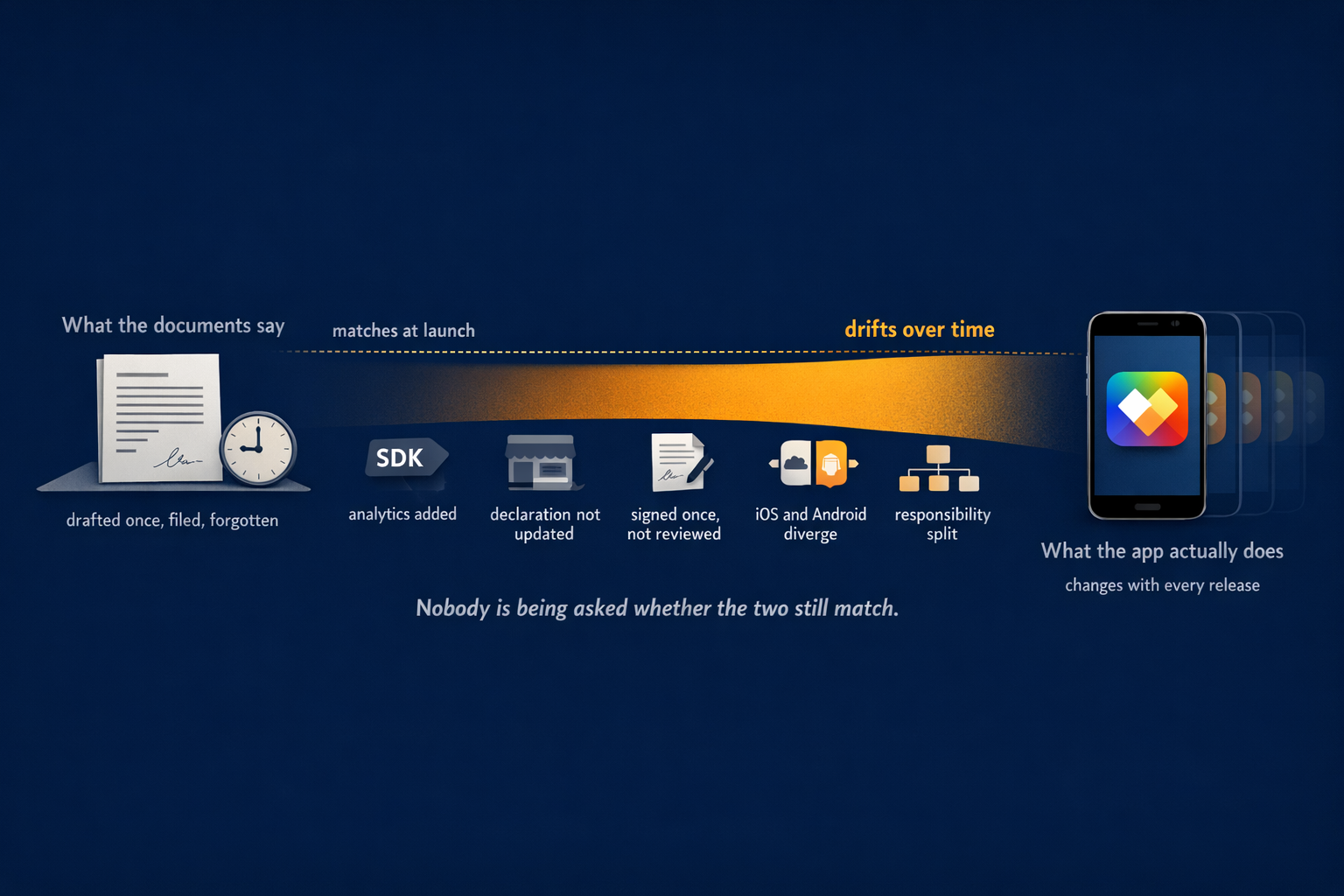
Legal advice and technical implementation drift apart over time. Not because anyone is careless. Because the two live in different documents, different tools, different people’s heads, and different weeks.
The lawyer drafts a privacy policy from what the client tells them the app collects, and does a competent job of it. A developer later adds an analytics SDK to help debug a production issue, or to answer a marketing request about funnel conversion. The privacy policy is now technically inaccurate, and nobody has told the lawyer.
The App Store submission and the Google Play Data Safety declaration are filled in at first release, based on what someone believed the app did that week. Six updates and a couple of feature releases later, nobody has revisited them. Whoever filled them in the first time may not be at the company any more.
An agency delivers an app to a client. Both sides sign off on a compliance document that felt current at the time. Neither party opens the document again to check it against the build twelve months later, because there is no natural point in the working relationship where that check would occur.
Each of those is common. Each is at least partially the fault of a workflow rather than a person. But the sharpest version of this problem is not any of the above. It is a structural difference in how iOS and Android handle compliance declarations, and how that plays out for anyone building cross-platform apps.
iOS builds the App Privacy label largely from what is in the app bundle. Declarations are close to the code, and if the code changes meaningfully, the declaration process is likely to catch it before submission. Android’s Data Safety declaration lives in the Google Play Console, entirely separately from the app bundle. It is filled in through a portal, based on what the person filling it in believes the app collects. Once entered, it does not automatically update. Change the app, and the declaration will still say whatever it said before.
For an app built on a cross-platform framework, the same underlying code can ship with two very different compliance realities on the two stores. The Android side is almost always the more exposed of the two, because the disjoint between what the app does and what the console declares is baked into how the platform is structured, not into anything anyone did wrong.
There is a related version of this problem that catches out established apps in particular. Both Apple and Google keep changing what they require, and they do it for a mix of reasons. Apple has had a longstanding privacy-first stance that predates most modern privacy regulation, going back to permission prompts for location, camera and microphone in early iOS releases and to the app sandbox model that has been part of iOS since launch. That stance is genuinely Apple’s own, not a compliance response. Google’s approach has tracked regulation more closely. iOS 17 introduced privacy manifests for a set of “required reason APIs.” Later iOS releases have extended what must be declared. The Google Play Console has added new Data Safety categories and questions across the last two years. Each of these is driven by some combination of the platform’s own product and security stance, competitive positioning between the two stores, and yes, the pressure of regulation that is increasingly global. Which specific driver dominates any given change is often mixed. What matters for anyone operating an app is that the direction of travel is the same: what your app must declare, and how it must behave, keeps expanding, whatever the driver. Any app that has not been submitted for review since these changes came in is running against a compliance framework the platform itself has moved underneath it. The gap is not the app’s fault. It is a structural feature of publishing to platforms that continue to evolve. And it is a particularly common trap for apps that reached a stable feature set years ago and have been updated only occasionally since, because the operating team may not realise the platform’s expectations have moved while their app has not.
And there is a version of this problem that has nothing to do with technology at all. It has to do with who actually holds the store account.
Store accounts are frequently held by someone other than the person building or maintaining the app. In agency work especially, the console credentials sit with the client’s IT team, or a marketing manager, or an operations person for whom “app store account holder” is one item on a long list of responsibilities. When something changes technically, the person who knows about the change often does not have console access. The person who has console access often does not know what has changed. Any declaration made in the console ages quietly, held by someone who cannot see what has moved underneath it.
A proper deploy document, listing what the client needs to update in the console for each release, would catch a lot of this. Some agencies do it well. It is one of the first things to fall off a fixed-price brief when nobody is specifically asking for it, and even a good deploy document requires the account holder to actually read and act on it. Both sides of that situation can be behaving reasonably, and the compliance picture still drifts.
The problem becomes sharper still at enterprise scale, though not because enterprises are worse at this than founders. Enterprises usually have more sophisticated legal and compliance functions than founders do, and they typically take these obligations more seriously. What changes at scale is not attitude, it is structure.
In an enterprise, the person responsible for app strategy sits in one function. The store account holder sits in another, often IT, sometimes marketing, sometimes procurement. The engineering team that built the app might be an internal engineering unit, or an external supplier, or a mixture, and the mixture may have changed since the app first launched. Legal sits in a third function. Data protection sits in a fourth. Any change to the app runs through several people, none of whom individually own the compliance picture. Console credentials may be held by someone who left the company two years ago. The privacy policy may be maintained by a legal team that has never spoken to the current engineering team. The declaration in the Play Console may have been filled in by an external contact whose contract ended, based on a version of the app that was superseded within a year of publication.
Nothing in that description implies incompetence. It describes what happens when a genuinely reasonable organisation splits responsibility for a customer-facing app across too many functions, external suppliers and years to hold coherently in any single person’s head. The gap between what the app does and what the declarations say is not anyone’s mistake. It is what the org chart quietly produces if nobody is specifically watching for it.
None of these patterns is anyone’s individual fault in a way that produces a moral takeaway. They are the result of workflows that have quietly become unfit for what mobile app compliance now requires. And in every case, the reason nobody catches the drift is that nobody is being asked, at any point in the workflow, whether what the store or the policy declares still matches what the app actually does. That question is the technical half of the check this article is really about.
What Technical Verification of Your App Actually Means
The verification is not exotic. It is a set of questions, and the questions are the same whether you are a founder, an account holder, an agency owner, a general counsel, or a lawyer preparing to advise a client.
What data does the app actually collect at runtime, from every SDK bundled inside it, not just from the code the developer wrote themselves. A third-party analytics library, a crash reporter, a payment processor, a support-chat widget, each of them has its own data collection footprint, and all of them are inside the app the moment they are added as dependencies.
What territories does the app distribute to, and what age rating carries what regulatory obligations across them. An app available in every country by default is quietly subject to almost every mobile-facing regulation on the planet, whether the operator realised that or not.
What does the app’s privacy manifest and Data Safety declaration currently say, and does either of them match what the current build actually does. This is the question the whole article turns on.
What SDKs are inside the app that carry their own data collection footprint that the app owner or account holder may not know about. In practice this is where the largest silent gaps tend to appear, because SDK behaviour is genuinely difficult to audit from the outside without the right tools.
How does the app’s declared behaviour compare with the declarations of similar apps in the same category. Any outlier declaration, one that says the app collects far less than every peer, or far more, tends to be worth investigating, because it usually reflects either a mistake in the declaration or a genuine and unusual feature that needs to be explained clearly.
Answering these questions used to require a manual audit, costing an agency day or a specialist consultant’s fee. That is precisely why they usually did not get answered. The cost was high enough that most working teams skipped the verification entirely and hoped the declarations were still current. In 2026 it is possible to run the verification in a few minutes using tools that read the app package directly, rather than relying on someone typing what they remember into a spreadsheet or a portal. Appnalysis is one such tool. It exists, it does this, and the technical part of the verification is now within reach of any working team without an audit budget.
Worth being clear about what is available at what tier. The compliance verification questions above can be answered at Appnalysis’s free registered tier for a working level of detail. The deeper technical breakdown, full SDK-level analysis and cross-app package comparison, requires a paid tier. See the Appnalysis pricing page for what each plan includes if you want to match the verification depth to the tier that suits your situation.
How the Halves Fit Together, and Who Is Watching
Once the technical check is available cheaply, it slots into existing workflows in ways thoughtful readers will already recognise once someone points them out.
Founder-led. Run the technical check first. Arrive at the lawyer’s office with an accurate picture of what your app actually does. Cheaper billable hours, more targeted legal advice, and a lawyer who is drafting from technical reality rather than from your best recollection.
Lawyer-led. The technical check runs as part of the intake process. The lawyer drafts the privacy policy against actual behaviour rather than the client’s description of it, and the resulting advice is more defensible if it is ever tested by a regulator or in a dispute.
Enterprise-informed. The check runs as part of the internal review workflow, giving legal, compliance, IT and operations a single shared picture of what the app actually does. Nobody in any of those functions could produce that picture on their own, because the information is deliberately distributed across functions by the way the organisation is designed. A shared technical picture is often the first artefact that lets these functions have the same conversation, and it lands most naturally in front of whoever is carrying the compliance hat in the organisation, whether that turns out to be a Data Protection Officer, a Head of Digital Compliance, an IT director wearing the hat as one of several, or an operations lead who inherited it by accident.
Ongoing. The check runs on major releases, catches drift between what has been declared and what has since shipped, before a regulator, a Google Play warning, or an App Store rejection surfaces it. Particularly important for cross-platform releases and for any situation where responsibility for the app is split across functions, organisations, or years.
There is one more audience quietly watching all of this, and it has been quietly watching for longer than most people realise. The UK insurance industry has been publishing on mobile app risk since at least 2014, when Macbeth Insurance Brokers first put out their Legal Essentials for Mobile Apps piece. That article has been maintained and republished for over a decade, which tells you something meaningful. Founders, agencies, enterprise risk teams and their clients have been coming to insurance brokers about mobile app cover for that long, and the brokers have been trying to help them think it through.
What has changed recently is the specificity of what insurers now want to see. Cyber insurance renewals in the UK increasingly ask about compliance controls at the app level, not just at the organisation level. A general cyber policy that covered the company as a whole in 2020 will now often ask, at renewal, about the specific compliance state of any customer-facing app the company operates. This applies with particular force at enterprise scale, where cyber insurance policies are more complex, involve more coverage layers, and are more likely to include specific questions about customer-facing app compliance at renewal time. Any gap between what the app is declared to do and what it actually does becomes, in principle, a gap the insurer might notice at claim time.
For agencies specifically, professional indemnity cover is stronger when there is evidence the agency verified their build against the client’s declarations, not just delivered the build. “It was not in scope” is a valid contractual defence but is a weaker insurance defence, because insurers are increasingly asking about reasonable professional practice, not just about contractual scope.
None of this is insurance advice, and this article does not give any. It is an observation about who is looking at mobile app compliance in 2026, and about how that population has quietly widened over the last few years.
The reason the technical check matters, then, is not just because a regulator or an App Store reviewer might catch a gap. It is because increasingly three audiences are looking for evidence that the gap does not exist: the regulator, the App Store reviewer, and the insurer. All three are asking versions of the same question. The technical check is the same answer to all three.
Where AI Governance Meets App Store Compliance
The same drift now shows up one level higher. Organisations that use AI to write code, triage reviews, draft store copy or answer customer questions are being asked a second question alongside the store one: can you show how that decision was reached. AI compliance and app store compliance are not separate programmes of work, they are the same evidence problem asked by two different audiences.
An AI governance framework that only describes policy will drift exactly as a privacy policy drifts. What holds is a framework anchored on observable facts: this is the app, this is what it declares, this is what the stores currently show, this is the date it was checked, and this is who checked it. That is the layer Appnalysis is built to supply, and it is why the check described above is worth running on a schedule rather than once at release.
The Honest Limit of This Article
A technical check cannot tell you whether a specific data collection falls under a specific legal exemption. It cannot tell you whether your particular contract makes you a data controller or a processor under GDPR. It cannot tell you how a regulator is likely to interpret your specific circumstances. It also cannot tell you which insurance product is right for your situation, or how a specific insurer will treat a specific claim.
Those are legal and insurance judgments, and they require their own professional advice. This article is not saying skip the lawyer or skip the broker. It is saying the lawyer’s advice, and the insurance conversation, are both more accurate, more defensible, and more helpful when they are conducted against a clear technical picture of what the app actually does, rather than a client’s or an operator’s best recollection.
Before we close this section, one more honest addition, because it comes up in almost every conversation on this topic. Many readers, before or instead of consulting a lawyer, will ask Claude or ChatGPT to help draft their privacy policy, to explain their obligations, or to review a document their agency has produced. That is now a normal step in how people research these questions, and it deserves an honest response. A general-purpose LLM can produce a very reasonable first pass, sometimes a strong first pass, and it is genuinely useful for orientation and for starting drafts. But it comes with no professional liability. If the answer is wrong, or based on outdated legal information, or misses a jurisdiction-specific rule, there is no professional relationship the reader can rely on to make good the loss. Every major LLM’s terms of service explicitly say so, and both Anthropic and OpenAI are clear that their models should not be relied on as legal advice. A lawyer’s advice comes with professional indemnity, a duty of care, and a regulated professional relationship. An LLM’s output does not. That is not a criticism of the LLMs, it is a straightforward description of how they are structured. Use them for the starter draft. Take the result to a lawyer for the sign-off. That combination gets you further than either alone.
Both halves are needed. The technical verification does not replace either of the professional conversations. It makes both of them work better.
Try It Yourself
Anyone reading this who has built an app or is building one, or advises those who do, is holding one half of a two-half check. The other half is now genuinely accessible in a way it was not two years ago. Whether you are a founder wanting cheaper legal hours, an account holder trying to keep the console current without being able to see the code, an agency owner trying to reduce the risk your clients ship out of scope, an enterprise general counsel or head of digital trying to build a coherent compliance picture across functions that do not naturally share information, the person in your organisation carrying the compliance hat with or without a formal title, a lawyer wanting more defensible advice, or an insurance professional wanting better evidence to advise your clients with, the same practical step applies. Verify what the app actually does. Then have the informed conversation.
Frequently asked questions
Go Deeper
- You Vibe Coded Your App: What You Actually Shipped: three real stories showing how the drift between what an app declares and what it actually does happens in practice
- Unaware Is Not a Strategy. Vibe App, Be Aware.: the regulatory framework map that sits behind the legal half of the check, with current fines and current thresholds
- The Case for Not Looking at Your Competitors. And Where It Can Run Out.: why teams have historically skipped the analytical work these checks now make possible, and why the calculation has changed
- The Software Industry Is Growing Up: why evidence of what your product actually does is becoming as commercially important as the product itself, across the whole industry
- App intelligence as an agent: what it means for AI workflows: how the technical check is actually produced
Further Reading (external)
- Harper James: legal documents your app needs: a well-regarded founder-facing guide from the legal profession on the documents the article discusses
- Thomson Reuters Practical Law: mobile applications: an institutional reference for readers who work with lawyers regularly
- Macbeth Insurance Brokers: Legal Essentials for Mobile Apps: an example of the insurance profession engaging with this topic across more than a decade
Published by Appnalysis. Written by Mark Thomas. Mobile intelligence for the agentic age.