Mobile App Security Testing vs Compliance Comparison
Mobile app security testing produces certifiable findings about specific security properties. Compliance comparison produces coverage evidence across the compliance landscape. Both matter for mobile apps in 2026, they do different jobs, and confusing the two produces bad decisions in regulated contexts. This article is about the compliance comparison job, held sharply against the security testing distinction.
I have been building and shipping mobile apps professionally since 2010, first at Coderus and now with Appnalysis, where we read what mobile apps ship as outside-in evidence. That work brings me into a lot of conversations with mobile teams and their compliance functions, and one confusion comes up more often than any other: the difference between mobile app security testing and compliance comparison. Both are needed. Neither replaces the other. Teams that treat them as interchangeable make bad decisions in regulated contexts.
This article is about compliance comparison specifically. What it is, why mobile teams need it alongside security testing rather than instead of, how it maps against the frameworks compliance functions actually work with, and how outside-in evidence produces the coverage picture that compliance work in 2026 depends on. Held throughout is the distinction from security testing, because getting that distinction wrong is the most common failure mode I see in these conversations.
Mobile app security testing means someone reads your source code, runs your app against active attack tooling, and produces a certified report your compliance function can put in the audit binder. That work requires code access, specialist expertise, and controlled environments. It produces findings that are certifiable in the specific sense that regulators, auditors, and insurance underwriters accept them as evidence of specific security properties. Companies like Synopsys, Veracode, Checkmarx, NowSecure, Guardsquare, and specialist mobile security consultancies do this work well. If your product is in a regulated context and you have not commissioned security testing, that is a gap that no amount of comparison work fills.
Compliance comparison is a different discipline entirely. It reads what your mobile app publicly ships across releases, on both platforms, and compares that against what compliance frameworks and app stores expect. It does not require code access. It does not produce certifiable findings. It cannot replace security testing in a regulated context. What it produces is a coverage picture: where the app clearly matches expectations, where it partially matches with interpretation needed, where it does not match but the team has a defensible position, and where the picture is ambiguous and needs conversation with auditors. That coverage picture is what mature compliance functions actually manage, and it is what continuous evidence supports.
Both disciplines are useful. Neither replaces the other. The rest of this article covers what makes compliance work genuinely hard for mobile apps in 2026, how compliance comparison maps against the OWASP Mobile Top 10 (2024), how accessibility fits as a distinct compliance surface, and how outside-in evidence produces the coverage picture your compliance programme needs alongside the security testing findings it also needs.
Compliance for Mobile in 2026: Coverage Pictures, Moving Targets, Framework Conflicts
Being straight, three specific realities make compliance work for mobile apps in 2026 different from what generic compliance content acknowledges. Each is grounded in what mobile teams actually ship and what compliance functions actually manage.
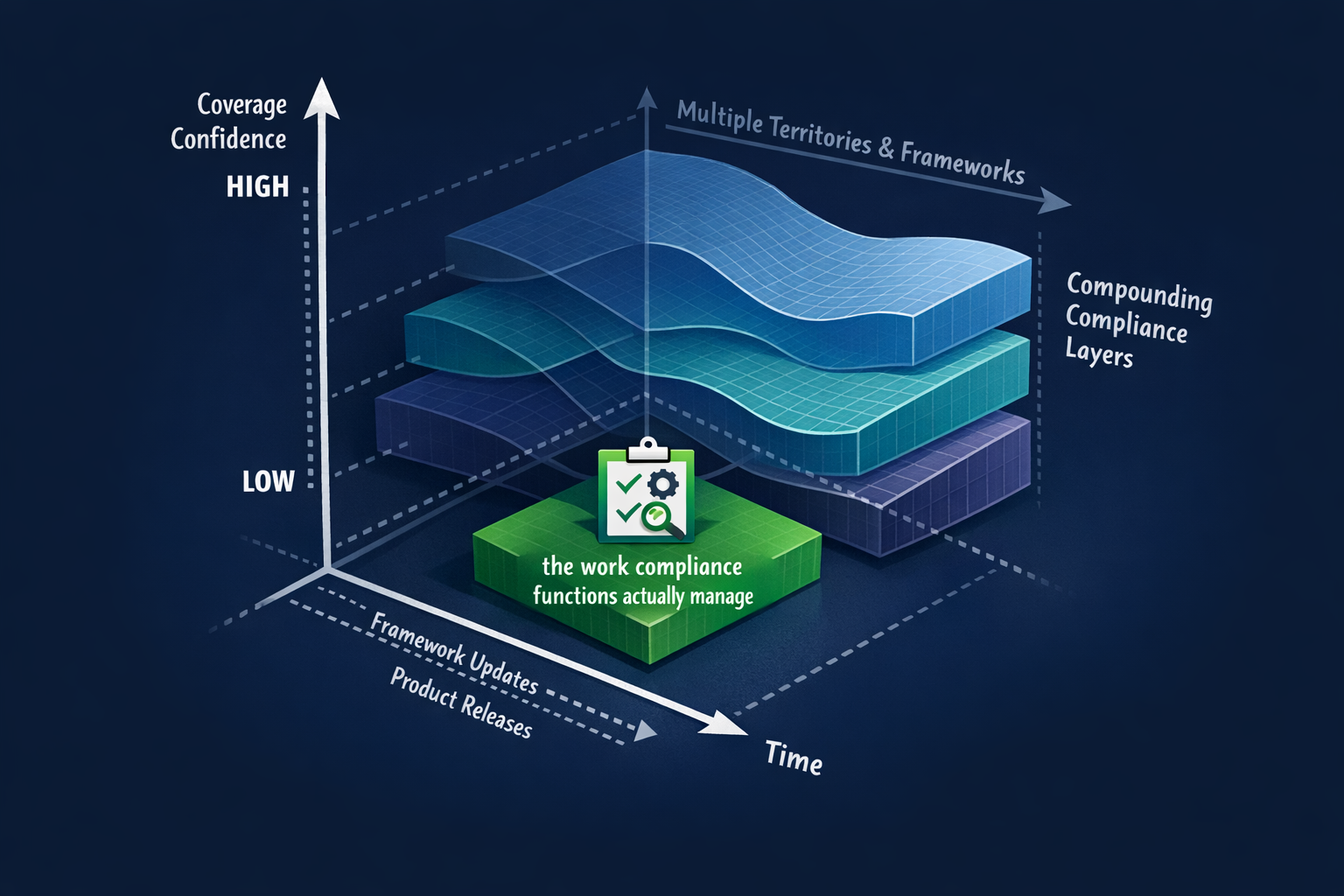
Compliance is a coverage picture, not a binary state. A mobile app has many compliance dimensions and the team's confidence across those dimensions varies. The camera permission is confidently covered because the privacy policy names it, the Data Safety declaration lists it, and the reason for requesting it is user-visible. The analytics SDK is confidently covered because the vendor's DPA has been signed and the subprocessor list is up to date. The new AI feature added last sprint is thinner because the compliance conversation happened after the release rather than before, and the transparency obligation under the AI Act was not fully worked through. The subprocessor list may have a gap because a peer SDK bundled its own subprocessor no one on the team noticed. That is a heat map, not a checkbox. Mature compliance functions manage the heat map: allocating attention to the thinner items, preparing defensible positions for the ambiguous ones, and ensuring the confidently covered items stay covered as the app evolves. Generic compliance content that talks about mobile apps as either "compliant" or "not compliant" is describing something compliance functions do not actually work with.
Both compliance requirements and the product move over time. The mobile team shipped nine releases this year. In the same year, the AI Act published new guidance, the ICO issued three opinions, Apple updated the App Store Review Guidelines twice, and Google revised the Data Safety requirements. That is the mobile compliance year, and it means the coverage picture you produced last quarter may be inaccurate on two axes now: the frameworks you were mapping against have been updated, and the product you were mapping has shipped six more times. Traditional annual review cycles produce increasingly stale pictures because both the frameworks and the products move faster than annual cadence can capture. Continuous evidence closes both axes by keeping the coverage picture current on both dimensions rather than either one.
Multiple frameworks apply to most modern mobile apps, and they do not always agree with each other. Some conflicts arise because frameworks do genuinely different things: a team shipping AI-embedded features faces GDPR's data protection framework and the EU AI Act's transparency and risk framework at the same time, and the two produce different specific obligations for the same feature. Other conflicts arise because similar legislation applies across different territories with meaningful variations. Data protection alone spans GDPR in the EU, UK GDPR post-Brexit, CCPA and CPRA in California, and a growing set of other US state privacy laws each with their own scope thresholds, user rights definitions, and enforcement mechanisms. AI regulation is fragmenting similarly across jurisdictions. Age assurance requirements vary meaningfully between UK, EU, and specific US states. A mobile app on the App Store and Google Play is available in most territories unless the team specifically restricts availability, which means the team inherits the compounding compliance surface of every territory whether they planned for it or not. Where frameworks agree, the coverage picture is straightforward. Where they conflict or vary, the compliance function makes judgement calls about which requirements to prioritise, how to satisfy multiple frameworks where possible, and where a deliberate position accepts a shortfall against one framework or jurisdiction to satisfy another. That judgement work is what compliance functions actually do, and it needs evidence about what the app actually ships to be defensible.
Together, these three realities describe compliance work as a three-axis problem: coverage confidence varying by item, both product and frameworks changing over time, and multiple frameworks that do not always agree on what compliant looks like for the same underlying behaviour. Compliance comparison from outside-in evidence is genuinely useful because it produces the coverage picture across all three axes without requiring the team to freeze the product or ignore the framework movement.
OWASP Mobile Top 10 (2024): What Is Observable From Outside
The OWASP Mobile Top 10 is the shared vocabulary compliance functions and security teams both know. OWASP updated the Mobile Top 10 in 2024, and OWASP has folded testing guidance into its Mobile Application Security (MAS) project alongside MASVS (Mobile Application Security Verification Standard) and MASTG (Mobile Application Security Testing Guide). Article references throughout are to the 2024 version rather than the older 2016 list that some security testing content still cites.
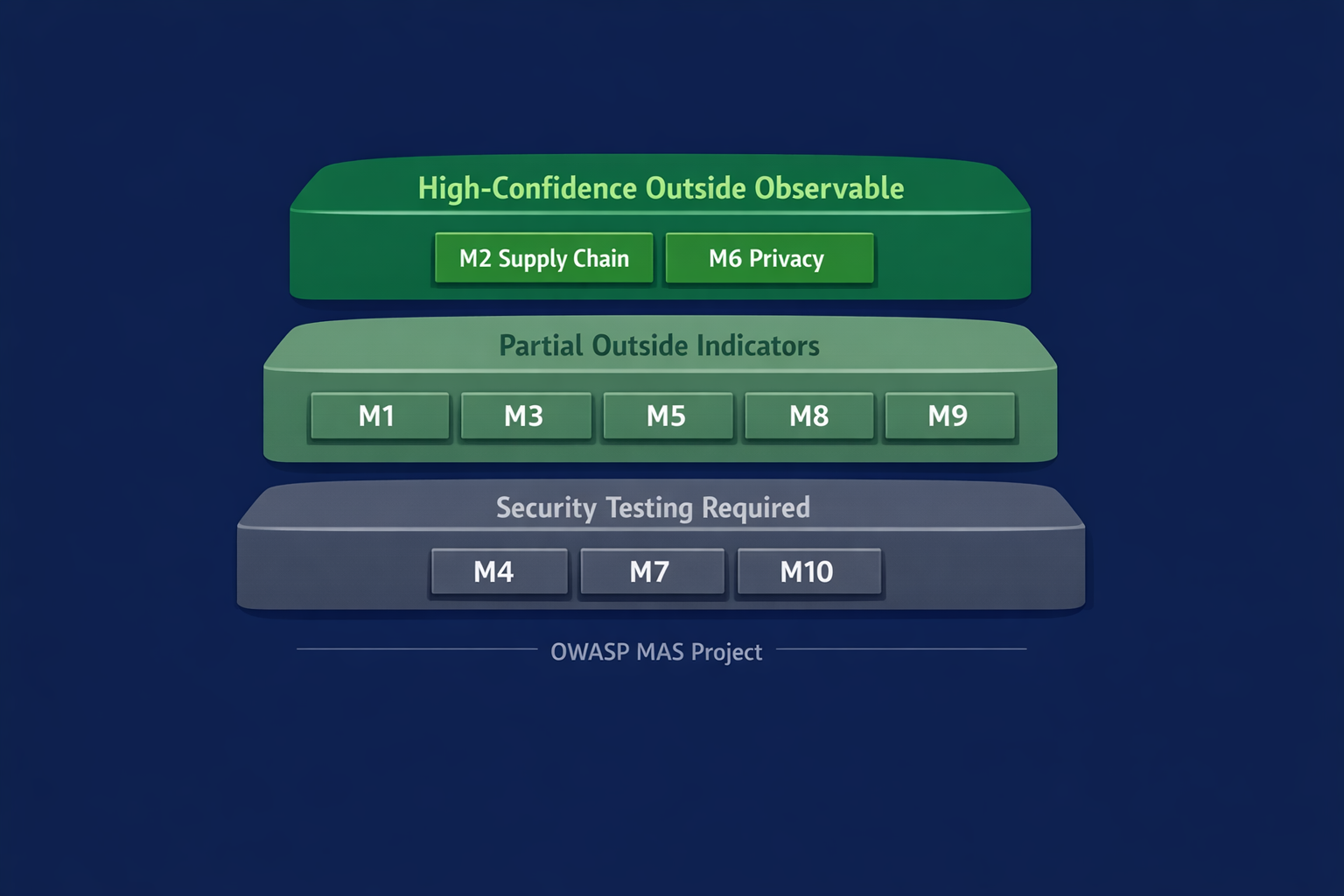
Mapping compliance comparison against the OWASP Mobile Top 10 (2024) helps mobile teams and compliance functions understand what outside-in evidence can genuinely produce and where security testing is required. Each item below is mapped to three-tier coverage confidence from outside-in evidence: high-confidence outside observable, partial outside indicators, and security testing required. Being straight, this mapping is not a substitute for the OWASP MAS project's fuller guidance, but it names what compliance comparison specifically covers.
M1: Improper Credential Usage. Partial outside indicators. Outside-in evidence can see what authentication SDKs the app bundles, what Data Safety declarations claim about credential handling, and whether platform-specific credential storage APIs are named in developer responses or documentation. What it cannot see is how credentials are actually handled at runtime, whether keys are hardcoded in the binary, or whether authentication flows are implemented correctly. Security testing is required for the runtime and binary-level questions.
M2: Inadequate Supply Chain Security. High-confidence outside observable. This is where compliance comparison is strongest. Outside-in evidence directly reads the SDK footprint the app ships, tracks version currency against known vulnerabilities, and compares declared subprocessors against SDK-implied subprocessors. Supply chain risk in mobile apps is largely a compliance comparison problem, and continuous evidence is materially more informative than point-in-time security testing for this dimension because the SDK footprint changes across releases.
M3: Insecure Authentication/Authorization. Partial outside indicators. Outside-in evidence can see what authentication mechanisms the app appears to use (Sign in with Apple, Google Sign-In, third-party identity provider SDKs), and whether Data Safety and platform declarations align. What it cannot verify is whether the authentication implementation is correct or whether authorisation checks are enforced. Security testing is required for the implementation and enforcement questions.
M4: Insufficient Input/Output Validation. Security testing required. Input and output validation are runtime behaviour questions that outside-in evidence cannot address. Compliance comparison notes the presence or absence of validation-relevant SDKs and framework choices, but the actual validation quality requires code review or dynamic testing.
M5: Insecure Communication. Partial outside indicators. Outside-in evidence can see whether the app declares network security configuration on Android, whether App Transport Security is configured on iOS, and whether known-good networking SDKs are present. What it cannot verify without runtime analysis is whether all communications are actually secured or whether specific endpoints deviate from the general configuration. Security testing is required for endpoint-level verification.
M6: Inadequate Privacy Controls. High-confidence outside observable. This is the second area where compliance comparison is strongest. Outside-in evidence directly reads what the app declares about data collection (Data Safety, App Store privacy labels), what permissions it actually requests, whether privacy policies are current and match what SDKs would collect, and whether user-facing privacy controls appear in the app's screens and store listings. Privacy compliance is largely a compliance comparison problem for the disclosure and declaration side, though runtime data flow verification requires deeper analysis.
M7: Insufficient Binary Protections. Security testing required. Binary protections (anti-tampering, obfuscation, integrity checks) are properties of the compiled app that require binary analysis or runtime testing to assess. Compliance comparison can note whether the app uses common binary protection tooling based on observable indicators, but the effectiveness of those protections requires security testing.
M8: Security Misconfiguration. Partial outside indicators. Outside-in evidence can see some configuration choices (Android network security config, iOS ATS, exported components as declared, platform-specific configuration files) and whether known-risky configurations appear. What it cannot fully assess is the security implication of each configuration choice or whether the configuration is complete. Security testing provides the fuller picture.
M9: Insecure Data Storage. Partial outside indicators. Outside-in evidence can see what storage-related SDKs the app bundles and what Data Safety declarations claim about data storage. What it cannot verify without binary or runtime analysis is whether data is actually encrypted at rest, whether keychain and keystore APIs are used correctly, or whether cached data leaks between app contexts. Security testing is required for the implementation questions.
M10: Insufficient Cryptography. Security testing required. Cryptography implementation quality requires code or binary analysis. Compliance comparison can note the presence of cryptography-related SDKs and libraries, but whether cryptography is implemented correctly is a security testing question.
Read together, this mapping shows compliance comparison covers roughly two of the ten items at high confidence (M2 supply chain and M6 privacy controls), five at partial coverage that informs the compliance conversation without fully answering it (M1, M3, M5, M8, M9), and three that require security testing (M4, M7, M10). That distribution is honest: compliance comparison is genuinely useful across most of the OWASP Mobile Top 10 dimensions, but it does not cover everything the OWASP framework addresses, and security testing remains necessary for the runtime, binary, and implementation quality questions that outside-in evidence cannot reach.
Accessibility as an Adjacent Compliance Surface
One compliance surface worth naming distinctly because it does not fit inside the OWASP Mobile Top 10 but matters increasingly for mobile apps is accessibility. Mobile app accessibility compliance is a real and growing regulatory area, driven by US ADA case law that increasingly treats mobile apps as public accommodations, the European Accessibility Act coming into force in 2025 with mobile-specific requirements, and platform-level accessibility guidelines from Apple and Google that shape store review decisions. Accessibility compliance is a distinct discipline with its own frameworks (WCAG 2.2 for the underlying standard, platform-specific accessibility APIs on iOS and Android), its own testing methodologies, and its own enforcement patterns.
This article's compliance comparison focus is on the OWASP Mobile Top 10 (2024) dimensions rather than accessibility because the two are different disciplines with different evidence patterns. What outside-in evidence can observe about accessibility is limited but real: whether the app declares accessibility features in store metadata, whether the developer responds to accessibility-flagged reviews, whether platform-specific accessibility settings are named in the app's user-facing documentation. Fuller accessibility assessment requires specialist tooling and testing methodologies distinct from what compliance comparison covers. If accessibility compliance is a specific concern for your mobile app, specialist accessibility assessment is the right investment alongside the security and privacy work described in this article.
How Compliance Comparison Fits Into the Compliance Programme
Compliance comparison does not replace security testing, professional legal advice, or platform relationship management. It sits alongside all of them as the specific dimension of evidence that produces the coverage picture across the OWASP Mobile Top 10 (2024) items where outside-in evidence is genuinely informative, plus the store-level compliance dimensions (privacy labels, Data Safety declarations, App Store Review Guidelines, Google Play Developer Policy) that compliance functions increasingly need to track continuously rather than annually.
The wider compliance programme brings together security testing findings (from the specialist testing firms named earlier), professional legal advice (particularly for framework interpretation, jurisdictional variation, and defensible positions on ambiguous items), platform relationship management (App Store and Google Play communications, particularly around policy changes and review decisions), and compliance comparison evidence (from outside-in analysis of the app itself and its wider category context). Each contributes a distinct dimension. None of them replaces the others.
For teams building or maintaining mobile apps in regulated contexts, the full working stack matters: security testing for the runtime, binary, and implementation quality questions that require specialist tools; professional legal counsel for the interpretation and jurisdictional questions that require legal judgement; platform relationships for the store policy and review questions that require direct communication; and compliance comparison for the coverage evidence, disclosure verification, and continuous change tracking that outside-in analysis produces. This ties directly to the argument in Everyone Talks About Technical Debt. Nobody Talks About Legal Debt: the working stack combines LLM speed with professional relationships, specialist testing, and visibility layers.
How Appnalysis Fits
We built Appnalysis because the outside-in evidence layer was the missing dimension in mobile compliance programmes. Security testing firms produce excellent findings but do not track what changes release-to-release. Legal counsel provides essential interpretation but does not read what the app actually ships. Platform relationships produce important signals but do not aggregate them across the app's compliance surface. Nobody was doing the continuous evidence work that closes the coverage picture between the other disciplines.
Appnalysis produces two categories of evidence for compliance work, and it is worth being specific about what each does.
App Store Intelligence covers the continuous evidence layer for the store-surface compliance dimensions. Release cadence and version notes tracking, Data Safety and privacy label declaration monitoring, permission requests as declared at store level, review patterns and sentiment shifts (particularly around privacy and security concerns), developer response behaviour, and store standing changes over time. These are the signals a compliance function reads to keep the coverage picture current between formal reviews.
App Intelligence covers the deeper evidence layer for the package-level compliance dimensions. SDK inventory verification against declared subprocessors, deep permission analysis at binary level compared against store declarations, and data flow verification against stated data handling. These require reading the app package directly and are typically used for the compliance moments where deeper evidence is needed (formal audit preparation, incident investigation, contract renewal, planned expansion into new jurisdictions).
Being straight about what Appnalysis does not do. It does not perform mobile app security testing. It does not produce certifiable security findings. It does not replace the OWASP MAS project's testing guidance or the specialist security testing firms whose work it is complementary to. It does not replace professional legal advice on framework interpretation. It contributes the specific dimension of continuous outside-in evidence that questionnaire-based platforms, security ratings, and vendor self-report cannot produce because that evidence requires reading the mobile app directly across its release cycle.
For teams using AI-assisted workflows (Claude Code, Cursor, Codex, Gemini in Android Studio, or JetBrains AI Assistant with MCP configured), Appnalysis is available as a knowledge specialist that agents can query directly during compliance work. That pattern is covered in more depth in Your AI Coding Agent Only Sees Half the Picture.
Try Appnalysis Against Your App's Compliance Surface
The fastest way to see whether continuous compliance evidence closes a meaningful gap in your compliance programme is to try it on your own app or a peer app in your category. Bring the app and ask Appnalysis to walk through the OWASP Mobile Top 10 (2024) items and store-surface compliance dimensions. Compare the coverage picture against your existing compliance documentation and security testing findings.
For store-surface compliance evidence (Data Safety declarations, privacy labels, permission scope changes, developer response patterns, store standing) the App Store Intelligence tier is designed for the continuous monitoring cadence a mature compliance programme needs.
For deeper package-level evidence (SDK inventory verification, subprocessor mapping, deep permission analysis) the App Intelligence tier provides the depth that the compliance moments where deeper evidence is needed actually require.
Frequently Asked Questions
Related Reading
- Everyone Talks About Technical Debt. Nobody Talks About Legal Debt — why compliance visibility matters at the same maturity level as security visibility
- Your App’s Compliance Roadmap. Have You Got the Right Paperwork Planned? — the compliance planning context this article’s verification work depends on
- Technical Due Diligence Checklist: Mobile Apps, No Source — the transaction-time counterpart for buyers assessing mobile app compliance posture
- Vendor Risk Assessment for Mobile SDKs Without Waiting on the Vendor — the third-party version of the compliance comparison work described here
- Your AI Coding Agent Only Sees Half the Picture — how Appnalysis works with AI-assisted compliance workflows via MCP