Technical Due Diligence Checklist: Mobile Apps, No Source
The best IP defence is not sharing anything. Here is how technical due diligence on a mobile product actually gets done when the team is deliberately protecting their source code, and why that is becoming the norm.
The best IP defence is not sharing anything. Every experienced product team knows this. NDAs are the standard mechanism for code sharing in due diligence and they work most of the time because most parties honour them. But they give you legal recourse after a breach rather than physically preventing one, and for teams whose competitive advantage lives in the source code itself, that residual risk can be enough to decide against sharing. Source code shared under NDA is source code that could still leak through a rogue employee, a compromised endpoint, a copied laptop, or a screenshot that ends up on Reddit, and no NDA remedy undoes the leak once it has happened. Sophisticated teams weigh the cost of sharing (IP leakage risk, competitive exposure, employee awareness surface) against the value of the due diligence conversation, and increasingly decide against sharing.
That leaves the acquirer, investor, procurement team, insurance evaluator, or VC associate with a real problem. They need to make a defensible decision about a mobile product they cannot legally access as source code. Traditional technical due diligence assumed source access, architecture documentation, and engineering conversations. Modern deal flow often includes none of those things, at least not until later stages when the deal is well progressed.
This article is the checklist for doing technical due diligence on a mobile app when the team is deliberately protecting their source code. Every signal on the checklist is observable from outside the app itself: the app package, the store listing, the release history, the review body, the platform declarations. Together they give a defensible view of the product's technical posture without either side having to compromise on IP protection.
There is also a second, larger reason source access matters less than it used to, which is worth naming honestly before we get to the checklist. But first, a related practical question that shapes how due diligence actually happens: who is doing this work, and who carries the consequence if they miss something.
Who Does This Work, and Who Carries the Liability
The reality of due diligence is that different parties across different contexts do this work under different accountability structures, and the outside-in evidence question lands differently depending on who is asking it.
M&A acquirers. The acquiring company's technical due diligence is typically led by the CTO, VP Engineering, or engineering director on the acquiring side. They may commission a specialist firm (Coderus itself operates in this space, for example) to do the actual reading. Liability sits with the acquirer's board or investment committee that approves the deal on the strength of the DD findings. If the DD misses something material about the target's technical posture, the acquirer's leadership carries the consequence when it surfaces post-close.
Venture capital and institutional investors. The associate or principal running the deal writes the memo, but the partner signing the cheque owns the recommendation. Being straight about a market convention worth naming: many VCs and institutional investors have explicit policies against signing NDAs at pitch stage. They cite the volume of companies they evaluate, the need to discuss opportunities with partners and portfolio companies, and the practical impossibility of managing NDA exposure across a portfolio pipeline. That means early investor conversations happen without NDAs, source code is not shared, and the technical evaluation has to be done on public evidence. Outside-in due diligence is not an alternative to source access in this context, it is the only option.
Enterprise procurement and vendor risk management. Vendor risk teams sit within IT or procurement, sometimes with a dotted line to security. They own the vendor assessment process before contracts get signed. Liability sits with the business unit that adopts the vendor and the CISO who signed off on the risk assessment. When they miss something material about a vendor's mobile app posture, the consequence lands as a security incident, a compliance failure, or a regulatory finding after the vendor is in production.
Cyber insurance underwriting. Insurance underwriters do their own technical review at policy issuance and renewal. Liability sits with the underwriter and, ultimately, the insurance company's actuarial reserves against claims. When the underwriter misses something in the technical assessment, the consequence lands as an unexpected claim payout years later. Increasingly, cyber insurance renewals require evidence about the insured's mobile app compliance and security posture, and that evidence has to be current rather than what was true two years ago.
Regulatory audit and internal audit. Internal audit teams or external auditors (Big Four, specialist boutiques) do the assessment against regulatory frameworks. Liability distribution depends on the regulatory context but generally sits with the audited entity's board and, in some jurisdictions, personally with named directors. When audit misses something material, the consequence can be personal accountability for individuals as well as institutional consequence for the organisation.
What is common across all five contexts. Someone is professionally accountable for the finding. They will personally carry the consequence if the assessment is wrong. That accountability changes what they need from the evidence: not just an answer, but a traceable answer with cited sources that survives an audit trail conversation. Fast analysis without defensibility is worse than useful for anyone in these roles. Defensible analysis with linked evidence is what liability-carrying decisions depend on.
This is why outside-in evidence matters for these readers specifically. When a DD finding leads to a decision that a deal proceeds, a vendor gets approved, a policy gets underwritten, or an audit passes, the person who made the call needs to be able to show what evidence supported the decision. Screenshots of a store listing that no longer exists, or SDK observations without version numbers, or review sentiment claims without the underlying reviews, are not defensible. Cited evidence with sources that can be independently verified is defensible. That is the specific job outside-in analysis does in a liability-aware DD workflow.
Why Source Code Matters Less Than It Used To Anyway
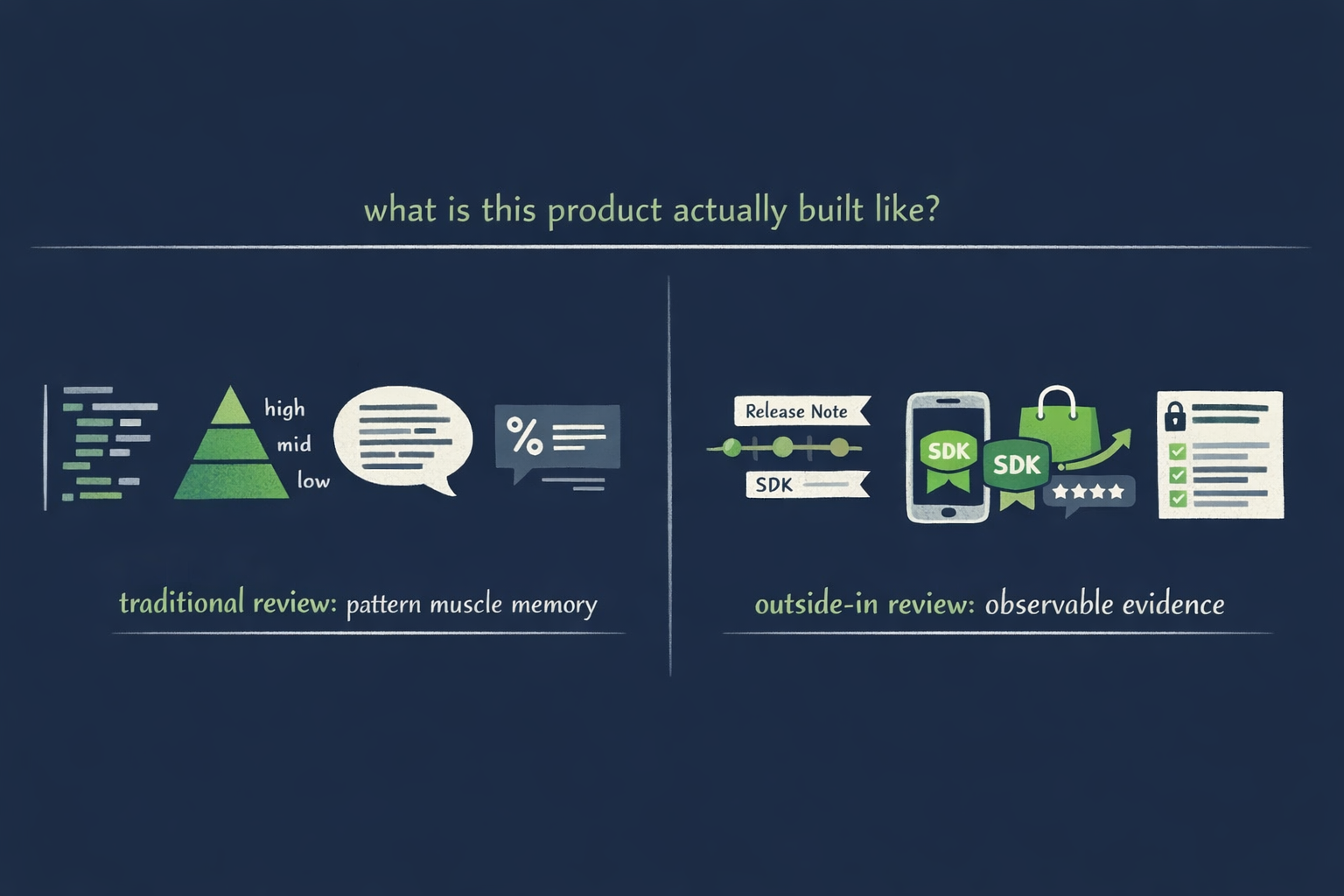
Traditional source code review depended on human patterns. A reviewer looked at the code and applied muscle memory built up over years of reading how experienced developers structure abstractions, how technical debt accumulates, how architectural decisions get made under pressure. Those patterns were the substance of the review. The reviewer's judgement about what they saw carried the weight.
The vibe coding pattern breaks that assumption. AI-assisted rapid iteration means each version of an app can differ substantially from the previous one, sometimes across many small refinements per day. The resulting patterns in the code do not carry the signals a human reviewer's muscle memory was trained to recognise. Vibe-coded apps are not written badly. They are written differently, and much of the code was iterated by the AI in ways that mean traditional review patterns simply do not apply.
Two specific consequences follow.
First, source code review muscle memory is becoming moot for a growing category of apps. A reviewer looking at vibe-coded source cannot apply the traditional signals. The abstractions do not indicate developer maturity in the same way. The architectural patterns do not reveal team seniority in the same way. The technical debt does not accumulate in the same shapes. Reading the code for its patterns tells you less than it used to.
Second, source code is becoming the transaction layer, and the product intelligence lives higher up. What the team decided to build, how they decided to prioritise, which features got iterated and which got removed, what user journeys the product actually serves. Those higher-level artefacts (PRDs, user journeys, product decisions) are where the real signal now lives. The code implements the decisions. It is not the decisions.
Outside-in evidence reveals those higher-level decisions more directly than source review does. Release notes show what the team decided mattered enough to ship. Version history shows what got iterated. Store metadata shows how the product is positioned. Reviews show what users experience versus what the team intended. Permissions show what the app actually accesses versus what the privacy notice claims. All of this is public evidence that is genuinely more informative for due diligence than the source code review would have been, particularly for vibe-coded apps.
This is the argument for outside-in technical due diligence: it is not just what you do when source code is unavailable. It is often what you should be doing anyway, because it reveals the product decisions that traditional source review was only ever indirectly measuring.
What Technical Due Diligence Usually Involves
Traditional technical due diligence (sometimes called technology due diligence, IT due diligence, or software due diligence depending on the buyer and the deal shape) is well-documented. Source code review. Architecture documentation review. Engineering team interviews. Infrastructure and deployment review. Security posture assessment. Documentation of technical debt and architectural decisions. Development process review including how the team ships, tests, and monitors.
When source access is unavailable (whether structurally or by IP protection choice), most of that traditional list becomes either impossible or heavily indirect. Architecture documentation may not exist as a shareable artefact. Engineering interviews may not be offered until later deal stages. Infrastructure review requires access that has not been granted. Technical debt is invisible without the code.
What remains available is the app itself, plus everything the app has said publicly about itself over its lifetime. That is genuinely more than most due diligence conversations assume, and it is what the checklist below is built on.
The Technical Due Diligence Checklist for Mobile Apps Without Source Code
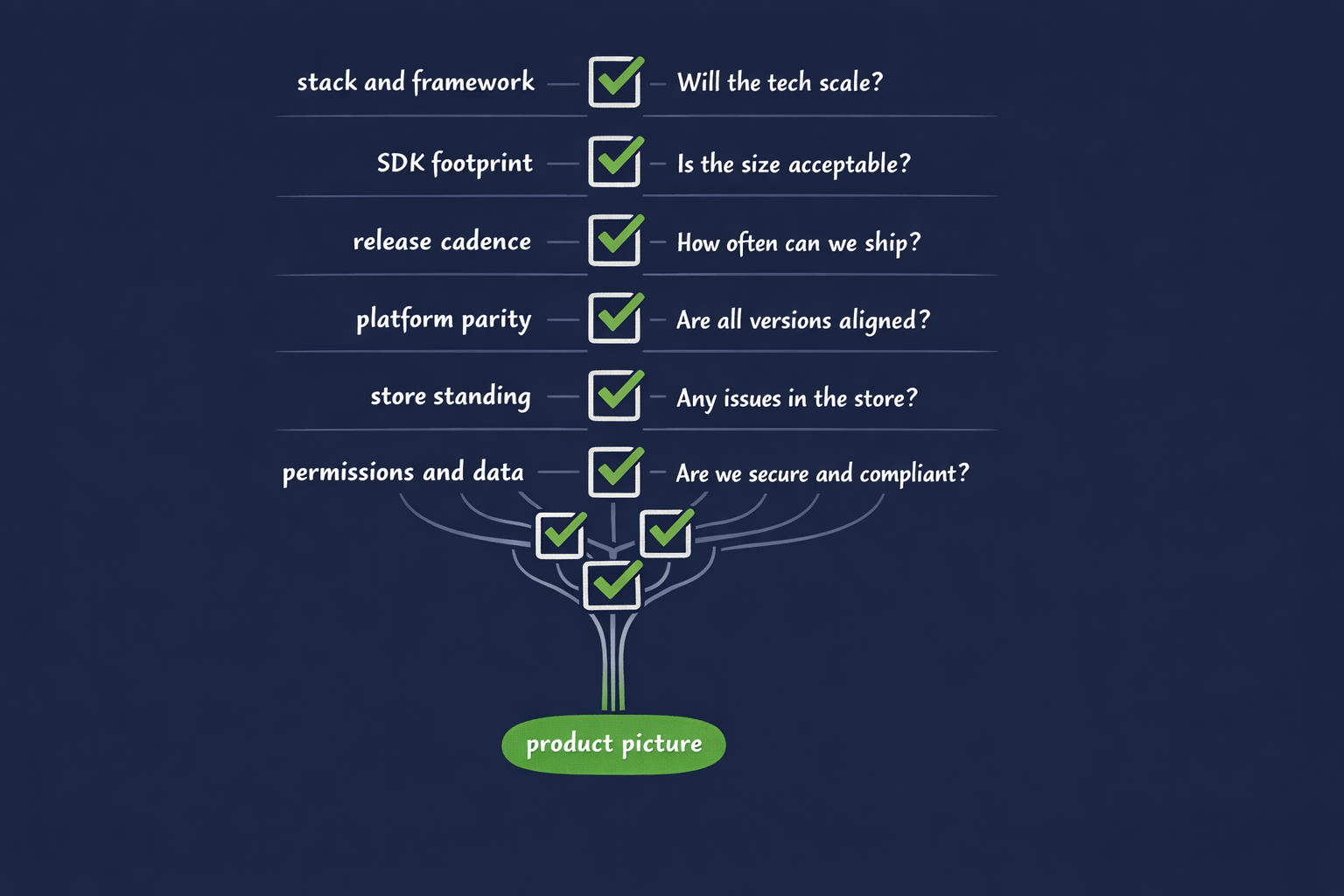
Every signal below is observable from outside the app. Each answers a specific delivery-risk question that traditional due diligence would have asked, using evidence rather than documentation.
Stack and framework choices. Native iOS, native Android, React Native, Flutter, Xamarin, Ionic, Kotlin Multiplatform, Capacitor, or a hybrid combination. The choice reveals engineering culture (native suggests larger teams with platform-specific expertise, cross-platform suggests smaller teams or startup constraints), maintenance load (each framework has different long-term costs), and hiring implications (some stacks have deep talent pools, others do not). All observable from the app package.
SDK footprint and dependency risk. Which third-party SDKs the app ships with, at what versions, and what those SDKs do. High SDK count can indicate rapid feature assembly, feature scope creep, or acquisition-driven integration debt. Specific SDKs can indicate specific dependencies (analytics choices, payment providers, ad networks, subprocessor relationships). Outdated SDK versions can indicate technical debt or slow maintenance cadence. All observable from the app package.
Release cadence and version history. How often the app has shipped releases across the past year, whether cadence has accelerated or slowed, and what the version bumps have communicated. Regular releases (weekly to monthly) suggest active engineering. Long gaps between releases can indicate resource constraints, technical challenges, or strategic pause. Version notes over time reveal what the team decided mattered enough to communicate. All observable from the App Store and Google Play version history.
Platform parity between iOS and Android. Whether iOS and Android versions ship simultaneously, whether feature parity is maintained, and whether both platforms receive equivalent attention. Divergent platform quality often reveals team composition (single-platform expertise, contracted development, or platform-preference decisions). Store metadata comparison and release timing reveal this directly.
Store standing and user sentiment. Ratings distribution, review count, review sentiment, developer response cadence, and the pattern of one-star reviews. High rating with low review count is different from high rating with high review count. Developer replies (or lack of them) reveal customer engagement discipline. One-star reviews often cluster around specific issues that are diagnostic of technical problems. All observable from store listings.
Permissions and data collection posture. What the app requests permission to access, what it declares it collects in Data Safety and privacy label declarations, and whether declarations match the SDK footprint. Divergence between declared collection and shipped SDKs is a compliance risk indicator. Permission scope creep across versions is a technical or product direction indicator. All observable from the app package and platform declarations.
What each signal implies for delivery risk. Read individually, each signal is a data point. Read together, they form a picture of engineering discipline, product velocity, technical debt exposure, compliance posture, and hiring risk. That picture is not the same as source code review. It is a genuinely different view of the same product, and for many due diligence purposes it is more informative than source code review would have been.
What Outside-In Evidence Tells You That Documents Cannot
A common due diligence question is "what documents do we need from the target". The honest answer for mobile products in the vibe coding era is often: fewer than you think, and less useful than you hope.
Documents describe intent. The team writes a PRD describing what they intend to build. They write architecture documentation describing what they intend the system to look like. They write technical debt documentation describing what they intend to fix later. Each of these is a snapshot of intent at a moment in time, and all of them require the team's active cooperation to produce and share.
The app itself is evidence of what actually shipped. Not intent, actual behaviour. The SDKs the app actually bundles. The permissions it actually requests. The data it actually collects. The features it actually delivers. The version cadence it actually maintains. All of this is public evidence that requires no cooperation from the team and no active document production.
In the vibe coding era specifically, the gap between documented intent and shipped reality can be substantial. AI-assisted iteration means teams sometimes do not know precisely what their most recent releases contain, because the AI made decisions during iteration that were not deliberately reviewed. Documents about intent may reflect what the team meant to ship rather than what actually got shipped. The app package is the authoritative source for what actually got shipped, whether or not the team could accurately document it.
For due diligence purposes, that authoritative source matters more than the document set. Not instead of the document set when it is available, but in place of it when it is not, and often more reliably than it in the vibe coding era regardless.
How Coderus Heritage Earns the Interpretation
Reading an app package to infer architectural decisions requires knowing what those decisions look like from the outside. That knowledge comes from having built mobile apps professionally for years. Appnalysis is built on that foundation. The team that built Appnalysis came from Coderus, a mobile engineering consultancy that has been shipping production apps across platforms since 2010. That heritage means the interpretation layer of Appnalysis is not academic pattern matching. It is engineering judgement about what specific patterns in an app package mean in practice.
In the traditional review era, source code was the primary evidence and the interpretation was in reading the code. In the outside-in evidence era, the app package is the primary evidence and the interpretation is in reading what shipped without needing the source. Both require engineering judgement earned over years of doing the work. That interpretation layer is what makes outside-in due diligence defensible rather than superficial.
How Appnalysis Fits Into Due Diligence in the Vibe Coding Era
Appnalysis is a new-world tool for a new-world problem. It exists because the traditional due diligence workflow (source access, architecture review, engineering interviews) is being replaced by a different workflow: IP-protected teams shipping vibe-coded apps at high cadence, evaluated by acquirers and investors who need to make defensible decisions without the traditional artefacts.
The specific job Appnalysis does in this workflow is producing the outside-in evidence set that the checklist above depends on. Reading the app package directly. Comparing SDKs against subprocessor declarations. Tracking release cadence and version history. Reasoning about what the store metadata and review patterns reveal. Doing this at speed so a due diligence pass takes hours or days rather than weeks.
Appnalysis is one part of the wider evidence layer that mobile-first due diligence increasingly runs on. It complements the compliance and third-party risk work that traditional GRC tools cover, the market intelligence that platform-based tools produce, and the AI-assisted workflows that developers and analysts now run through MCP-compatible AI coding agents (covered in Your AI Coding Agent Only Sees Half the Picture). Together, this stack is how due diligence gets done in 2026.
For teams already thinking about how AI-era workflows shift what the code layer means, the argument connects directly to the pattern named in You Vibe Coded Your App: What You Actually Shipped and to the wider question of visibility covered in Everyone Talks About Technical Debt. Nobody Talks About Legal Debt.
Try Appnalysis Against an App You Are Evaluating
The fastest way to see whether outside-in due diligence produces a defensible picture is to try it on a specific app you are evaluating. Bring the app's App Store or Google Play listing and ask Appnalysis to walk through the checklist above. The output will show whether the signals converge on a coherent product picture or reveal specific delivery-risk questions worth pressing on before the deal proceeds.
Frequently Asked Questions
Related Reading
- You Vibe Coded Your App: What You Actually Shipped - the pattern this article extends into due diligence
- Everyone Talks About Technical Debt. Nobody Talks About Legal Debt - why outside-in visibility matters at the compliance dimension too
- Your App's Compliance Roadmap. Have You Got the Right Paperwork Planned? - the compliance context due diligence teams should understand
- Your AI Coding Agent Only Sees Half the Picture - how Appnalysis works with AI coding agents to make outside-in evidence directly queryable
- SimilarWeb Alternatives for Mobile Apps: Panel Estimates vs Evidence - the wider evidence-first framing across the intelligence cluster