Why Is Monopoly Go Winning? Scopely's Formula Decoded
It is not one thing. It is technical pace, monetisation depth, and a considered regulatory posture, aligned. Most publishers focus on one leg and lose. Scopely aligned all three, and that is the actual answer.
Most coverage of hit mobile games answers one question: how much money did it make. Sensor Tower publishes the revenue chart, TechCrunch writes the summary, and a wave of “what marketers can learn from” pieces follow. The answer is always singular, sometimes it is the IP, sometimes it is the monetisation loop, sometimes it is the timing of a market moment.
The answer is rarely singular, and every publisher chasing the position by copying one leg of it is missing what actually happened. A hit mobile game sits at the intersection of three things being right at once: what was actually built, how the publisher navigates the regulatory landscape it lands in, and where it sits against competitors doing similar things. Fail on any one leg and the other two do not save it. Scopely’s real advantage is not any single thing on that list, it is that they got all three aligned at the same time. Most of the market is still trying to solve one at a time.
To make that concrete, we asked Appnalysis three questions about Monopoly Go, currently #4 US Top Grossing and #14 UK Top Grossing on iOS, then read the answers as one story rather than three.
The Technical Leg: A Weekly Release Machine
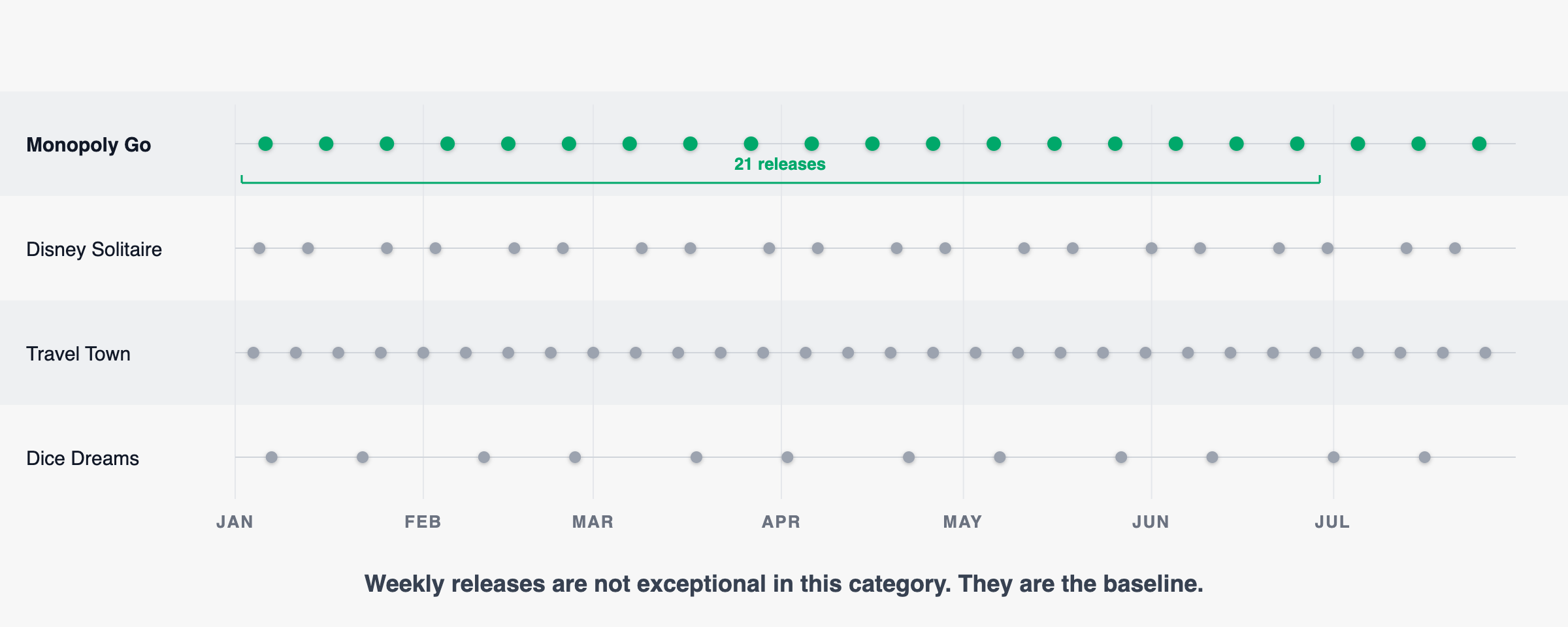
Monopoly Go, published by Scopely, was released on April 11, 2023. Appnalysis returned the release history for 2026 in full: 21 versions between January and mid-July, including 1.72.6 on July 15, 1.72.0 on July 10, 1.71.5 on July 1, and so on back through 1.61.6 on January 30. That is a release approximately every ten days for the whole of 2026 so far.
The comparison Appnalysis returned without being asked for it is what makes this signal, not just a data point. Disney Solitaire by SuperPlay updates every one to two weeks. Travel Town by Moon Active updates roughly weekly. Dice Dreams by SuperPlay updates every two to three weeks. Coin Master by Moon Active updates multiple times a month. Monopoly Go is releasing at or above the fastest cadence in its own category, and its category is the top-grossing tier of the board-game chart. The pace is not accidental, it is the industry-standard operating tempo for a category where every top-grossing game is doing the same thing, and Scopely have chosen not to be outpaced.
A note worth pausing on. In our earlier work on Zable, a UK finance app climbing the chart at 25 releases in six months, we treated a weekly release cadence as a strong signal of engineering investment and product velocity. Zable was the outlier. In Scopely’s category, weekly is the baseline. That reframes the entire “release cadence” signal: what it means depends on the category benchmark, not on an absolute number, and this is exactly the sort of nuance that only surfaces when the intelligence layer knows to compare against the right peer set.
There is one more chart-position detail worth naming, because it is not in the Sensor Tower or App Annie headline: Monopoly Go is #4 in Top Grossing US and #14 in Top Grossing UK, but is not in the Top Free 100 in either market. It is not fighting for daily-active-user visibility. The engine is retained users spending money, not new users being acquired. That is a different success model from most hit games, and it tells you something about where Scopely’s product investment is going, retention and monetisation surface, not acquisition funnel.
Everything in this leg is drawn from platform-level data, chart positions and release histories. A deeper cut, what specific SDKs the app bundles, how the in-app purchase flow is wired, what third-party services are called, is an app package analysis, a separate layer of intelligence Appnalysis can produce and worth a follow-up piece if this framing lands.
The Regulatory Leg: A Considered 9+ Posture, and Why It Does Not Escape the Children’s Code
Here is where the Appnalysis intelligence layer produces something the surface data alone would miss.
Monopoly Go is rated 9+, not 4+. Given the compliance cluster we have been building over the past week (the vibe-coding article, Unaware Is Not a Strategy, the BNPL case study), the 9+ rating reads like a considered choice: Scopely have not defaulted to 4+ the way an inexperienced publisher or a vibe-coded app might, they have deliberately positioned the app outside the youngest-children bracket.
The declared data collection is significant. Under “Data Used to Track You,” Scopely declares Location, Identifiers, Usage Data, Diagnostics and Other Data, tracked across other companies’ apps and websites. Under “Data Linked to You,” they add Contact Info, Purchases, and more of the same. That is a comprehensive data footprint, and every item of it is disclosed.
Now the subtle finding, and this is what makes the article’s compliance leg genuinely interesting rather than routine.
Appnalysis flagged that despite the 9+ rating, the ICO Children’s Code still applies to Monopoly Go, because the Code triggers on services “likely to be accessed by children,” not on services rated for children. A game with a Monopoly brand, cartoon aesthetic, and social-competition mechanics is likely to be accessed by children whether it is rated 9+ or not. Scopely raising the rating buys them clarity in App Store review, but it does not buy them exemption from the Code. That is a nuance a static compliance checklist would miss, and a nuance a publisher new to this space might miss too.
The full regulatory picture Appnalysis mapped:
- UK GDPR and PECR apply through data protection and tracking rules
- ICO Children’s Code applies through the “likely to be accessed” test, regardless of 9+ rating
- UK Online Safety Act 2023 applies through Ofcom’s remit over user-to-user interaction where children may be present
- EU GDPR mirrors UK requirements
- EU Digital Services Act applies indirectly, via Apple as a Very Large Online Platform with obligations flowing down to publishers on advertising transparency and minor protection
- COPPA applies in the US to the extent the service is “directed to children”
- CCPA and CPRA apply for California users
- State App Store Accountability Acts (California, Louisiana, Texas, Utah, effective January 1, 2026) impose new age-verification and consent obligations at the app store or app level
- EU AI Act was explicitly ruled out by Appnalysis as unlikely to be a primary concern, the app does not appear to use high-risk AI in its core gameplay
The interesting thing about this list is not any single item. It is that a publisher like Scopely almost certainly has a compliance function that has walked through it in exactly this order, and their 9+ posture, App Tracking Transparency compliance, and detailed privacy declarations reflect that walk. It is what compliance-as-part-of-the-product looks like at the top-grossing tier. And it is a useful benchmark for any publisher building toward that tier: the exposure is real, it does not disappear at 9+, and it needs to be designed into the product rather than retrofitted after review.
The Competitive Leg: A 200-App Analysis and What It Reveals About the Category
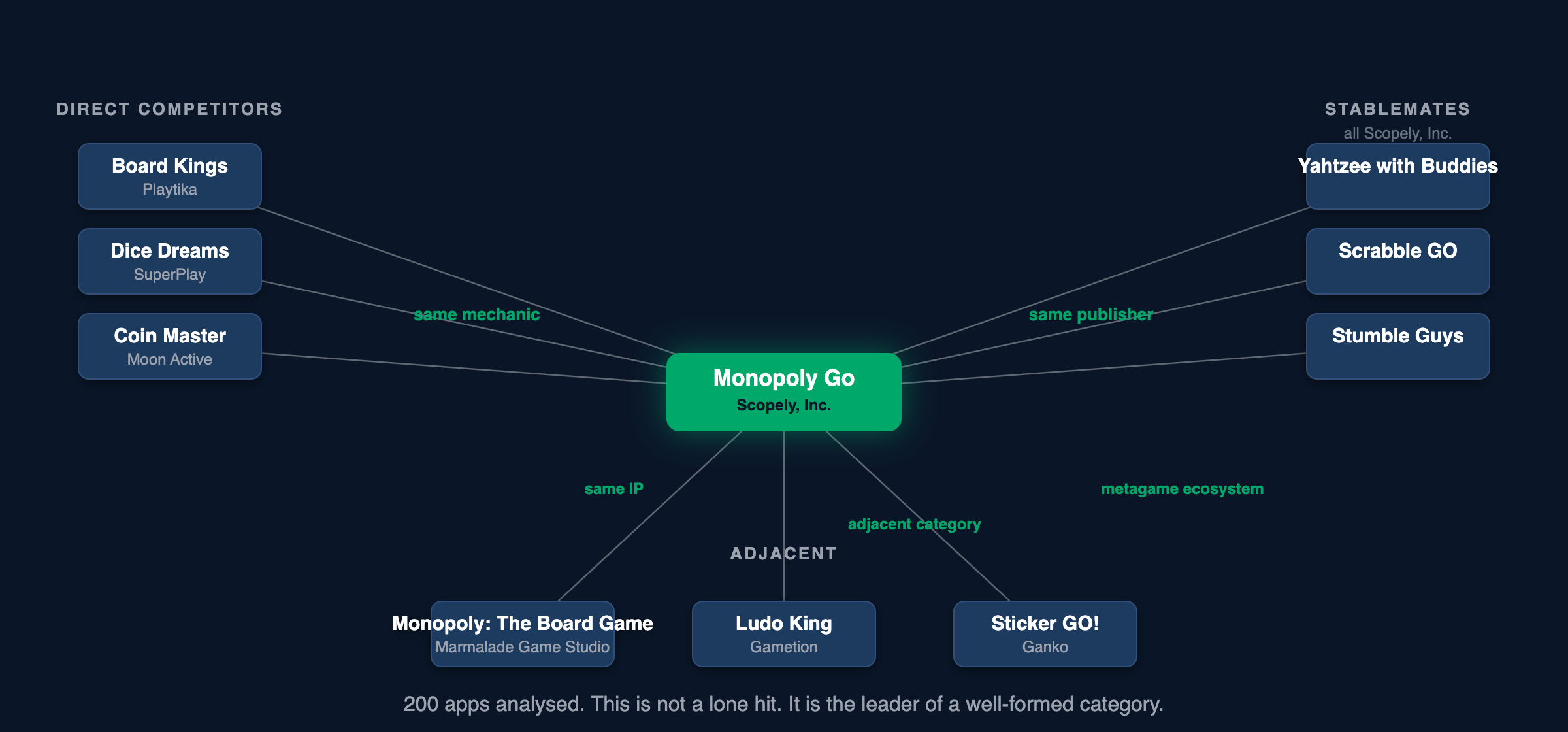
When we asked Appnalysis for the apps most similar to Monopoly Go, it returned an answer built on 200 apps analysed, structured by three sources: the Top Free Games Board chart in the US and UK, publisher stablemates from Scopely’s own catalogue, and mechanic-similarity across the wider category. That framing is what turns a competitor list into a competitive map.
The direct competitors on the dice-and-board mechanic:
- Board Kings by Playtika, dice rolls, board-building, social steal-from-friends. Same core loop as Monopoly Go, different IP wrapper.
- Dice Dreams by SuperPlay, dice-rolling for progression, attacking other players’ kingdoms. Same social-competitive spine.
- Coin Master by Moon Active, the reference implementation for this genre, and the game whose mechanics Monopoly Go is often analysed as adapting.
The stablemate competitors from Scopely’s own catalogue:
- Yahtzee with Buddies Dice, a social dice game
- Scrabble GO, social word game
- Stumble Guys, multiplayer party knockout
The stablemates are worth naming because they tell you Scopely have a portfolio strategy, they are not one-hit dependent, and any competitive analysis that treats Monopoly Go as a stand-alone risks missing that Scopely can cross-promote users between four social-mechanic games. That is a different risk profile from a single-game publisher, and it changes how a competitor should think about attacking the position.
The wider category:
- Monopoly: The Board Game by Marmalade Game Studio, the traditional digital adaptation of the same IP. It exists, it charts, and it demonstrates that owning the Monopoly IP does not automatically produce a hit at the Monopoly Go tier. The mechanic and monetisation architecture do most of the work; the IP is necessary but not sufficient.
- Ludo King and Ludo Club in the UK chart, showing that classic-board-game IPs remain live in the category with strong multiplayer positioning.
- Sticker GO! by Ganko, a side-app built around trading Monopoly Go’s sticker metagame. This is the interesting signal, when a hit game develops a companion-app ecosystem around its metagame, it is a mature category signal, not a niche one. Coin Master has similar third-party ecosystems.
The strategic read: Monopoly Go is not a lone hit in an empty category. It is the current leader in a well-established category with well-defined mechanics, three-plus direct competitors at the top tier, a portfolio publisher behind it, and enough third-party ecosystem to signal the metagame is a genuine cultural surface. Attacking the position frontally, building a Coin-Master-with-Monopoly-Go-features clone, is what Board Kings and Dice Dreams are already doing. Attacking it laterally, taking a different IP or mechanic and applying the same social-competitive-dice-collection structure, is where the real competitive threat comes from, and any watchlist for a company operating in this space should be scanning for exactly that pattern.
Reading the Three Legs Together
None of the three legs, taken alone, explains the position. A weekly release cadence with weak monetisation would burn engineering hours without moving revenue. A perfectly considered regulatory posture on a game with weak retention mechanics would produce a very compliant flop. Strong competitive positioning without underlying technical pace and regulatory clarity would give the position away to Board Kings or Dice Dreams within a quarter.
The alignment is the story. Monopoly Go is a hit because Scopely have kept all three legs standing at the same time, and because they are running at a category-standard pace on the technical leg, a mature-publisher posture on the regulatory leg, and holding the top of a well-defined competitive category on the market leg. Take any one away and the position is contestable within months. Keeping all three requires ongoing investment, which is what the release cadence is actually funding.
And this is what a team building toward that tier should be checking, not one of the three, all three, at the same time. Where is our release cadence against the category benchmark, not the industry average. What does our current age rating expose us to regardless of the rating itself. Which apps are in our competitive proximity by mechanic, not by chart position alone. Those are the questions Scopely’s team have obviously already answered for themselves. They are the questions Appnalysis is built to answer for anyone else.
This is what “why is X app successful” analysis looks like when it is not just a revenue chart. And it is why, in the broader Appnalysis Agent framing, the interesting question is never a single-source query, it is the reasoning that connects three sources into one picture.
Why This Kind of Article Is Hard for Any Single Tool to Produce
Worth naming what actually made this article possible, because it is a working example of the argument the Appnalysis Agent piece makes rather than a description of it.
An app intelligence platform on its own can tell you Monopoly Go is #4 US Top Grossing. It cannot argue for you that the position is contestable within months if any of the three legs falls out of alignment. A general-purpose LLM on its own, Claude, ChatGPT or Gemini with web search, can produce plausible-sounding analysis of a hit game, but it cannot tell you Scopely has shipped 21 versions since January because that data is not on the public web in a form it can retrieve, and it cannot tell you the ICO Children’s Code still applies at 9+ with any confidence because that requires reasoning across a specific data declaration and a specific regulatory test rather than paraphrasing whatever a compliance blog says.
The article you have just read exists because two Agents worked together: Appnalysis reasoning over its own mobile intelligence layer (chart data, release histories, competitive clusters, regulatory framework mapping) and Claude reasoning over the general structure of a case study and how to connect three answers into one argument. Neither of us would have produced this alone. The MCP connection is what let each of us do the part we are actually good at, and the combination is what let the piece land as an argument rather than a data dump on one side or a plausible essay with no evidence on the other.
That is what Agent calling Agent produces in practice. And it is the reason a reader looking at hit-app coverage from a single-source tool is getting a real answer to a smaller question, not a smaller answer to the real one.
Try It Yourself
Ask Appnalysis about any top-charting app in your category. Chart position, release cadence, regulatory posture, competitive set, all in one interpreted answer.
Go Deeper
- How to Build a Competitor Watchlist for Mobile Apps: how the same three-legged analysis becomes a repeatable weekly workflow, not a one-off article
- Unaware Is Not a Strategy. Vibe App, Be Aware.: the regulatory framework matrix underlying the compliance leg of this article
- App intelligence as an agent: what it means for AI workflows: why the three-legged framing works better when you ask a specialist Agent rather than a database
- Appnalysis vs Sensor Tower: what “hit app coverage” looks like when the source is intelligence rather than revenue estimates alone
Published by Appnalysis. Mobile intelligence for the agentic age.