Sensor Tower Alternatives: Evidence-First App Intelligence
Why teams look for a Sensor Tower alternative
If you are researching Sensor Tower alternatives, you are almost certainly comparing mobile app intelligence platforms rather than shopping for a specific product.
For more than a decade, Sensor Tower has been one of the best-known names in mobile market intelligence, helping publishers, agencies, investors and product teams understand app performance across the iOS App Store and Google Play.
Following its acquisition of data.ai (formerly App Annie), Sensor Tower has become one of the largest providers of mobile market intelligence available today.
But as mobile teams become more evidence-driven, many organisations are beginning to ask a different question.
Rather than simply understanding what happened, they increasingly want to understand why it happened, and what action they should take next.
That difference is where Appnalysis was created.
What is Sensor Tower?
Sensor Tower is a mobile app intelligence platform that provides estimated market intelligence for mobile apps.
It is widely used for:
- Download estimates
- Revenue estimates
- Market share
- Category rankings
- Advertising intelligence
- Publisher benchmarking
- Competitive landscape analysis
For organisations needing market sizing, investor reporting or executive dashboards, Sensor Tower has become an established part of the mobile ecosystem.
Where Sensor Tower Excels
Sensor Tower is particularly strong when your questions are about the overall market.
For example:
- Which finance apps are growing fastest?
- How large is this category?
- Which publishers dominate a country?
- How much revenue is estimated across competitors?
- Which companies are increasing advertising spend?
These questions require sophisticated modelling across very large datasets.
For market sizing and executive reporting, Sensor Tower is one of the industry's leading platforms.
Considering a data.ai or App Annie Alternative?
Sensor Tower acquired data.ai (formerly App Annie) in 2023, and the two platforms have since been consolidated. Anyone previously using data.ai or App Annie is now, in practice, using Sensor Tower. That consolidation is worth naming because it changes the alternatives picture. Where there were once three distinct incumbent platforms, there is now one dominant provider with a consolidated data model, pricing structure, and product roadmap.
For teams evaluating what to use instead, the question is less about picking between similar tools and more about deciding what job you need done. Market estimates and executive reporting remain Sensor Tower's strength. Evidence-first intelligence, where every insight links back to publicly available sources, sits in a different category and is what Appnalysis was built for. The two approaches are complementary, and many teams end up using them together rather than choosing one over the other.
Where Teams Often Need Something Different
Once a product discussion begins, the questions usually change.
Instead of asking:
How many downloads did our competitor receive?
Teams begin asking:
- Why did their ratings suddenly improve?
- Which feature caused the change?
- What did users actually like?
- Which screenshots changed?
- What functionality was introduced?
- What evidence supports that conclusion?
- How should we respond?
These are product questions rather than market questions.
Answering them requires evidence rather than estimates.
Evidence-First Intelligence vs Estimated Intelligence
This is the biggest philosophical difference between the two platforms.
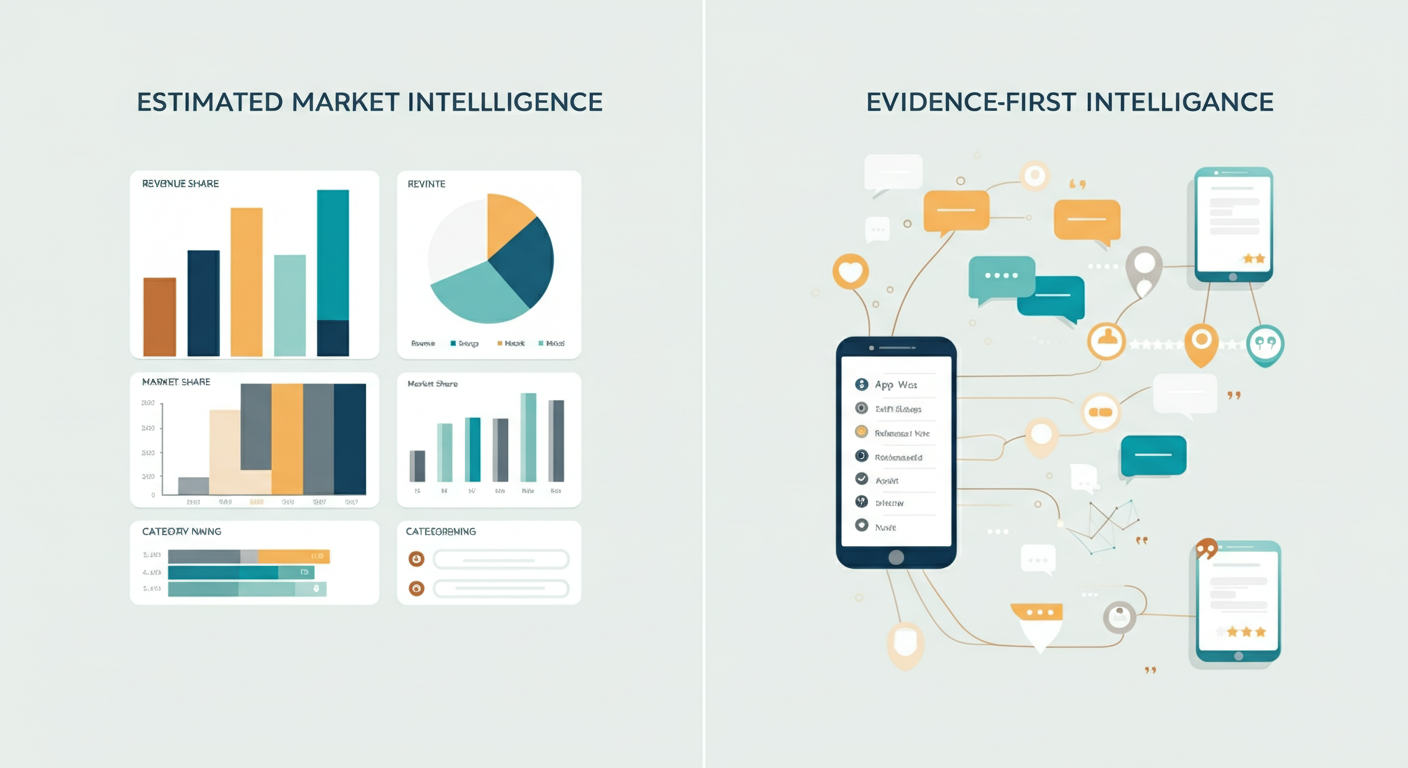
Sensor Tower specialises in estimated market intelligence.
Appnalysis specialises in evidence-first intelligence.
For example, rather than saying:
Estimated downloads increased 18%.
Appnalysis might explain:
- Release notes introduced subscriptions
- Screenshots highlighted the new feature
- Review sentiment improved immediately afterwards
- Users repeatedly referenced the new capability
- Ratings increased across successive releases
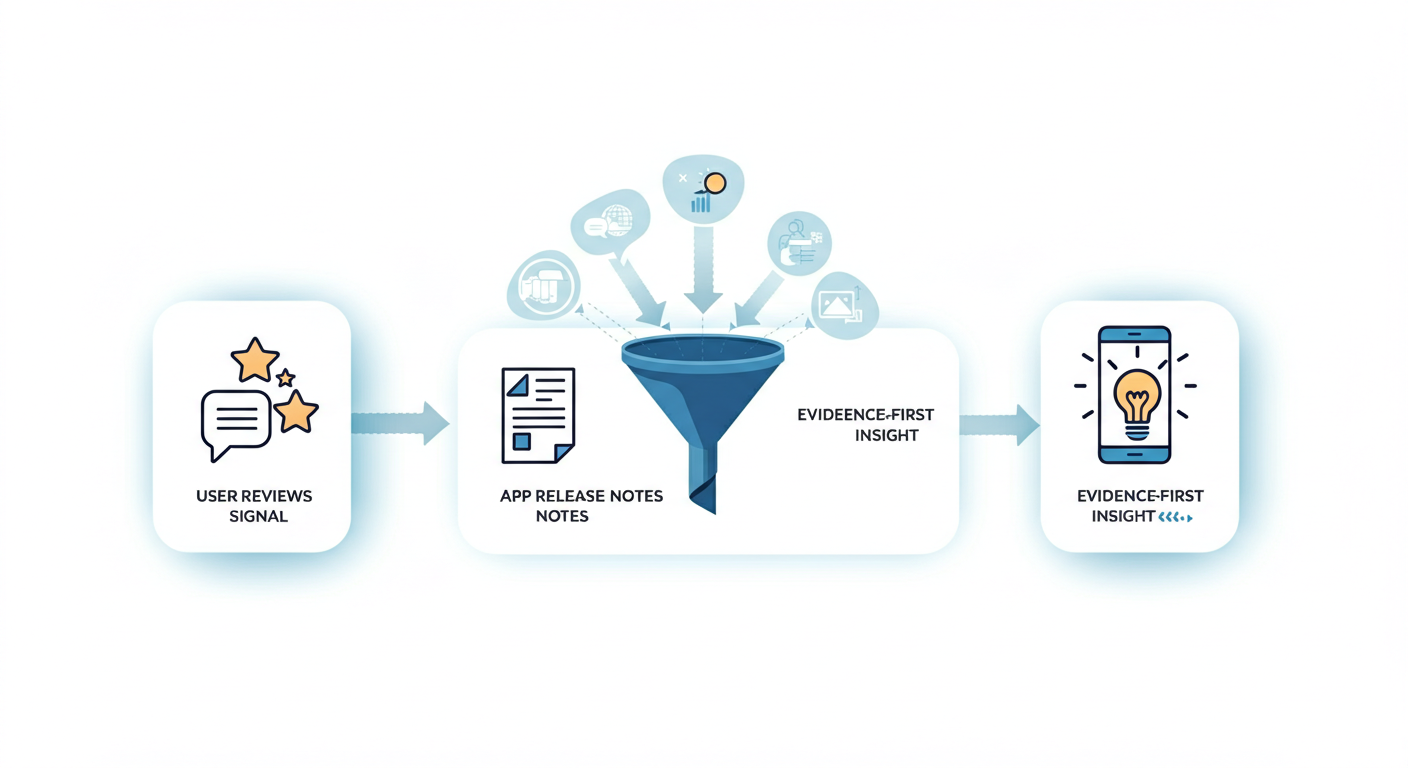
Each insight links back to publicly available evidence.
Rather than asking users to trust a dashboard, Appnalysis allows them to verify the underlying signals themselves.
Comparison at a glance
The two platforms are built around different questions. Here is how they compare across common use cases.
| Capability | Sensor Tower | Similarweb | Appnalysis |
|---|---|---|---|
| Market sizing | ✓ | ✓ | Limited |
| Download estimates | ✓ | ✓ | Focus on evidence |
| Revenue estimates | ✓ | Limited | Not primary focus |
| Web traffic and behaviour | Not primary | ✓ | Not primary |
| Cross-platform digital intelligence | Limited | ✓ | Mobile only |
| Category benchmarking | ✓ | ✓ | ✓ |
| Review intelligence | Limited | Limited | ✓ |
| Release note analysis | Limited | Limited | ✓ |
| Screenshot evolution | Limited | Limited | ✓ |
| Feature tracking | Limited | Limited | ✓ |
| Evidence-backed reporting | Partial | Partial | ✓ |
| AI conversational insights | Emerging | Limited | ✓ Ask Appnalysis |
| MCP connection for AI assistants | Not available | Not available | ✓ Mobile intelligence Agent via MCP |
The platforms answer different questions rather than attempting to solve exactly the same problem.
Which Tool Should You Choose?
Choose Sensor Tower if your priority is:
- Executive reporting
- Market sizing
- Download estimates
- Revenue estimates
- Advertising intelligence
- Investment research
Choose Appnalysis if your priority is:
- Product strategy
- Competitor feature analysis
- Agency research
- Roadmap validation
- Due diligence
- Understanding why competitors are succeeding
- Evidence-backed client presentations
Many organisations may ultimately use both.
One explains the market.
The other explains the evidence behind product decisions.
Sensor Tower pricing, and what you are actually paying for
Sensor Tower does not publish list pricing. Access is quote-only and scoped per seat, per module and per market, so the figure you are given depends on how many countries, categories and data feeds you need. Publicly reported contracts have tended to land in the five-figure range annually for full market-intelligence access, with smaller ASO-only packages available lower down. Treat any specific number you find online as indicative rather than current.
That opacity is the reason most people search for the price in the first place. It is worth being clear about what the spend buys: a modelled view of downloads, revenue and ad activity across the whole market, maintained continuously at a scale that is genuinely expensive to produce. If your decision needs market sizing or investor-grade estimates, that is a fair price for a hard problem.
The cost question becomes uncomfortable when the budget is being spent on a job the platform was never built for. Teams frequently buy market estimates and then use them to answer product questions: which SDKs a rival ships, what permissions it declares, how its accessibility or privacy posture compares. Estimates cannot answer those questions, so the spend gets stretched across a gap it cannot close.
Appnalysis takes the opposite approach on transparency: tiers and what each one includes are published on the Appnalysis pricing page, so you can size the decision before you speak to anyone. The two are not priced against each other because they are not solving the same problem, and a serious evaluation should compare cost per answered question rather than cost per seat.
Sensor Tower Competitors and Adjacent Platforms
Beyond the direct alternatives above, several adjacent platforms serve overlapping needs. Appfigures specialises in app store analytics with a focus on rankings and reviews, and often appears alongside Sensor Tower in tool comparisons. Similarweb is primarily a digital intelligence platform with web traffic and behaviour as its core, and mobile app coverage extending from that, which makes it a fit for teams whose research question spans web and mobile together rather than mobile specifically. AppFollow focuses on ASO and review management for teams whose main job is ranking iteration. AppTweak sits in similar ASO-tool territory. Adjust and Airship serve mobile marketing attribution rather than market intelligence. Each solves a specific job that Sensor Tower touches on but does not specialise in.
Where Appnalysis sits in this landscape is deliberately narrow. Rather than trying to be a general-purpose mobile intelligence platform, Appnalysis specialises in evidence-first analysis: what an app actually contains, what it declares, how it compares to peers on the specific technical and regulatory dimensions that matter for a product or agency decision. That is a different job from Sensor Tower's market estimates, a different job from Similarweb's cross-platform digital intelligence, and a different job from AppFollow's ASO workflow.
Appfigures as a Sensor Tower alternative
Appfigures is the alternative most often shortlisted on price. It publishes its tiers openly, starts far lower than an enterprise market-intelligence contract, and covers rankings, reviews, keyword tracking and download and revenue estimates. For a small publisher or an agency running a handful of accounts, it frequently does enough. The trade-off is depth of coverage: the estimate model is less exhaustive across markets and categories than Sensor Tower's, which matters if your output is investor-facing rather than operational.
AppTweak, App Radar and AppFollow, the ASO-led alternatives
These three cluster together because they all approach the market from app store optimisation rather than market intelligence. AppTweak is the most analytically complete of the group and the one that competes most directly with Sensor Tower on data breadth. App Radar leans towards guided workflow and smaller teams. AppFollow is strongest on review management and reply automation, which is an operational job rather than a research one. Pick from this group if your recurring question is how do we rank higher, not what is happening in the market.
MobileAction and Similarweb, the broad-coverage alternatives
MobileAction combines ASO tooling with ad intelligence and competitor tracking, making it the closest mid-market substitute for a full Sensor Tower seat. Similarweb comes at mobile from the web side, so it wins when the question spans both surfaces and loses when the question is mobile-specific. Both are credible replacements for a team that wants one broad platform rather than a specialist one.
A note on data.ai and App Annie alternatives
Searching for a data.ai or App Annie alternative now leads back to the same place, because Sensor Tower acquired data.ai and App Annie was its earlier name. If you were a data.ai customer looking to move, the practical shortlist is the one above rather than a straight swap, and the consolidation itself is a reasonable prompt to re-examine whether estimates were ever the thing you needed.
The right comparison for your team depends on which job is the constraint. If the constraint is understanding market movement, Sensor Tower is the reference platform. If the constraint is broader digital intelligence spanning web and app together, Similarweb sits in that category. If the constraint is understanding why one app is winning against another with evidence you can share with a client or a regulator, evidence-first intelligence is the category to look at, and Appnalysis is one of the platforms built for it.
Frequently Asked Questions
What are the best Sensor Tower alternatives?
The right alternative depends on the job you need done. For market estimates and executive reporting, there is currently no direct like-for-like alternative to Sensor Tower at scale. For broader digital intelligence that spans web traffic and mobile together, Similarweb sits in that category. For evidence-first intelligence that explains why competitors are behaving the way they are, Appnalysis is built for that job. For ASO iteration specifically, AppFollow and AppTweak sit in that category. For mobile marketing attribution, Adjust and Airship serve that need. Most teams evaluating alternatives are looking for something Sensor Tower does not do specifically well, rather than a like-for-like replacement of what it does.
Is Appnalysis a Sensor Tower alternative?
Yes, although many organisations will find the two products complementary rather than direct replacements.
Does Appnalysis estimate downloads?
No.
Appnalysis focuses on publicly available evidence rather than modelling downloads or revenue.
Which platform is better for product managers?
If your work involves competitor features, roadmap planning and understanding user feedback, Appnalysis is designed around those workflows.
If your focus is market sizing or executive reporting, Sensor Tower may be the better fit.
Which platform is better for agencies?
Agencies often need evidence they can present directly to clients.
Appnalysis links insights back to release notes, screenshots, reviews and other publicly available sources, making discussions easier to validate.
Can I use both together?
Absolutely.
Many teams use market intelligence to understand what is happening and evidence-first intelligence to understand why it is happening.
Final Thoughts
This isn't really a story about one platform replacing another.
It's about two different approaches to mobile intelligence.
Sensor Tower has become one of the industry's leading platforms for understanding the size and movement of the mobile market.
Appnalysis was built to help explain the decisions happening inside that market.
If your question is:
"How big is the opportunity?"
Sensor Tower is an excellent place to start.
If your question is:
"Why is this competitor succeeding, and what should we do next?"
That's where Appnalysis was designed to help.
Try Ask Appnalysis with a competitor you already know and compare the answers. Or connect Appnalysis to Claude or ChatGPT via MCP and let your AI assistant ask for you. Appnalysis is a mobile intelligence Agent, so the same interpreted answers are available wherever your team works. Most teams discover the two platforms answer different questions, making them complementary tools rather than direct substitutes.
Related reading
- Mobile App Competitor Analysis: A Step-by-Step Guide
- How to Get Full App Store Top 100 Data
- How the four app intelligence categories compare
How Appnalysis Fits Into Your Tool Stack
Appnalysis is not a replacement for every tool in the mobile intelligence space. It is built for a specific job: evidence-first analysis of what an app actually contains, what it declares, how it compares to peers, and whether it matches its own compliance documentation. Teams that use Appnalysis effectively tend to combine it with tools that handle jobs Appnalysis is not built for.
An LLM like Claude or ChatGPT handles orientation, drafting, and first-pass research. An ASO tool handles keyword ranking, review management, and ASO iteration if that work is central to your team. Sensor Tower or Similarweb handle market estimates and broader digital intelligence if that data is what your executives need to see. Appnalysis handles the layer neither of the others is built for: the evidence-first intelligence that explains why one app is winning against another, what it actually collects, how it declares itself, and where the compliance gaps sit.
The combination is where the real workflow starts to work. An LLM plus an ASO tool plus Appnalysis is a genuinely capable stack for most product, agency, and enterprise teams. Sensor Tower plus Appnalysis is the stack for teams that need both market movement and evidence-first intelligence. Similarweb plus Appnalysis is the stack for teams whose research spans web and mobile together.
Try Appnalysis against a competitor you already know. See what an evidence-first answer looks like when it sits alongside the market-estimates data you already have.
- The Appnalysis platform
- Appnalysis pricing
- Try a question in /ask
- How Appnalysis works with Claude for ASO workflows
- Appnalysis Mobile Intelligence Agent
How Appnalysis compares as an app intelligence tool
This piece is a one-to-one comparison. For a market-wide look across Sensor Tower, data.ai, AppFollow and Appnalysis, see our app intelligence tools compared round-up.
For the keyword-research step specifically, jump straight to the app store keyword research workflow inside our Appnalysis + Claude ASO guide.