Competitor app analysis: a practical mobile guide
A practical framework for turning app intelligence into better product, strategy, compliance and go-to-market decisions.
Every product team eventually asks the same question.
"What are our competitors doing?"
Unfortunately, the answer is often disappointing.
A collection of screenshots.
A spreadsheet of features.
A few App Store reviews.
Perhaps a SWOT workshop where half the observations begin with:
"I think..."
That isn't competitor analysis.
It's competitor observation.
Modern mobile products evolve continuously. Features appear every few weeks. AI capabilities emerge overnight. SDKs change. Regulations evolve. Privacy expectations shift.
If your competitor analysis only looks at what users can see today, you're missing most of the picture.
Good competitor analysis doesn't produce more information.
It produces better decisions.
Whether you're planning your product roadmap, preparing a client pitch, entering a new market, carrying out technical due diligence or assessing regulatory exposure, every recommendation should be traceable back to evidence rather than opinion.
That's why we believe the future belongs to evidence-based mobile competitor analysis.
A Different Way to Think About Competitors
Before diving into frameworks and technology, it's worth changing one mindset.
We often call them competitors.
In reality, they're also your peers.
Every organisation in your market is trying to solve similar customer problems. They'll experiment with new features, adopt new technologies, respond to changing regulations and discover what customers value most.
Some ideas will succeed.
Some won't.
Just as they're undoubtedly learning from your product, there's nothing wrong with learning from theirs.
The objective of competitor analysis isn't to copy competitors.
It's to understand why particular decisions appear to be working, why others struggle, and whether those lessons apply to your own product.
Innovation rarely happens in isolation.
The strongest product teams remain curious about the market around them, celebrate good ideas wherever they appear, and use evidence to make better decisions for their own customers.
Viewed this way, competitor analysis becomes less about beating competitors and more about continuously learning from your peers.
What is Mobile App Competitor Analysis?
Mobile app competitor analysis is the structured process of understanding competing applications so better business decisions can be made.
Unlike traditional competitor research, it isn't simply about comparing features.
It combines multiple sources of evidence to answer questions such as:
- Why is one competitor growing faster?
- Which features are customers actually valuing?
- Which technologies are becoming industry standards?
- Which AI capabilities are appearing across the market?
- Which regulations are changing the competitive landscape?
- Which opportunities are competitors missing?
Ultimately, competitor analysis isn't about copying successful products.
It's about making better strategic decisions.
Many organisations summarise those decisions using familiar frameworks such as SWOT (Strengths, Weaknesses, Opportunities and Threats), Porter's Five Forces, PESTLE, product roadmaps and investment papers.
The quality of those strategic decisions depends entirely on the quality of the evidence beneath them.
The app insights that feed those decisions come from multiple layers simultaneously: how competitors present themselves in the store, what their product actually does, which technologies they have adopted, what users say about them, and how regulators are beginning to treat them. That is what makes mobile app competitor analysis different from a feature comparison or a SWOT workshop.
Why Mobile Competitor Analysis Is Different
Traditional competitor analysis usually focuses on websites.
Mobile applications are different because the product exists across multiple layers.
A modern competitor analysis combines five complementary perspectives.
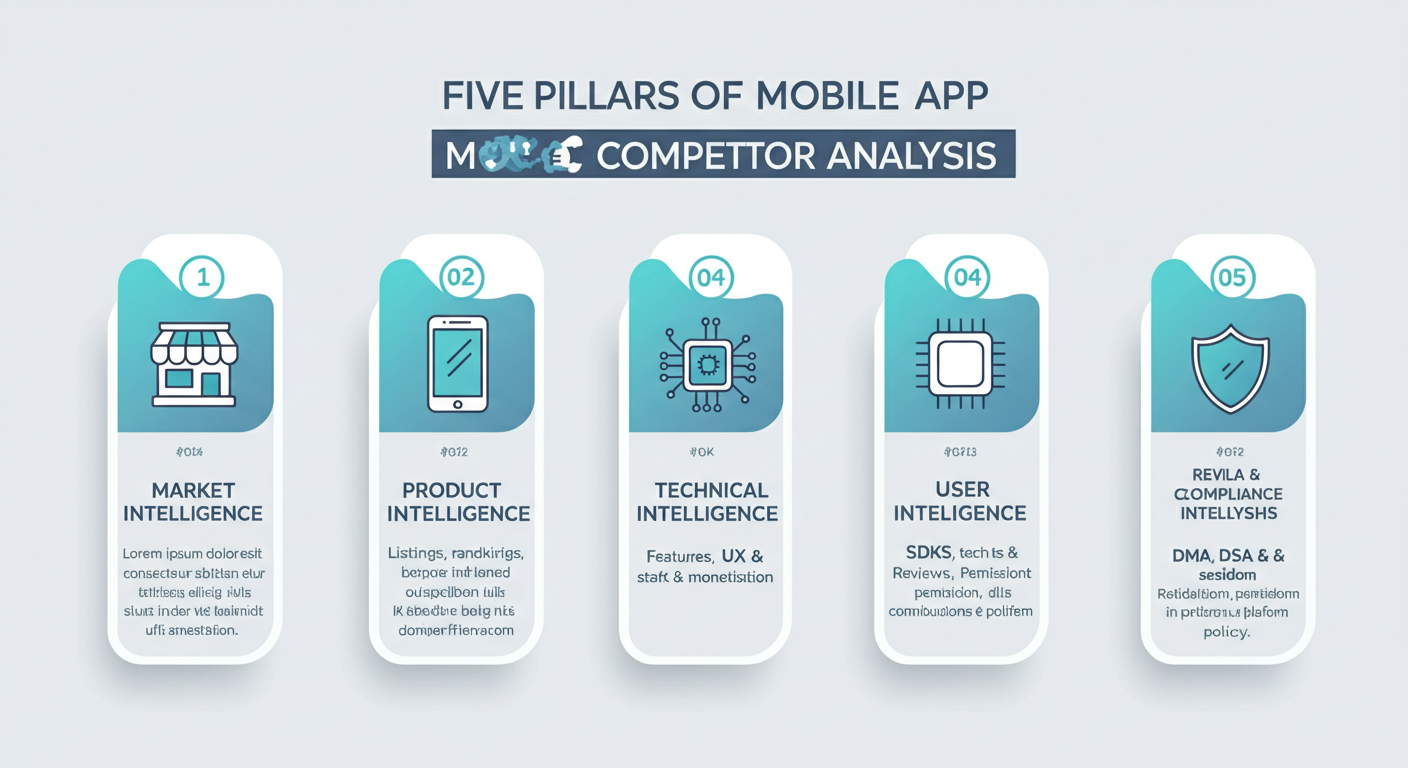
1. Market Intelligence
How the competitor positions itself in the app market: listing presentation, ranking position, category placement, and the visibility signals that reveal where they are investing in discovery.
Including:
- App Store listings
- Google Play listings
- Rankings
- Categories
- Screenshots
- Preview videos
- Localisation
- Pricing
- Release cadence
This answers:
"How does the company want users to perceive its product?"
App store optimisation tools are designed to analyse this layer: they surface keyword gaps, conversion benchmarks, metadata patterns and listing copy across competing apps. They are the starting point for market intelligence, not the end of it.
2. Product Intelligence
What users actually experience.
Including:
- Features
- User journeys
- Onboarding
- Monetisation
- Subscription models
- Accessibility
- Platform support
This answers:
"What has actually been built?"
3. Technical Intelligence
Looking beneath the interface often reveals competitive strategy long before marketing does.
Including:
- SDKs
- Analytics platforms
- Attribution providers
- AI frameworks
- Authentication providers
- Payment systems
- Messaging
- Maps
- Permissions
- Privacy declarations
Technology choices often explain product strategy.
4. User Intelligence
Users frequently explain product success before analysts do.
Evidence includes:
- Ratings
- Reviews
- Sentiment
- Feature requests
- Pain points
- Adoption signals
This answers:
"How are customers responding?"
5. Regulatory & Compliance Intelligence
This is one of the biggest changes in modern competitor analysis.
Today, organisations increasingly need to understand not only what competitors are building, but whether those products comply with rapidly evolving platform policies and legislation.
Depending on your industry, this may include:
- Digital Markets Act (DMA)
- Digital Services Act (DSA)
- UK Online Safety requirements
- AI governance
- Accessibility obligations
- Privacy disclosures
- Permission usage
- Third-party SDK compliance
- Platform policy changes
For sectors such as finance, healthcare, education and government, regulatory intelligence has become just as important as feature intelligence.
Competitor analysis is no longer only about product strategy.
It's increasingly about opportunity and risk.
The Six-Step Framework
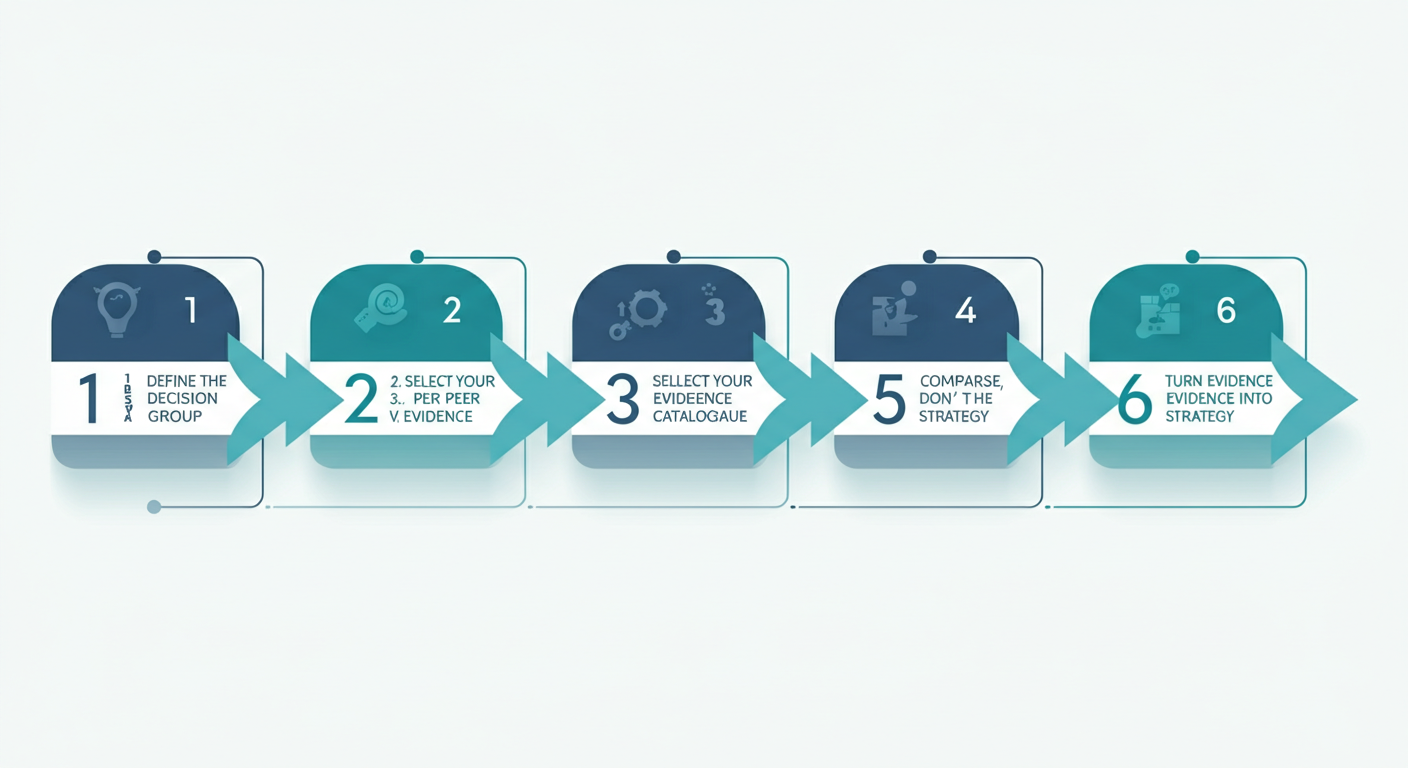
Step 1. Start With the Business Decision
Don't begin by collecting data.
Begin by defining the decision.
Examples include:
- Should we launch subscriptions?
- Should we enter Germany?
- Should we prioritise AI?
- Are competitors preparing for alternative app stores?
- Which technologies are becoming industry standards?
Every piece of evidence should support a decision.
Step 2. Select the Right Peer Group
A useful comparison normally includes:
- Direct competitors
- Category leaders
- Fast-growing challengers
- Adjacent innovators
Three carefully selected peers usually produce better insight than analysing twenty superficially.
Step 3. Collect Evidence
Gather evidence across multiple dimensions.
Market evidence
- Store listings
- Rankings
- Reviews
- Screenshots
- Release notes
Technical evidence
- SDKs
- Technology stack
- Permissions
- Privacy declarations
Business evidence
- Monetisation
- Geographic rollout
- Regulatory disclosures
- Platform support
Don't collect data.
Collect evidence.
Step 4. Compare, Don't Catalogue
Avoid writing five separate reports.
Build one comparison matrix instead.
Compare:
- Positioning
- Features
- User experience
- Technology
- SDKs
- Reviews
- Ratings
- Privacy
- Security
- Regulatory readiness
- Monetisation
- AI adoption
Patterns matter more than individual observations.
One app adopting a new AI framework is interesting.
Five competitors adopting similar technology becomes a market signal.
Step 5. Turn Evidence Into Strategy
This is where competitor analysis becomes valuable.
Executives rarely consume raw research.
They consume strategic recommendations.
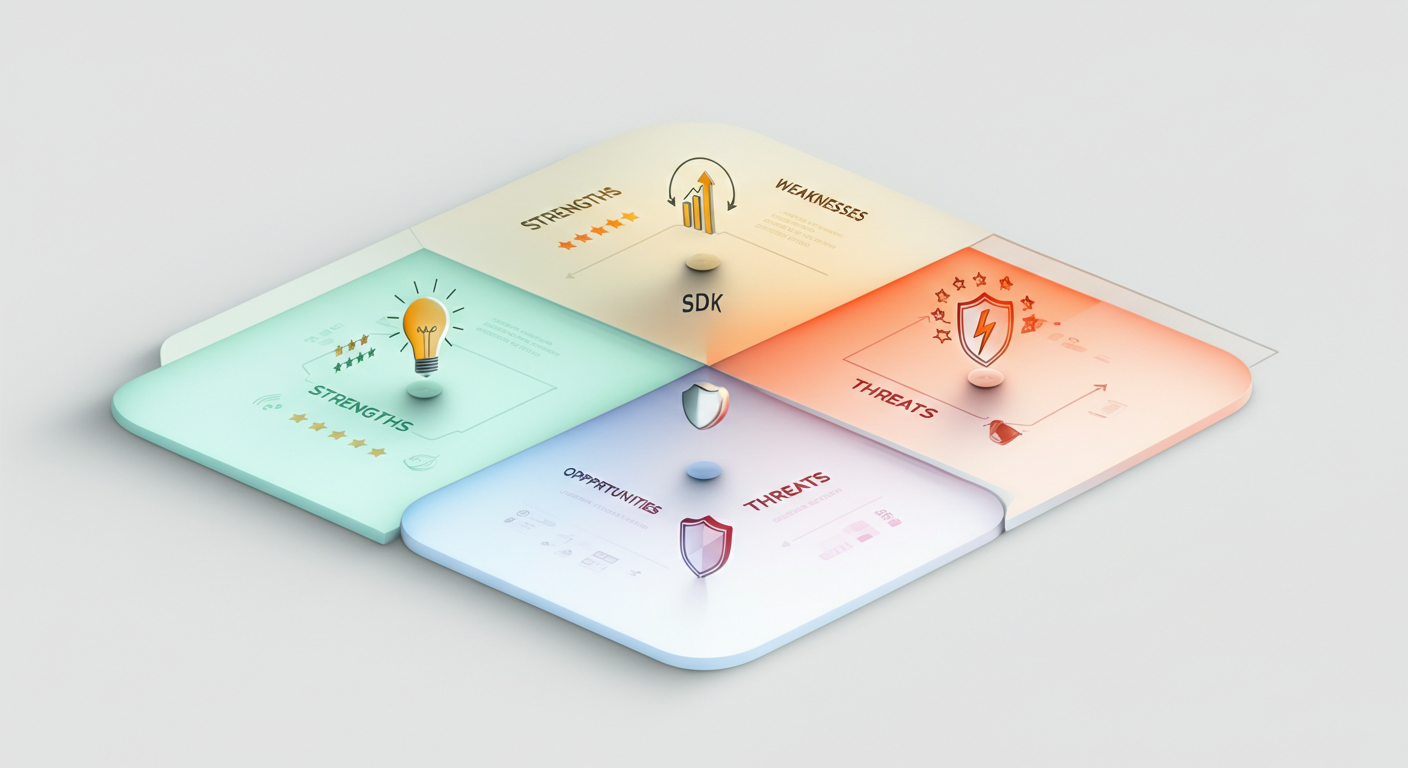
One of the most common outputs is a SWOT analysis.
The difference is that every observation should now be supported by evidence.
SWOT
Evidence Examples
Strengths
High ratings, frequent releases, positive sentiment, strong feature adoption
Weaknesses
Missing capabilities, outdated SDKs, declining reviews, accessibility issues
Opportunities
Emerging AI trends, regulatory changes, underserved markets, new platform capabilities
Threats
Fast-growing competitors, platform policy changes, compliance risks, disruptive technologies
Other strategic outputs might include:
- Product roadmaps
- Go-to-market plans
- Executive briefings
- Due diligence
- Investment assessments
- Compliance reviews
- Acquisition analysis
Competitor analysis should never end with a report.
It should end with a better decision.
Step 6. Repeat Continuously
Mobile markets don't stand still.
Neither should your competitor analysis.
New releases, changing customer sentiment, emerging AI capabilities and evolving regulations mean yesterday's analysis quickly becomes outdated.
Treat competitor intelligence as an ongoing capability rather than a quarterly project.
Manual Analysis vs Continuous Intelligence
Traditional competitor analysis is usually repeated from scratch every quarter.
- Someone downloads the apps.
- Reads the reviews.
- Captures screenshots.
- Builds a slide deck.
It works.
Until the next release.
Continuous intelligence works differently.
- Evidence is collected continuously.
- Changes are detected automatically.
- Comparisons remain current.
- Teams spend less time gathering information and more time making decisions.
Where Appnalysis Fits
Appnalysis was built around this modern workflow.
Rather than treating competitor analysis as a one-off research exercise, Appnalysis continuously combines:
- App Store intelligence
- Product intelligence
- Technical app analysis
- SDK intelligence
- Review and sentiment analysis
- Feature comparison
- Release history
- Market benchmarking
- Regulatory and compliance intelligence
The result is a living evidence base that supports product strategy, agency pitches, investment research, technical due diligence and compliance reviews.
Appnalysis is a mobile intelligence Agent. Teams can ask it questions directly through Ask Appnalysis, or connect it to Claude, ChatGPT and other AI assistants via MCP, where it runs its own reasoning across these evidence sources and returns interpreted answers rather than raw data.
Instead of asking:
"Can someone analyse these competitors?"
Teams can ask:
"Which competitors introduced AI features this quarter, what technologies did they adopt, how have users responded, and are there any emerging regulatory or compliance considerations we should be aware of?"
That is a question you can put to Appnalysis today, at Ask Appnalysis, or through your own AI assistant once connected via MCP.
Evidence-Based Competitor Analysis Checklist
Before presenting your next competitor analysis, ask yourself:
- ✓ Have I defined the business decision?
- ✓ Have I selected the right peer group?
- ✓ Have I looked beyond the App Store?
- ✓ Have I analysed technology as well as features?
- ✓ Have I considered regulations and compliance?
- ✓ Have I compared competitors rather than creating isolated reports?
- ✓ Can every recommendation be traced back to evidence?
If the answer is yes, you're no longer producing competitor reports.
You're creating decision intelligence.
Final Thoughts
Every successful app influences the market.
Today's market leader may inspire tomorrow's challenger.
Today's challenger may introduce the feature that becomes tomorrow's industry standard.
Competitor analysis isn't about copying success.
It's about understanding the decisions behind it, learning from them and building something even better for your own users.
Your competitors are also your peers.
They'll learn from your successes just as you'll learn from theirs.
The organisations that improve fastest aren't those that watch the market most aggressively.
They're the ones that learn from it most effectively.
And the future of that learning is evidence-based.
Frequently asked questions
Related reading
- Appnalysis vs Sensor Tower
- How to Get Full App Store Top 100 Data
- Application analysis versus market intelligence
- How to Build a Competitor Watchlist for Mobile Apps
- How to Use Appnalysis and Claude to Build a Competitor Watchlist
Learn more about Appnalysis
Explore how Appnalysis turns mobile app intelligence into evidence-backed answers:
- The Appnalysis platform
- What you get with Appnalysis
- Appnalysis pricing
- For agencies
- See how Appnalysis answers competitor questions
- See how Appnalysis answers competitor questions
- See how Appnalysis answers competitor questions
Tool-by-tool comparison for competitor app analysis
If you want to see how a competitor app analysis platform compares head-to-head with the incumbent, read Appnalysis vs Sensor Tower.