Agency Pitch: Free Work, LLMs, and What Only Agencies Add
The economics of agency pitches have been under quiet pressure for years and are now under visible pressure. Free research work eats billable capacity. Paid discovery phases carry real client risk. And frontier LLMs have changed what clients can do themselves before an agency conversation begins. This piece is written for both sides of the transaction: for agency practice leads working out what the pitch process should look like now, and for the clients evaluating them who want to understand what they should actually be paying for. Both sides converge on the same answer: the value agencies add is shifting from research and analysis to specialist judgment, shipping-real execution, and accountability, and the evidence that supports it needs to be produced faster and better than it was three years ago.
Every agency pitch involves free work, and the economics matter
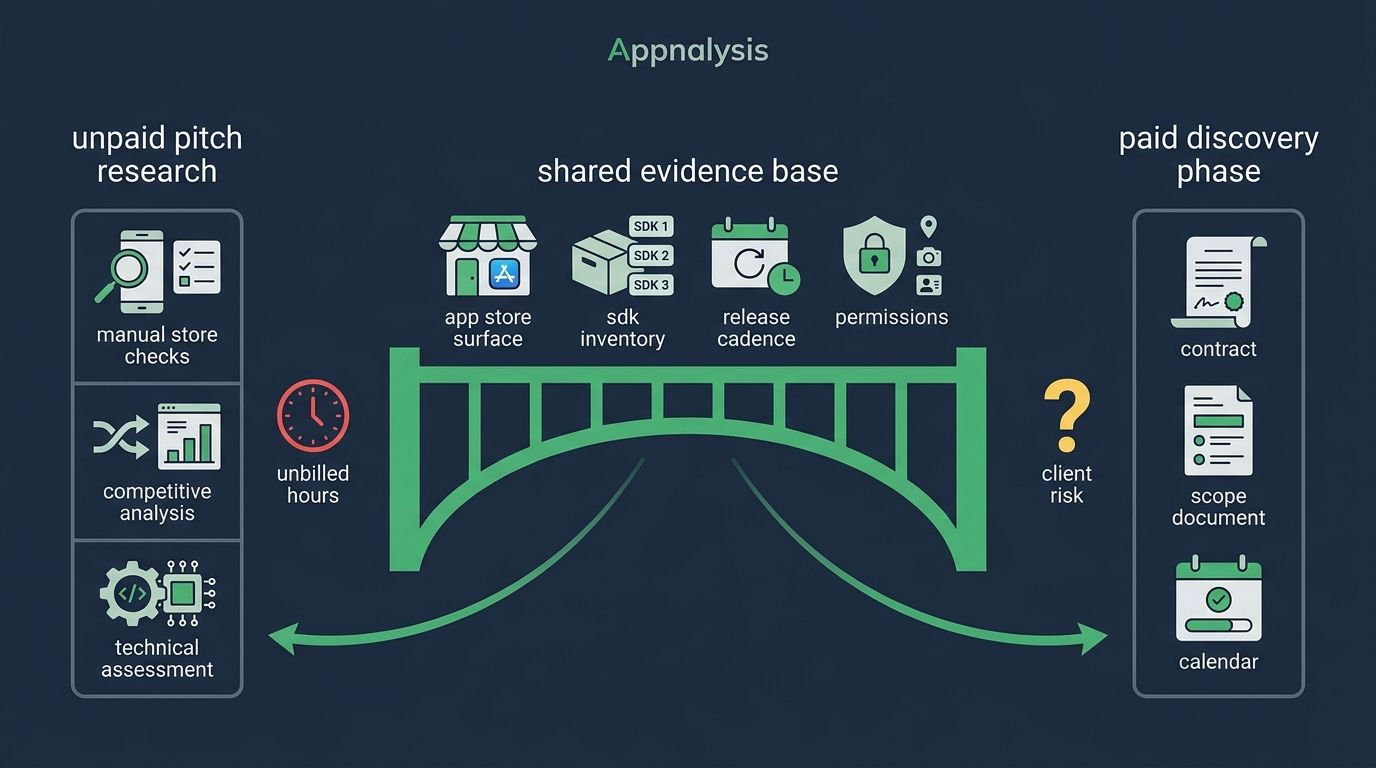
There is a truth about agency pitches that agency leads know intimately and clients rarely think about: every meaningful pitch involves unbilled research work.
The prospect calls, describes their situation, and asks for a proposal. The proposal needs to be thoughtful. The thoughtfulness comes from research. The research takes time. That time is not billable. It has to be recovered from somewhere else in the agency, which usually means the billable capacity of the people doing the pitch work.
This has always been true. Agencies have always spent unbilled time on prospects who might or might not convert. What has changed is how much research clients now expect in a pitch, how quickly they expect it, and how many other pitches an agency is likely running in parallel. The math has tightened.
The rational agency response to tightened pitch economics is not laziness. It is careful allocation of unpaid research capacity. Agencies invest more research time in pitches likely to close, less in pitches likely to shop around. Agencies invest more research time in known sectors where the research amortises across future pitches, less in unfamiliar sectors where the research is single-use. Agencies invest more research time in warm referrals with clear budget signals, less in cold RFPs that read as spec-work-in-disguise.
None of that is a criticism of agencies. It is what a well-run agency has to do to remain a going concern. But it has consequences for what pitches actually contain, and the way the agency pitch process has evolved is worth understanding for both sides of the transaction.
The agency counter-move: paid discovery, and why clients hesitate
The natural agency counter-move to unbilled pitch research is to convert unpaid discovery into paid discovery as fast as possible.
The proposal comes back with a two-phase structure. Phase one: a paid discovery, scoping or design sprint engagement. Phase two: the main build, contingent on discovery findings. This is not cynical. It is economically necessary. It converts the free-work problem into a billable phase, de-risks the agency's exposure, and gives the agency proper time to understand the problem before proposing a solution. Most established software agencies now propose some version of a paid discovery phase as the first step of any serious engagement.
Clients, reasonably, hesitate.
Paying for problem definition before committing to a build carries real risk. The discovery output might be thin, leaving the client having paid for research they cannot reuse. The discovery output might be rich but the agency turns out to be wrong for the build, meaning the client has paid for work they will need to hand to a competitor. The proposed solution might be shaped conveniently around the agency's own capabilities, meaning the client has paid to be steered toward the agency's preferred build rather than the objectively right one. And there is information asymmetry: the agency knows what a good discovery output looks like, the client mostly does not, so evaluating whether the discovery was worth the money is harder than it should be.
Both sides have legitimate concerns. Agencies aren't wrong to want paid discovery. Clients aren't wrong to hesitate. The tension is genuine.
What changes the tension is not eliminating either party's concerns. It is bringing better evidence into the room earlier, so that both the pitch conversation and the discovery conversation are conducted with a shared factual base rather than with the client dependent on the agency's account of what is knowable.
The pitch conversation has changed because of what clients can now do themselves
Everything above was already true two years ago. What changed in 2025 and accelerated through 2026 is what clients can now do before the pitch conversation begins.
A client evaluating whether to build a mobile app, or evaluating an existing app that needs work, can now use Claude, ChatGPT, Gemini or Copilot for general analysis, and Claude Code, ChatGPT Codex, Xcode coding intelligence (which supports Claude Agent, Codex and Gemini directly in the IDE), or Gemini in Android Studio for code-level work. They can produce a preliminary competitive scan of apps in their space. They can extract product patterns from screenshots or App Store listings. They can generate wireframes, mockups, sometimes working prototypes. They can draft technical specifications that read plausibly enough to a non-engineer. They can ask an LLM to critique their own product idea and get a coherent response.
The pitch used to open with the client explaining what they thought they needed and the agency doing the analytical work to sharpen or challenge that thinking. The pitch increasingly opens with the client arriving having done a version of that analytical work themselves, presenting an LLM-assisted analysis, and asking the agency to build the thing.
This is not a small shift. It changes what agencies are expected to bring to the room. Historical agency pitches leaned heavily on demonstrating research and analytical capability. If the client has already done a version of research and analysis, that demonstration lands differently. The competitive analysis the agency produced used to be a differentiator. It is now table stakes at best and potentially inferior to what the client produced with an LLM at worst.
There is a specific implication worth naming plainly. The value agencies now provide sits in specialism (sector depth, shipping-real judgment, platform politics, accountability), and specialism is only useful in the pitch conversation if the agency can bring it to bear quickly. Which means agencies increasingly need tools that let specialists produce specialist-quality output in the time available for pitch work. A senior specialist who spends three days manually gathering competitive evidence before applying their judgment is not commercially differentiated from an LLM-assisted generalist who produces plausible-looking output in three hours. A senior specialist who has evidence produced continuously and can apply their judgment to it in three hours is genuinely differentiated. Tooling that supports specialism is what makes specialism visible in the pitch, and that is a specific commercial question for agencies to answer in 2026 that was not on the agenda in 2023.
The market data on this is stark. In Ad Age's 2026 Business Forecast, several of the 100 industry leaders surveyed predicted an end to the traditional billable hour, with agencies moving upstream toward business partnering or risking replacement by in-house automation. Forrester's Predictions 2026 report projected a 15% reduction in marketing agency jobs in 2026, following continued headcount pressure through 2025. Snyk's 2023 AI Code Security Report found only 10% of developers scan most of the AI-generated code they ship, and nearly 80% admitted to bypassing security policies when using AI coding tools. The marketing-agency data is the leading edge, but software and app agencies face the same underlying pressure: prospects arriving with LLM-assisted analysis in hand, and general-purpose analytical capability becoming rentable (increasingly, tokenizable) by the month rather than something only agencies can supply.
The consequence for pitches is specific: the agency's job is no longer to be the primary source of analytical and creative capability. The client can rent that from OpenAI or Anthropic for $20 a month. The agency's job has moved somewhere else. Understanding where it moved to is the point of this piece.
What agencies actually add that frontier LLMs cannot
The old answer to "what does the agency add" was capability. Skills, tools, team members, disciplines the client didn't have in-house. Increasingly, that answer isn't good enough because a lot of that capability is now rentable by the month.
The honest answer to what agencies add in 2026 sits on two axes worth naming separately.
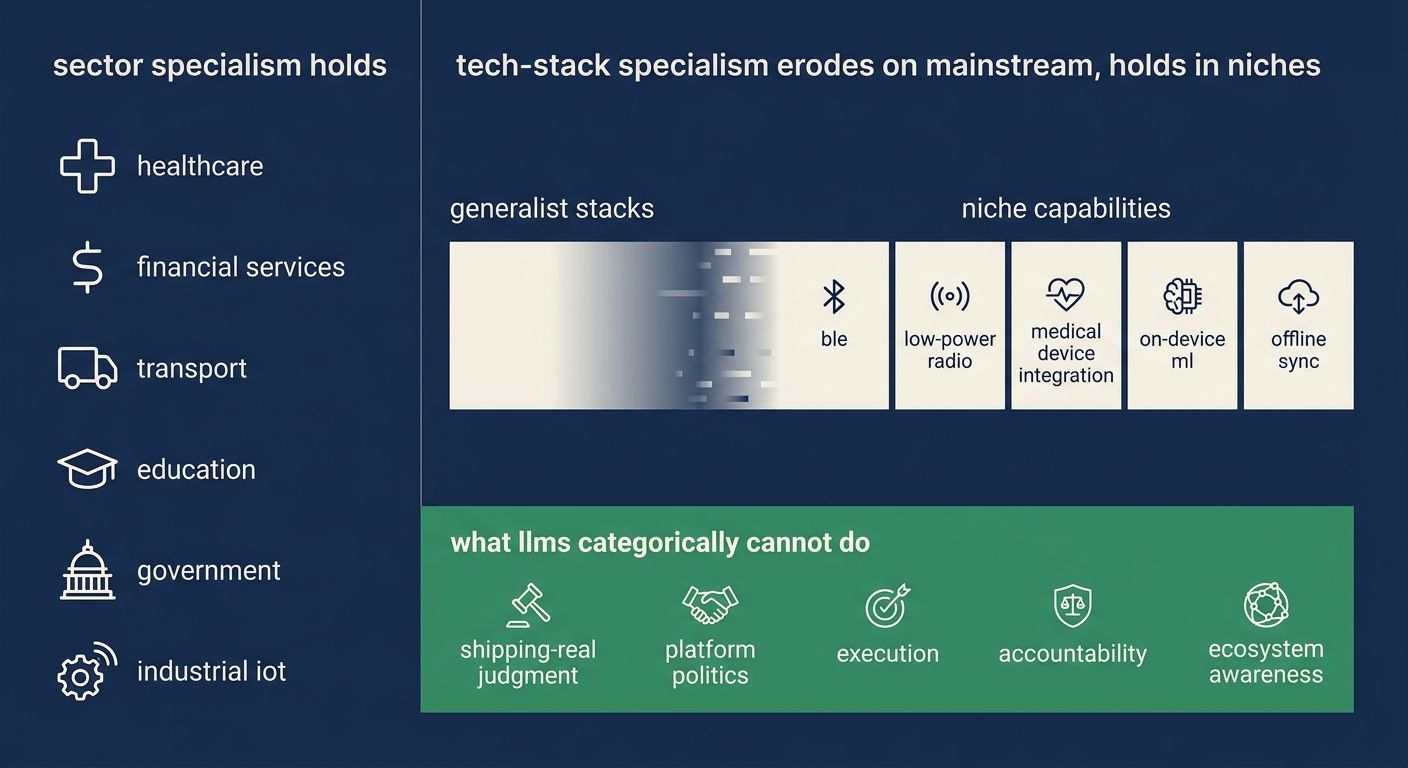
Sector specialism is holding up strongly against LLM disruption.
Sector expertise compounds in ways LLMs cannot easily replicate. An agency that has built five healthcare apps genuinely knows things a general-purpose LLM does not: HIPAA workflow nuances, patient consent patterns that actually work in practice, clinician UX conventions that survive real clinical settings, integration realities with EHR systems, MHRA and FDA app classification decisions, regulated-industry procurement politics, sector-specific vendor relationships. That knowledge lives in team members who have made mistakes in that sector and remember what worked, which is different from knowledge that lives in training data about the sector.
The same holds for financial services (regulatory approval politics, banking-integration realities, KYC and AML implementation patterns), transport (safety-critical software governance, operator relationships, procurement cycles), education (safeguarding requirements, procurement gates, evidence-of-outcomes patterns), government (procurement frameworks, security clearance, accessibility requirements above the WCAG baseline), industrial IoT (device fleets, connectivity realities, maintenance economics). These are sectors where agency specialism represents hard-won ground that LLM-assisted generalists cannot easily replicate because the knowledge exists in shipped-and-learned experience, not in training corpora.
Tech stack specialism is eroding, but not gone.
The harder half of the picture: LLMs are genuinely capable across mainstream tech stacks now. Documentation for React Native, Flutter, native iOS with Swift, native Android with Kotlin, and mainstream backend patterns is well-represented in training data. Junior and mid-level engineers punch above their weight on unfamiliar stacks with LLM assistance. The gap between "specialist agency in this stack" and "general agency using LLMs well" on pure execution is narrowing on the mainstream.
But it has not collapsed entirely. Deep tech stack specialism still matters where the stack is genuinely niche (embedded systems, specialist audio and video processing, XR platforms), where performance requirements are extreme (games, real-time financial interfaces, live video), where the platform has significant undocumented behaviour or platform politics (Apple's watchOS quirks, Android OEM fragmentation edge cases, background execution rules that shift between OS versions), and where very recent platform capabilities are involved (iOS 27 foldable-specific work for iPhone Duo, iOS accessibility APIs that just shipped, platform-specific AI capabilities). In those pockets, specialist agencies genuinely differentiate.
The deeper point about tech-stack specialism is who drives the prompts. LLM-generated code is often good, sometimes excellent, and it is limited by what the person prompting it knows to ask for. Take a concrete example: fast BLE (Bluetooth Low Energy) transport for a wearable-plus-phone product. An LLM can write the BLE connection code competently once you know exactly what you want. What it cannot do is know from experience that BLE throughput on Android below API 26 behaves differently from above, that certain phone OEMs silently degrade BLE performance during battery-saving modes, that certain wearable stacks require specific connection interval negotiation to avoid dropouts, or that a BLE sniffer trace of a working competitor product will reveal the actual over-the-air pattern faster than a week of iteration will. An engineer who has shipped multiple BLE products knows to ask for the right thing quickly, knows to reach for the BLE sniffer at the right moment, and knows which patterns work in practice. That knowledge is what the LLM cannot supply, and it is what distinguishes an experienced specialist from an LLM-assisted generalist even in a domain where the LLM writes plausible code. The same pattern holds across many technical specialisms: LLMs execute well when driven by expert prompts and struggle when the driver does not know what to ask for.
Beyond those two axes, agencies add specific capabilities LLMs categorically cannot replicate.
Judgment about shipping-real versus training-data pattern-matching. LLMs will confidently recommend patterns that don't survive contact with the App Store review process, with real users on real devices, or with the operational realities of a mobile release cadence. Agencies that have shipped know which patterns actually work and which merely sound right. This is not an abstract point. Apple blocked updates for popular vibe-coding platforms including Replit and Vibecode in March 2026, citing rules about executable code that LLMs did not know to design around. Reported incidents where AI-assisted code that looked correct in demo environments broke in production are a recurring pattern rather than isolated events, because production is not the training data.
Platform politics awareness. App Store review realities, Google Play policy nuances, platform-specific rejection patterns, review team behaviour by category, appeals processes that work versus appeals processes that waste time, developer account politics, regulatory landscape shifts that affect what platforms allow. This lives in agencies that have submitted many apps to review and learned by rejection, not in training data.
Team assembly and operational execution. LLMs generate; humans deliver. Coordinating designers, engineers, QA specialists, project managers, DevOps, security reviewers, and clients through a build cycle is not a task LLMs perform. Agencies do this and take responsibility for the delivery.
Accountability for delivery. LLMs do not sign SOWs. They do not carry professional indemnity insurance. They do not respond to production incidents at 2am. They do not stand behind delivery timelines. Agencies do.
Ecosystem awareness. Which SDK vendors are stable versus which are quietly failing. Which frameworks the market is abandoning. Which cloud services are about to change pricing. Which analytics platforms are being deprecated. Which authentication providers are worth using. This lives in continuous engagement with the ecosystem, not in a snapshot of training data.
For the underlying pattern of why LLMs specifically struggle with specialist knowledge, Your AI Coding Agent Only Sees Half the Picture covers what specialist knowledge LLMs cannot produce from training corpora alone, and why continuous evidence layers change that.
The vibe-coded prototype pattern specifically
A specific version of the client-arrives-with-work-already-done pattern is worth naming: the vibe-coded prototype.
Vibe coding, in the sense Andrej Karpathy popularised in early 2025, is building software by describing what you want to an AI tool and iterating through conversation. A founder with an app idea can now open Cursor or Replit or Claude and produce something functional within hours. The prototype runs, the demo goes well, and the founder arrives at the agency conversation with something to show rather than something to describe.
This is a genuine change in what pitches contain. Agencies increasingly encounter prospects who have vibe-coded a working prototype and are now asking for help getting it to production.
The prototype hides more than it shows. Vibe-coded apps commonly ship with authentication vulnerabilities, exposed API keys, disabled row-level security, hardcoded credentials, no error handling, no logging, no monitoring, no test coverage, and no build discipline. The prototype works in a demo environment because the demo environment is not adversarial. Production is adversarial. The prototype does not survive it.
For deeper treatment of what vibe-coded prototypes actually hide versus what they show, Vibe Coded App? Here's What You Actually Shipped covers the specific gap between what a prototype demonstrates and what production requires.
For agencies pitching against vibe-coded prototypes, the honest position is that the prototype represents genuine progress and should be respected as such. It shows the founder is serious, has invested time, and has thought through the product enough to make an LLM produce something concrete. That is not nothing. But the agency's job is to explain what needs to happen between the prototype and a shippable product, and that gap is substantial in ways the LLM did not surface for the founder.
The agencies that navigate this well treat vibe-coded prototypes as founder-articulated product specifications rather than as software that just needs polish. The specification is now clearer than it would have been from a written brief. What is required to build the real version remains substantial. The agency's job is to translate the specification into a shippable product, using specialist judgment the LLM does not have.
Why agencies really prefer referrals and known sectors, revisited
The pre-LLM version of why agencies prefer referrals and known sectors was economic: better conversion rates on referrals mean better return on unpaid pitch time, and known sectors amortise research across multiple pitches.
There is a more specific reason worth naming. Referrals win pitches quicker because the trust link is already established. A prospect arriving via referral is not evaluating whether the agency is trustworthy from a cold start; they are evaluating whether the agency is right for this specific job, with the trust question substantially pre-answered by whoever made the referral. Cold pitches have to build that trust from scratch inside the pitch itself, which is why they take longer, convert worse, and require more agency preparation to compensate for the trust gap. Trust arriving via referral is the single most valuable asset in the pitch conversation, and it is exactly the asset LLMs cannot substitute for.
The post-LLM version is stronger still. In a world where LLMs commoditise general-purpose analytical work, the things that referrals and sector-familiarity provide (trust, sector knowledge, existing relationships, shared context, recognisable outcomes) are precisely the things that LLMs cannot commoditise. Referrals and known-sector pitches are not just economically efficient. They are strategically stronger than they were, because they compound in dimensions LLMs cannot compete on.
Agencies that lean harder into their strongest sectors, invest deeply in sector-specific knowledge, and cultivate the specific relationships that produce referrals within those sectors are building around what LLMs cannot easily replicate. Agencies that spread themselves across many sectors, competing primarily on cross-sector capability, are competing on ground where LLMs are closing the gap fastest.
This is not a call to narrow radically or to reject cross-sector work. Most agencies have genuine reason to work across sectors. It is a call to be honest about where the moat actually sits and to invest accordingly. Sector depth compounds in ways general capability does not.
The evidence agencies need that isn't in an LLM's training data
The specific work agencies need to do in pitch preparation (and in paid discovery) sits in evidence that LLMs cannot produce because it is not in their training data.
Competitive intelligence about what apps in the target sector actually ship, right now, not what apps in the sector shipped when the LLM was trained. Which competitors ship what features, which SDKs they use, which permissions they request, how their release cadences run, how their Data Safety declarations compare, which platforms they've deprecated support for, which markets they're active in. This is observable outside-in evidence about the shipping present, not statistical pattern-matching from historic training data.
Technical assessment of the prospect's own current app if they have one. What SDK inventory does it ship, what permissions does it request, what OS versions does it support, what release cadence does it run, what is its store standing history, are its declarations consistent across platforms. Again, this is observable evidence about the actual app, not general knowledge about what apps in the sector tend to do.
Sector benchmarks from current shipping reality. Not "typical patterns in healthcare mobile apps according to training data circa mid-2024" but "here is what the top ten healthcare apps in this specific market are actually shipping now, with source-linked evidence". The distinction between statistical pattern-matching and observable current reality is the distinction between what an LLM can produce and what evidence-layer tools can produce.
For the underlying two-lens framing that distinguishes first-party analytics from outside-in evidence, Product Intelligence for Mobile Apps: The Two Lenses covers the pattern in depth. For the wider tools landscape across mobile app intelligence categories, Market Intelligence Tools for Mobile Apps covers what tools serve which specific questions.
The commercial point matters here: when an agency arrives at a pitch with current outside-in evidence about the prospect's competitive space, the agency's specialist judgment gets applied to observable current facts rather than to LLM-generated inferences. That difference lands hard in a pitch because prospects who have used LLMs themselves recognise the difference between statistical pattern-matching and observable evidence. The pattern-matching sounds plausible. The evidence is verifiable. Verifiable beats plausible in a pitch every time.
What changes when the evidence layer exists before the pitch conversation begins
Everything above converges on a specific observation about how pitches change when agencies have outside-in evidence about mobile apps already produced rather than needing to research it fresh each time.
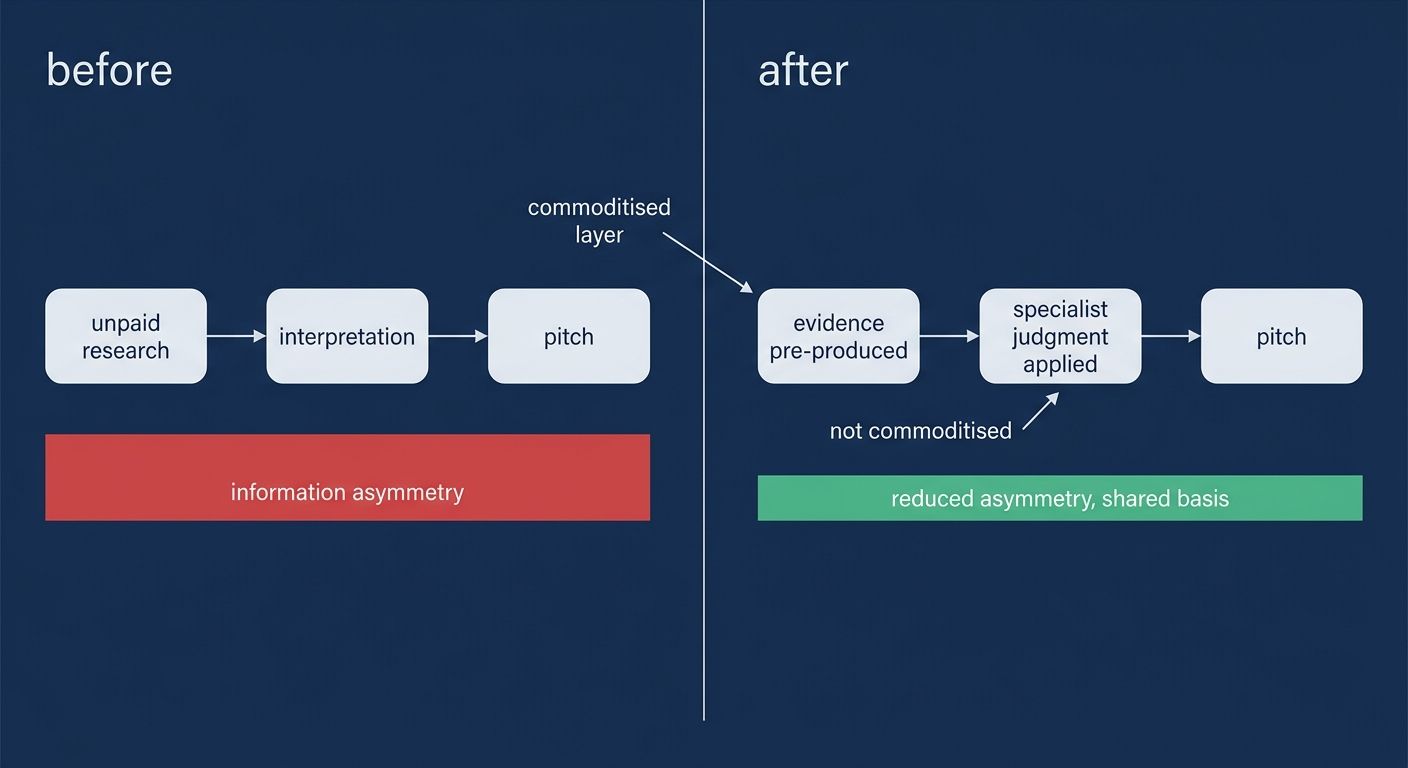
Free work reduces. The competitive research that used to eat unbilled hours is already available. The tech stack assessment of the prospect's own app is already available. The sector patterns are already visible. Pitch preparation shifts from data gathering to interpretation and framing.
Paid discovery becomes richer, not thinner. The agency arrives at discovery with the technical landscape already mapped. Discovery time is spent on strategy, judgment, sector-specific interpretation, and the parts of the problem that only agency specialism can answer. Clients get more value from the paid discovery because more of the paid time goes to work that only humans can do.
Client information asymmetry reduces. Clients who see the same evidence base the agency has can evaluate the agency's discovery output more confidently. They can ask better questions. They can push back on inferences that don't hold. They can also recognise which parts of the discovery output represent genuine specialist judgment that they could not have produced themselves.
Agency differentiation from LLM-produced advice becomes concrete. When the agency's proposal draws on observable current evidence and applies specialist sector judgment to it, and the client's LLM-produced analysis draws on training data, the difference in quality is visible in the outputs, not just claimed in the pitch. That difference lands.
Agency-client trust builds faster. Both sides operating from a shared factual base is fundamentally different from the client relying on the agency's account of what is knowable. It removes the information-asymmetry hesitation that makes paid discovery feel risky. It shifts the conversation from "trust us to research this well" to "here is the evidence, here is our interpretation, here are the questions we can help answer that the evidence alone cannot".
For the specific evidence-layer approach that supports this shift, Competitor App Analysis: A Practical Mobile Guide and The Case for Not Looking at Your Competitors cover the adjacent framing about what competitive research is genuinely useful for and what it is not.
As a body of app store research and mobile app benchmarking evidence becomes routinely available to agencies before pitch work begins, the pitch economics shift in a specific way. Not by making pitches free (they will not be) or by eliminating discovery (it should not be eliminated) but by changing where in the process the highest-value human work happens. The evidence-gathering commoditises. The interpretation and judgment does not.
The agency RFP question
Formal RFP processes deserve their own note because they are where the pitch-economics tension hits hardest.
The traditional RFP frustration for agencies is well-documented: substantial unpaid response effort, thin information provided by the client, requirements written by procurement teams disconnected from the actual buyers, evaluation criteria weighted heavily toward price, and a high risk that the client is genuinely price-shopping rather than genuinely evaluating.
LLM disruption adds a specific new twist. Client procurement teams can now generate more comprehensive-looking RFP documents faster, ask for more detailed responses because the RFP-drafting effort dropped, and expect faster turnaround because they know agencies can use LLMs to draft responses. The RFP process has become simultaneously easier to run (from the client side) and more onerous to respond to (from the agency side). Neither side is wrong about their side of that trade.
The evidence-layer question in RFPs is specifically useful. RFPs increasingly ask for competitive context, technical assessment of the client's current systems, sector-specific commentary, and evidenced claims about what the agency understands about the client's space. Agencies that can produce these responses from actual outside-in evidence rather than from LLM-produced inference stand out substantively. Agencies that respond with LLM-drafted content look like everyone else, because everyone else is doing the same thing.
For agencies deciding which RFPs are worth responding to, the evidence-availability question is a useful filter. RFPs where the agency already has evidence about the client's sector are worth substantive response effort. RFPs in unfamiliar sectors where the agency would need to build evidence from scratch have worse pitch economics than they did before, because the LLM-assisted competition can produce plausible responses without doing the underlying work.
What this doesn't change
An honest article about what agencies add in 2026 requires an honest note about what none of this changes.
People buy from people. This is well documented in decades of B2B sales research, and it has not stopped being true because LLMs arrived. Pitches are ultimately won by human agencies presenting to human buyers, and the human relationship carries more weight than the analytical output produced along the way. Judgment still matters and always has. Storytelling in pitches still matters. Chemistry between agency and client still matters, and often decides pitches at least as much as capability does. Relationships built over time still convert. Price positioning still matters, especially against the LLM-produced alternative. Reference calls with existing clients still carry weight. Being genuinely nice to work with still matters. The ability to disagree with a client productively still matters.
What has changed is not the fact that people buy from people. What has changed is the economics around that fact. Agencies used to be able to justify substantial unpaid pitch preparation on the assumption that the human relationship plus the analytical output together would win the pitch. Now the analytical output part is decreasingly a differentiator, so the economics of pitch preparation have to be justified differently. The human relationship still wins the pitch, but the analytical work that used to accompany it and demonstrate the agency's value has to either shift into paid discovery, get produced from evidence tooling at a fraction of the historical unpaid cost, or be honestly acknowledged as no longer the primary differentiator it was.
None of the human factors are technology. Technology changes what agencies compete on. It does not change what makes agencies win pitches once the technology-mediated shortlist is set.
Everything in this piece assumes agencies are good at the human parts of agency work. It focuses on the technology-mediated parts because those are what has visibly shifted. The human parts have not shifted, and agencies who are good at them will continue to win pitches on the strength of that, evidence-layer tooling or not.
What this means, for agencies and for the clients evaluating them
The two audiences this piece has addressed converge on the same conclusion, from different angles.
For agency practice leads: the free-work-plus-paid-discovery-plus-LLM-disruption combination is real and structural, not cyclical. The rational responses are to invest deeper in sector specialism (which compounds), to accept that pure tech-stack specialism is eroding on the mainstream (and to focus tech-stack investment on niches where it still differentiates), to build evidence capability that produces observable current facts about the sectors you serve (so pitch preparation and paid discovery both improve), and to be honest with clients about what agency work actually is now versus what it used to be. The old pitch script (we will research this, we will produce a comprehensive analysis, we will show you what we found) is being commoditised. The new pitch position (we already have the evidence, we bring specialist judgment about what it means, we take accountability for the delivery) works better.
For clients evaluating agencies: understand what you are actually paying for. You are increasingly not paying for research and analysis, which LLMs commoditise. You are paying for specialist judgment about which sector-specific realities matter, shipping-real experience about what actually works in production, platform politics awareness, execution capability, and accountability for delivery. Evaluate agencies on those axes rather than on whether their competitive analysis looks impressive (yours might too, if you asked Claude the right questions). Paid discovery becomes less risky when you can see the same evidence the agency has and can evaluate the interpretation independently. Ask agencies what evidence they will bring to the discovery, not just what deliverables it will produce.
Both sides benefit from evidence that reduces information asymmetry. Neither side benefits from the pretence that agencies are the primary source of research and analysis, because that pretence is decreasingly true and prospects who have used LLMs know it.
How Appnalysis fits, for agencies and for the clients evaluating them
Appnalysis produces continuous outside-in evidence about mobile apps: competitive intelligence about what apps in a sector actually ship, technical assessment of specific apps from their App Store and Play Store surface plus package-level analysis, SDK inventory, permission scope, release cadence, cross-platform declaration consistency, and the specific evidence categories agencies need to walk into pitches with observable current facts rather than statistical inference.
For agencies, Appnalysis changes the pitch-preparation economics. The competitive research is produced continuously and accessible in minutes rather than gathered manually across days. The technical assessment of a prospect's app can be run before the first pitch call. The sector benchmarks are available across the categories the agency serves. Time that used to go to data gathering can go to specialist interpretation and pitch framing. Paid discovery becomes an interpretation exercise supported by evidence rather than a scramble to gather it.
For the /agencies audience specifically, the Appnalysis /agencies page covers the agency-facing use cases in more operational depth than this piece can.
For clients evaluating agencies, Appnalysis is available to you too. You can see the same evidence base your agency partner sees, which reduces the information asymmetry that makes paid discovery feel risky. You can evaluate whether an agency's discovery output represents genuine specialist interpretation or is essentially re-presenting evidence you could have seen yourself. Both applications point toward the same commercial pattern: the discipline of paying for judgment and execution rather than for research and analysis works better for everyone when the underlying evidence base is shared.
The aim, over time, is to provide for mobile apps what Bloomberg provides for financial markets: an aggregated evidence layer that turns scattered signals into an interrogable resource, so that specialist judgment gets applied to observable current facts rather than to inference or memory. That ambition is being built rather than complete, but it is the direction the pitch economics point toward.
This piece sits alongside a broader argument about how the software industry is developing evidence and accountability infrastructure. For that wider treatment, Software Is Growing Up. Now the Institutions Are Arriving. covers the institutional pattern this specific agency-pitch shift is one instance of.
Continue the conversation
If you're an agency lead working out how pitch preparation should evolve, or a client trying to evaluate what agency work should look like now, get in touch.
Frequently Asked Questions
Related Reading
- Your AI Coding Agent Only Sees Half the Picture - the specialist-knowledge argument LLMs cannot replicate
- Vibe Coded App? Here's What You Actually Shipped - what vibe-coded prototypes hide versus what they show
- Product Intelligence for Mobile Apps: The Two Lenses - the outside-in evidence framing this piece builds on
- Competitor App Analysis: A Practical Mobile Guide - the deeper competitor analysis methodology
- The Case for Not Looking at Your Competitors - adjacent framing on what competitive research is actually useful for
- Market Intelligence Tools for Mobile Apps - the wider tools landscape
- Software Is Growing Up. Now the Institutions Are Arriving. - the wider pattern this agency-pitch shift is one instance of