Market Intelligence Tools for Mobile Apps: A Guide
Market intelligence tools, competitive intelligence tools, and mobile app intelligence are three overlapping but distinct categories that answer different questions for mobile teams. This guide compares the tools landscape for mobile apps specifically: which category answers which question, which tools operate in each category, and where the recognisable names sit. The comparison sits under [What is Mobile App Intelligence](https://info.appnalysis.com/insights/what-is-mobile-app-intelligence) as the category definition. This article covers the tools underneath it.
Mobile teams doing competitive research quickly discover that the tools landscape uses overlapping vocabulary in ways that are genuinely confusing. Market intelligence, competitive intelligence, and mobile app intelligence are three related but distinct disciplines, each with its own tool category, and the vocabulary is used inconsistently across vendors. Some tools claim to cover all three. Some tools specialise in one and adjacent-mention the others in their marketing. Some tools have vocabulary that suggests broad coverage but capability that is narrow.
This guide compares the tools landscape for mobile apps specifically. The comparison covers which category answers which question, which tools operate in each category, and where the recognisable names actually sit. The categorisation is honest about what each tool actually does rather than what its marketing implies, and it names both the generalist tools that cover multiple industries and the mobile-specific tools that focus on the mobile app market.
The article is aimed at product managers, product marketing managers, competitive intelligence analysts, agency practice leads, and mobile team leads evaluating tools for competitive and market research work. Different roles will find different sections most useful depending on which specific decision is under review.
How the Three Categories Relate
Market intelligence, competitive intelligence, and mobile app intelligence sit as three related disciplines with distinct focus areas. The definitions matter because tools in each category answer different questions and the wrong tool for a specific question produces incomplete answers regardless of how comprehensive the tool is within its own category.
Market intelligence tools focus on the market as a whole: category size, category growth patterns, segment definitions, customer demographics across a market, competitive dynamics at industry level. Market intelligence work informs decisions about which markets to enter, which segments to target, how the wider market is evolving, and where the strategic opportunities sit. Recognisable tools in this space include Statista, Euromonitor, Coresignal, and various market research firms that produce category-level reports and datasets.
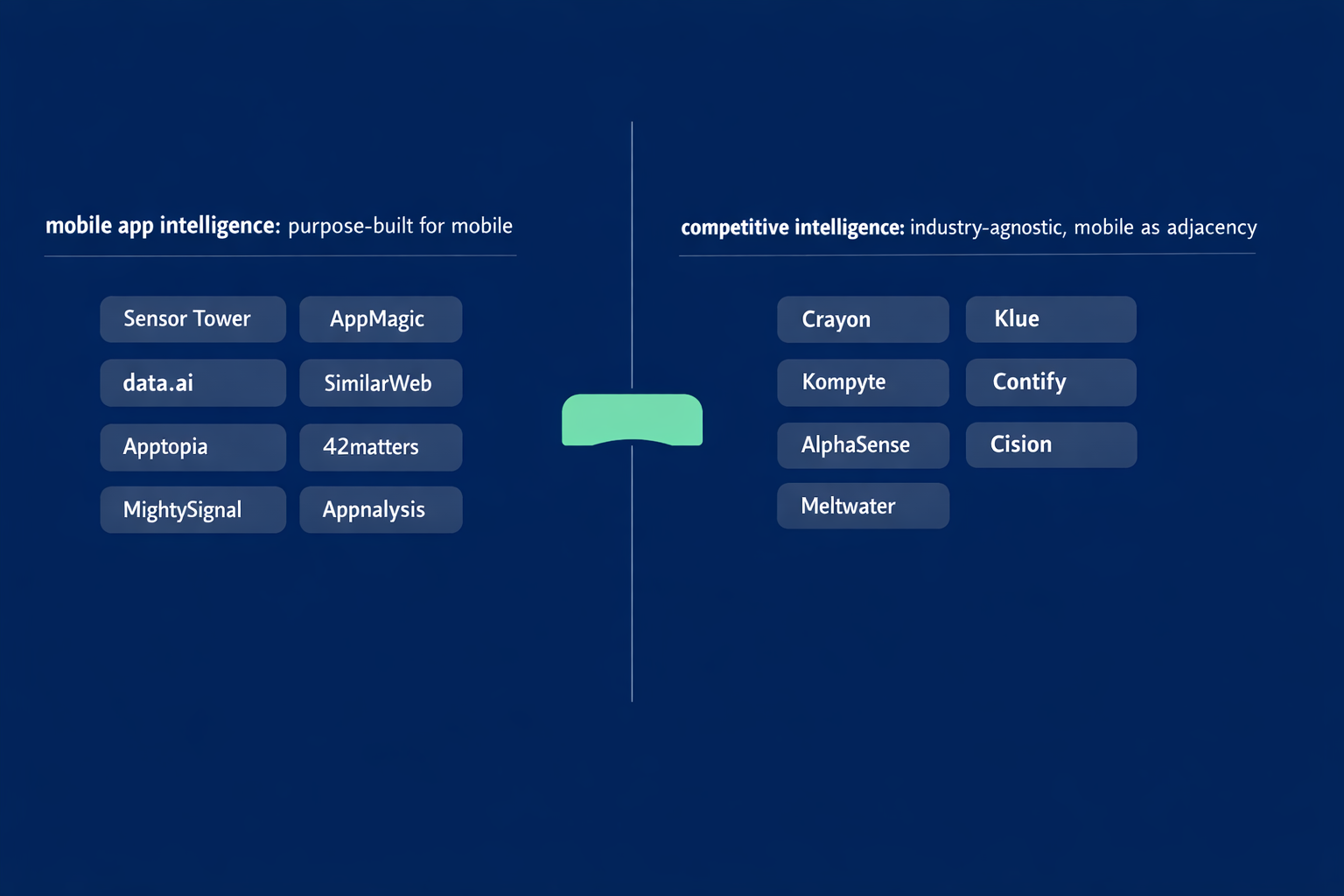
Competitive intelligence tools focus on specific competitors: what they are launching, what they are pricing, what their positioning is, what they are saying in public communications, what their partnership patterns are. Competitive intelligence work informs decisions about how to position against specific rivals, how to respond to competitor moves, and how to spot early signals of competitor strategy shifts. Recognisable tools in this space include Crayon, Klue, Kompyte, Contify, AlphaSense, Cision, and Meltwater. Most of these are industry-agnostic rather than mobile-specific.
Mobile app intelligence tools focus specifically on the mobile app market: what apps are shipping, what their store performance looks like, what their SDK footprints contain, what their compliance posture is, what their release cadence patterns show. Mobile app intelligence work informs decisions specific to the mobile app market and mobile product decisions that generic competitive or market intelligence tools do not address. Recognisable tools in this space include Sensor Tower, AppMagic, data.ai (formerly App Annie), SimilarWeb (for mobile-adjacent data), Apptopia, 42matters, MightySignal, and Appnalysis.
The three categories overlap in specific places. A mobile app intelligence tool that includes category-level data functions partly as market intelligence for the mobile app market. A competitive intelligence tool that covers a specific competitor's mobile app functions partly as mobile app intelligence for that specific competitor. The overlap is real but the specialisation matters: tools designed primarily for one category typically produce deeper output within that category than tools that cover it as an adjacency.
| Category | Primary question | Tool examples | Typical output |
|---|---|---|---|
| Market intelligence | What is the market doing overall | Statista Euromonitor Coresignal | Category reports and datasets |
| Competitive intelligence | What are specific competitors doing | Crayon Klue Kompyte Contify AlphaSense | Competitor briefs and battle cards |
| Mobile app intelligence | What are shipping apps actually doing | Sensor Tower AppMagic data.ai Apptopia Appnalysis 42matters MightySignal | App-level and category-level mobile data |
For a deeper definition of mobile app intelligence as a discipline, see [What is Mobile App Intelligence](https://info.appnalysis.com/insights/what-is-mobile-app-intelligence).
The Main Tools Compared
The tools landscape for mobile app competitive and market intelligence includes both mobile-specific specialists and generalist competitive intelligence platforms that cover mobile as an adjacency. The comparison below covers the recognisable tools mobile teams typically evaluate, organised by which category each tool primarily operates in and what specific mobile-related output it produces.
| Tool | Category focus | Mobile-specific capability | Typical user | Notes |
|---|---|---|---|---|
| Sensor Tower | Mobile app intelligence | Store performance estimates category rankings ad intelligence | App publishers marketing teams | Longest-established mobile intelligence provider |
| AppMagic | Mobile app intelligence | Store performance category rankings publisher data | App publishers marketing teams | Independent alternative to Sensor Tower |
| data.ai (formerly App Annie) | Mobile app intelligence | Store performance and market insights | Publishers analysts | Repositioned from App Annie brand |
| SimilarWeb | Mobile and web intelligence | App store rankings and traffic estimates | Marketing analytics | Web-first tool with mobile app coverage added |
| Apptopia | Mobile app intelligence | SDK and audience data | Product marketing | Product-adjacent SDK data |
| 42matters | Mobile app intelligence | SDK inventory and app metadata | Ad tech partnerships | SDK intelligence specialist |
| MightySignal | Mobile app intelligence | SDK inventory and technographics | Sales intelligence | SDK-focused for sales use cases |
| Appnalysis | Mobile app intelligence | Store-surface evidence plus package-level analysis | Product managers analysts | Bloomberg-for-mobile-apps positioning |
| Crayon | Competitive intelligence | Industry-agnostic mobile as one channel | Product marketing | Not mobile-specific |
| Klue | Competitive intelligence | Industry-agnostic battle cards | Sales enablement | Not mobile-specific |
| Kompyte | Competitive intelligence | Industry-agnostic monitoring | Product marketing | Not mobile-specific |
Being direct about what the table shows: the mobile app intelligence category has multiple tools competing on adjacent slices of the same underlying evidence surface. Sensor Tower, AppMagic, and data.ai lead on store performance estimates and category rankings. Apptopia, 42matters, and MightySignal focus on SDK and technographic data. Appnalysis focuses on outside-in evidence covering both store-surface signals and deeper package-level analysis. SimilarWeb covers mobile as an adjacent capability to its primary web intelligence focus. The generalist competitive intelligence tools (Crayon, Klue, Kompyte) cover mobile as one of many channels rather than as a specialisation.
For competitive and market intelligence work on mobile apps specifically, mobile-specific tools typically produce deeper and more current output than generalist competitive intelligence tools. Teams doing broader competitive intelligence work across multiple channels often use a generalist tool plus one or more mobile specialists as complementary sources.
Best Competitive Intelligence Tools for Mobile Apps
"Best" depends on what the mobile team is trying to answer. Different teams evaluating competitive intelligence tools for mobile apps face different specific questions, and the best tool for each depends on which specific evidence the team needs and how that evidence is used.
For teams wanting store performance benchmarks (downloads, revenue estimates, category rankings) across the mobile app market, the mobile-specific tools that lead the store performance category are Sensor Tower, AppMagic, and data.ai. Each has different data collection methodology, different geographic coverage strengths, and different pricing structures. Teams typically evaluate one or two of these based on which specific data they need most.
For teams wanting SDK and technographic evidence (what SDKs are shipping in which apps, which frameworks are being adopted, which integration patterns are emerging), the mobile-specific tools that specialise in this data are Apptopia, 42matters, MightySignal, and Appnalysis. Each has different depth and different focus. Apptopia and 42matters emphasise SDK inventory. MightySignal leans toward sales intelligence use cases. Appnalysis covers SDK inventory as part of a broader outside-in evidence surface that includes Data Safety declarations, permission scope, and compliance patterns.
For teams wanting competitor tracking (specific competitor releases, positioning, messaging, partnership announcements) across multiple channels including mobile, the generalist competitive intelligence tools (Crayon, Klue, Kompyte, Contify) are typically stronger than mobile specialists because they are purpose-built for the competitor tracking use case across channels. Teams typically pair a generalist competitive intelligence tool with one or more mobile specialists.
For teams wanting mobile market intelligence at category level (how a specific mobile category is evolving, what patterns are emerging across shipping apps, how compliance and product decisions are being made across the category), the mobile-specific tools that produce category-level intelligence rather than just app-level data include Sensor Tower, data.ai for their category reports, and Appnalysis for its outside-in evidence across categories.
The honest evaluation criteria that matter across all four use cases include: data freshness (how recent the underlying data is), category coverage (which mobile app categories are covered well versus superficially), geographic coverage (which stores and regions are included), pricing model (subscription structure and cost scaling), integration capability (whether the tool integrates with existing analytics and workflow tools), and evidence transparency (whether the tool shows what its data actually says versus presenting interpretations). Different tools score differently on each criterion, and the best tool for a specific team depends on which criteria matter most for the specific decisions the team is making.
SimilarWeb Alternatives for Mobile Apps
SimilarWeb is a widely recognised name in the competitive intelligence and market intelligence space, with strong web analytics roots and mobile app coverage added over time. Teams evaluating SimilarWeb often want to understand what alternatives exist specifically for mobile app intelligence use cases, because SimilarWeb's mobile coverage is adjacent to its primary web intelligence focus rather than being its main specialisation.
For mobile-specific alternatives to SimilarWeb, the main options are:
Sensor Tower, AppMagic, and data.ai for store performance estimates, category rankings, and mobile market data. These are purpose-built for the mobile app market rather than web-first with mobile added.
Apptopia, 42matters, and MightySignal for SDK and technographic data specifically. These focus on mobile app package-level evidence rather than traffic estimates.
Appnalysis for outside-in evidence covering both store-surface signals and deeper package-level analysis, positioned as the mobile app intelligence equivalent of financial data providers.
For a specific comparison of Appnalysis and SimilarWeb for mobile app intelligence use cases, see [Appnalysis vs SimilarWeb](https://info.appnalysis.com/appnalysis-vs-similarweb) for the deep-dive on the differences.
The right SimilarWeb alternative depends on the specific mobile intelligence use case. Teams wanting mobile-first store performance data typically evaluate Sensor Tower, AppMagic, and data.ai. Teams wanting SDK and technographic evidence typically evaluate Apptopia, 42matters, or MightySignal. Teams wanting broad outside-in mobile evidence with both store-surface and package-level coverage typically evaluate Appnalysis.
Competitive Intelligence Reports for Mobile App Teams
Competitive intelligence output for mobile app teams typically comes in two shapes: report-shape output (periodic deliverables covering a specific market or competitor at a point in time) and continuous-monitoring output (ongoing feeds that surface changes as they happen). Both have legitimate use cases and most mature competitive intelligence functions use both.
Report-shape output works well for strategic planning cycles, quarterly business reviews, annual market planning, and specific competitor deep-dives. Reports produce comprehensive coverage of a specific topic at a specific point in time. The trade-off is that reports capture the market or competitor at a moment and become progressively less current as time passes from publication.
Continuous-monitoring output works well for tactical response, product marketing enablement, and early signal detection on competitor moves. Continuous feeds surface changes as they happen, keeping the team informed without requiring periodic manual research effort. The trade-off is that continuous output produces high volume that requires filtering and interpretation to convert into actionable intelligence.
For mobile app teams specifically, the balance between report and continuous output depends on the team's decision cadence and the specific intelligence work being done. Teams making strategic decisions on annual cycles benefit from strong report output. Teams responding to competitor releases and market moves benefit from continuous monitoring. Teams doing both need tools that produce both shapes of output or a combination of tools that cover the two shapes.
The tools referenced in earlier sections vary in their output shapes. Sensor Tower and data.ai produce both report output (their published market reports) and continuous dashboard access. Crayon and Klue focus more on continuous monitoring with battle card synthesis. Appnalysis produces continuous outside-in evidence with the option to synthesise into report-shape output for specific research questions.
How Appnalysis Fits Into the Tools Landscape
Appnalysis is Bloomberg for mobile apps. Serious mobile intelligence work has needed an aggregated intelligence layer for years, and the fragmented state of mobile market evidence has held the discipline back. Appnalysis produces that layer for mobile the way Bloomberg produces it for financial markets: aggregating signals that were previously scattered, giving analysts and researchers a workable interface to interrogate them, and making systematic mobile intelligence possible at speeds that manual research cannot match.
Within the tools landscape described above, Appnalysis sits in the mobile app intelligence category with a specific position: outside-in evidence covering both store-surface signals and deeper package-level analysis, useful for competitive intelligence work on mobile apps and for market intelligence work on the mobile app market.
Two categories of Appnalysis output matter for the tools landscape comparison.
App Store Intelligence covers the continuous outside-in evidence layer: release cadence and version notes across categories, Data Safety and privacy label declaration patterns, permission requests as declared at store level, review patterns and sentiment shifts, developer response behaviour, and store standing changes over time. This layer overlaps with what Sensor Tower, AppMagic, and data.ai produce on store performance and market data, with the specific difference that Appnalysis reads the store surface directly rather than estimating from panel data or aggregated download signals.
App Intelligence covers the deeper package-level evidence: SDK inventory verification, subprocessor mapping from shipped SDKs, and deep permission analysis. This layer overlaps with what Apptopia, 42matters, and MightySignal produce on SDK data, with the specific difference that Appnalysis covers SDK inventory as part of a broader evidence surface rather than as a specialised standalone product.
For teams using AI-assisted research workflows (Claude Code, Cursor, or other agents with MCP configured), Appnalysis is available as a knowledge specialist that agents can query directly during research work. That pattern is covered in more depth in [Your AI Coding Agent Only Sees Half the Picture](https://info.appnalysis.com/insights/ai-coding-agent-mcp-knowledge-specialists).
One thing worth naming about the tools landscape overall. No single tool covers every competitive and market intelligence question a mobile team might have. Mature teams use combinations: a generalist competitive intelligence tool for cross-channel competitor tracking, one or more mobile-specific tools for store performance and market data, and a tool for SDK and package-level evidence. The specific combination depends on the team's use cases, budget, and integration requirements.
Try the Tools on a Specific Question
The fastest way to evaluate whether a specific tool addresses your team's mobile intelligence needs is to run a specific question through it that matches your actual research work. Bring a specific competitor, a specific category, or a specific technology adoption question you are trying to answer.
For outside-in mobile evidence at the level described throughout this article, the Appnalysis platform is designed for direct query on specific research questions.
Frequently Asked Questions
Related Reading
- What is Mobile App Intelligence - the category definition hub this article sits under
- Appnalysis vs SimilarWeb - the SimilarWeb-specific comparison spoke
- Mobile Thought Leadership Research: What Changes When You Read the Apps - sibling article in the content-and-research cluster
- Mobile App Metrics That Inform Training and Capability Planning - sibling article on metrics benchmarking for capability decisions
- Technical Due Diligence Checklist: Mobile Apps, No Source - the transaction-time application of mobile app intelligence
- Vendor Risk Assessment for Mobile SDKs Without Waiting on the Vendor - the SDK-focused governance application
- Compliance Comparison: What Mobile App Security Testing Cannot Cover - the compliance-focused governance application
- Your AI Coding Agent Only Sees Half the Picture - how Appnalysis works with AI-assisted research workflows via MCP