Compliance Automation Software for Mobile Apps
Compliance automation software for mobile apps sits at a specific gap in the compliance tooling landscape. GRC platforms handle workflow, framework mapping, and audit orchestration well. What they typically do not produce is the underlying evidence about mobile apps that compliance work depends on. This article covers what compliance automation looks like when it starts from continuous outside-in evidence rather than point-in-time collection: how it changes audit readiness, where it fits alongside existing GRC investment, and what mobile teams should look for in evidence-layer tooling.
Compliance automation as a category has grown fast in the last five years. GRC platforms including Vanta, Drata, Sprinto, Hyperproof, OneTrust, and Anecdotes have made SOC 2, ISO 27001, and privacy framework work substantially more manageable than the spreadsheet-and-Slack approach many organisations used before. The workflow orchestration is genuinely better, the framework mapping is genuinely useful, and the audit preparation experience has been transformed for teams that adopted these platforms.
What compliance automation software has not solved is the evidence problem for mobile apps specifically. GRC platforms structure how compliance work happens, but the actual evidence about mobile apps (what SDKs shipped in the latest build, what Data Safety declarations match or diverge from observable technical evidence, what permission scope changed in the last release, what compliance-relevant patterns exist across the app portfolio) still gets collected through periodic reviews, spot checks, or manual data pulls by the mobile team. The workflow is automated. The evidence collection often is not.
This article covers what changes when compliance automation software starts from continuous outside-in evidence rather than periodic collection cycles. The article is aimed at compliance function leads, information security leaders, mobile team leads, and agency compliance practitioners working on SOC 2, ISO 27001, GDPR, CCPA, or equivalent frameworks for organisations with mobile app portfolios. It covers the two-layer picture (workflow layer plus evidence layer), the specific mobile evidence categories that matter, and how to think about tooling choices when your organisation has already invested in a GRC platform.
How Compliance Automation Works Today
Compliance automation software today is organised around a specific model: periodic evidence collection tied to a compliance framework, workflow orchestration to coordinate the collection, and audit output at the end of each cycle. Vanta, Drata, Sprinto, Hyperproof, OneTrust, and similar platforms all follow variations of this pattern. Frameworks (SOC 2, ISO 27001, HIPAA, PCI, GDPR) get mapped to controls. Controls get mapped to evidence requirements. Evidence gets collected through automated integrations where possible and through manual upload or checklist responses where not. The platform tracks progress, flags gaps, and produces audit-ready output.
That model works well for cloud-based and SaaS-based evidence collection because the source systems have APIs the platforms can integrate with. Cloud provider configurations, identity provider settings, endpoint management state, CI/CD pipeline metadata: all of it sits behind APIs that a compliance automation platform can pull from continuously. The evidence layer is largely solved for cloud infrastructure because the source data is programmatically accessible.
Mobile apps are different. The evidence relevant to mobile compliance (Data Safety declarations, privacy label accuracy, SDK and third-party inventory, permission scope changes, release cadence, store enforcement history) does not sit behind APIs the compliance platform can integrate with. It sits in the shipped app package and on the app store surface. Compliance automation platforms handle it through a specific mechanism: the mobile team gets an evidence request in the questionnaire pattern covered in the SDK case, fills it in on a cycle, and the platform records the response as evidence. The same shape applies across mobile compliance evidence more generally.
Two things follow from this. First, the evidence produced this way is point-in-time snapshots rather than continuous coverage: whatever the mobile team recorded on the day they completed the periodic review is what the platform has, and anything that changed the day after does not appear until the next cycle. Second, the accuracy depends entirely on the mobile team's ability to answer accurately about a moving product across every SDK, every permission, and every release: a genuinely hard task at scale that legitimately fails from time to time. Neither is a criticism of the compliance platform; it is a limitation of what compliance platforms can collect through the workflow layer alone. The compliance automation software market is genuinely valuable for what it does; the evidence layer for mobile specifically is where a gap exists.
For the wider context on how compliance and legal debt accumulate when evidence collection is periodic rather than continuous, Everyone Talks About Technical Debt. Nobody Talks About Legal Debt covers the accumulation pattern.
Continuous Compliance as the Alternative Model
Continuous compliance is the term the market uses for the alternative to periodic evidence collection. Rather than snapshotting evidence at cycle boundaries, continuous compliance means gathering evidence about the actual state of systems on an ongoing basis, so the evidence base reflects current reality rather than the last time somebody completed a periodic review. The compliance judgement itself still sits with the organisation's compliance and legal function; what changes is the freshness and completeness of the evidence base they work from.
For cloud infrastructure, continuous compliance is well established. Configuration drift detection, real-time posture monitoring, and continuous control validation are standard features of the leading cloud security platforms. Compliance automation platforms integrate with these tools and pull continuous evidence for cloud controls automatically.
For mobile apps, continuous compliance requires a different mechanism because the evidence source is different. The shipped app package on the app store is the primary evidence source, and continuous compliance monitoring for mobile app portfolios means reading the app store surface and the packages themselves on an ongoing basis. Continuous compliance evidence for mobile app portfolios covers release cadence tracking (what shipped when, with what version notes), Data Safety and privacy declaration changes, permission scope changes across versions, SDK inventory changes, store standing changes, and review sentiment shifts that might signal compliance-relevant user experience issues.
The output of this continuous evidence work is not a report at a cycle boundary. It is a continuously updated evidence base about the app portfolio, with change events surfaced as they happen. That output feeds into whatever compliance workflow the organisation runs (whether that is a GRC platform, an internal tracking system, or an audit prep exercise), providing the evidence layer that the workflow layer depends on but does not produce itself.
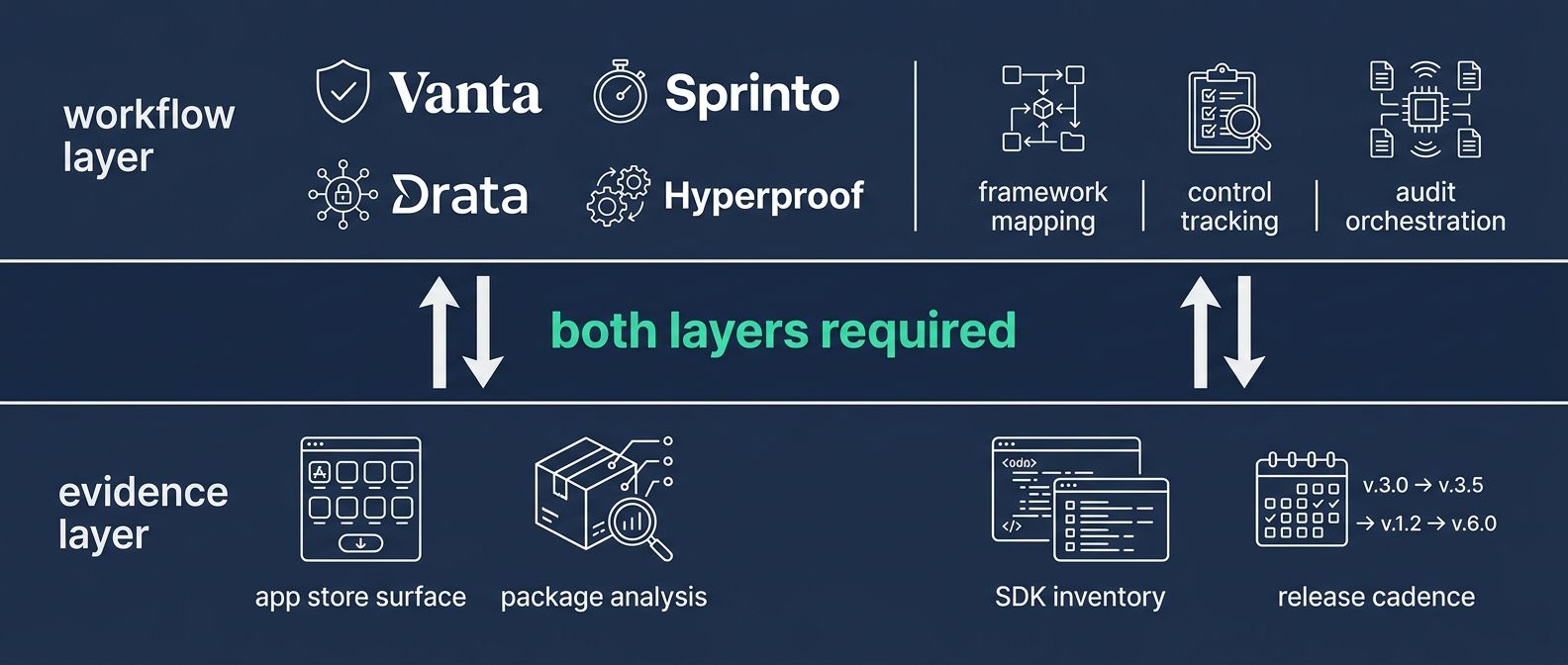
The distinction between workflow layer and evidence layer matters because they solve different problems and both need solving. The workflow layer coordinates the work: what needs collecting, who collects it, how it gets reviewed, when it is audit-ready. The evidence layer produces the observable facts: what shipped, what was declared, what changed, and where the evidence does not appear to line up. Continuous compliance for mobile apps means the evidence layer runs continuously rather than at cycle boundaries, feeding the workflow layer with current-state signal rather than snapshots. This is the specific application of compliance monitoring principles to a data source (the shipped app package and app store surface) that does not sit behind APIs the platform can integrate with.
For the specific relationship between mobile app compliance and security testing (which covers a different but adjacent evidence category), Compliance Comparison: What Mobile App Security Testing Cannot Cover covers what security testing produces versus what compliance evidence requires.
Where the Evidence Layer Stops
Continuous outside-in evidence can establish a great deal about a mobile application without requiring access to source code or internal systems. It can show what an app publicly declares, which technologies and permissions are observable, what changes between releases, how iOS and Android differ, and where the evidence appears inconsistent.
But evidence is not the same as a compliance conclusion.
Some facts exist only inside the organisation. A technical signal cannot by itself establish why personal data is processed, how long it is retained, the contractual role of a third party, whether a particular SDK capability is enabled in a specific user journey, or which legal basis the organisation relies on. Continuous evidence tells you what shipped and what changed; it does not tell you which of those changes matter legally in your specific business context.
That creates three distinct layers of compliance work worth naming explicitly:
| Layer | What it answers | Typical examples |
|---|---|---|
| Outside-in evidence | What can we observe? | App-store declarations, SDK presence, permissions, release changes, platform differences, store history |
| Organisation context | Why does it operate this way? | Processing purpose, retention, hosting, contractual relationships, internal procedures, planned territories, AI use |
| Legal interpretation | What does that mean legally? | Applicable obligations, controller/processor roles, adequacy of consent, contractual remediation, regulatory exposure |
The goal of compliance automation should not be to collapse these three layers into an automated compliance verdict. It should automate the first layer wherever possible, identify the questions that genuinely need answers from the organisation, and give compliance and legal specialists a better evidence base on which to make their assessment.
That changes the role of periodic review too. Instead of repeatedly asking mobile teams for facts that can already be observed from the shipped application, periodic reviews can concentrate on the organisational context that cannot be obtained from the outside: processing purpose, retention decisions, contractual arrangements, internal procedures, planned territorial expansion, AI feature use. The result is not less human involvement in compliance work. It is better-targeted human involvement, supported by better evidence, with legal interpretation still sitting where it belongs.
Audit Readiness Through Continuous Evidence
Audit readiness is the state where an organisation can produce, at short notice, the evidence auditors will ask for across the compliance frameworks the organisation is certified against. Audit readiness typically deteriorates between audits (evidence goes stale, controls drift, documentation lags) and gets restored through intense pre-audit preparation cycles. Most compliance functions know the pattern.
The pre-audit sprint exists because periodic evidence collection produces predictable gaps. The last comprehensive evidence collection was months ago. Since then apps have shipped, SDKs have been added or removed, Data Safety declarations may or may not have been updated to reflect observable behaviour, permission scope has probably changed. All of this needs surfacing, documenting, and evidencing before the auditors arrive. The pre-audit sprint is the compensation mechanism for the continuous coverage gap between cycles.
Continuous evidence changes this experience. When the evidence layer runs continuously, audit readiness becomes a state the organisation maintains rather than a state it periodically restores. The evidence auditors ask for exists in current form because it has been gathered on an ongoing basis. The pre-audit sprint reduces to reviewing what already exists rather than scrambling to produce what does not.
For mobile apps specifically, continuous audit readiness covers several concrete categories. Release history with version notes and version diffs, so questions about "when did this change" have direct answers. Data Safety and privacy label declarations tracked over time, so divergence from observable technical evidence surfaces before it becomes an audit finding. SDK inventory changes documented, so third-party and potential subprocessor questions can be investigated from current evidence. Permission scope evolution across versions, so changes that may affect transparency, permission or consent requirements can be identified for review. Store standing history, so questions about enforcement actions or policy issues have a documented answer.
Pre-audit work does not disappear entirely under continuous evidence: interpretation, narrative context, and organisational documentation still need doing before auditors arrive. What changes is that the evidence itself exists rather than needing to be reconstructed. The pre-audit phase becomes about presentation and narrative rather than about last-minute evidence collection. That is genuinely different from the current experience most compliance functions have.
For the wider treatment of how to structure a mobile compliance approach across the audit cycle, Roadmap: Getting Your Mobile Compliance Right covers the structural framework compliance leads can use.
Change-Triggered Legal Readiness
Compliance work has historically had a calendar trigger: annual audits, quarterly reviews, framework recertification cycles. That trigger works for the parts of compliance that genuinely follow a calendar. It works less well for the parts that follow the product.
A new SDK arriving in a shipped app is a moment when the compliance and legal team may need to look again: is this SDK's operator a party that requires contractual arrangements, does its presence change the third-party picture, does its declared purpose appear consistent with the observable implementation and the organisation's stated use of it. A new permission being requested is another such moment. A new territory being launched into. A new subscription model being introduced. A new AI feature being rolled out. A material change to a Data Safety declaration. Each of these is a product change that could carry compliance implications, and none of them align with the audit calendar.
The gap between the compliance calendar and the product calendar is where compliance debt accumulates. The paperwork and the app drift apart between audits, and the drift only surfaces at the next cycle. Continuous evidence with change detection turns this from a periodic reconciliation problem into a change-triggered review workflow: when something material changes in the shipped product, the compliance and legal team knows about it in time to decide whether it needs a closer look.
Compliance should not only have a calendar trigger. It should also have a product-change trigger, and the evidence layer is what makes the product-change trigger possible for mobile apps specifically. This is different work from audit preparation and belongs alongside it rather than replacing it. Both matter; historically only the calendar trigger has been resourced.
What Evidence Compliance Automation Should Collect for Mobile Apps
Compliance automation for mobile apps needs specific evidence categories that map to the questions frameworks actually ask. Not every category matters for every framework, but the shape of what continuous mobile compliance evidence produces is worth naming concretely.
Data Safety and privacy label declarations. Both Google Play (Data Safety) and Apple App Store (Privacy Labels) require developers to provide accurate declarations about what data an app collects, how it uses the data, and which third parties receive it. These declarations are the anchor for GDPR, CCPA, and many sectoral privacy compliance questions. Continuous evidence tracks the declared state over time, flags changes, and can compare declarations against observable package-level indicators (which SDKs are present, which permissions are requested, which sensitive APIs are used) to surface whether the declarations appear consistent with the observable evidence. Establishing that a declaration is legally correct in a specific business context sits with the organisation and its legal function; establishing whether the declaration appears consistent with observable technical evidence is what continuous outside-in analysis can do.
SDK inventory and third-party review. The SDKs shipped in an app are candidate third parties that may require contractual or subprocessor arrangements. SDK presence identifies a party worth investigating; it does not by itself establish that personal data is being transmitted to that party, what data is transmitted, or whether the entity is legally acting as a processor, subprocessor, controller, or in some other role. Google's own SDK and Data Safety guidance acknowledges that data handling depends on the SDK's specific implementation and configuration. Continuous evidence produces the observable SDK inventory from the shipped package (not from what the mobile team remembered to declare in the compliance platform) and identifies the operating entities for each SDK, giving the compliance and legal function the technical fact pack needed to determine the actual contractual and subprocessor picture. Changes over time show which SDK candidates were added, dropped, or upgraded, feeding version-controlled documentation of what changed and when.
Permission scope changes. What permissions the app requests, and which of those permissions are marked as required versus recommended, sits in the shipped app manifest as declared evidence. Permission changes can trigger questions about necessity, transparency, and, where applicable, consent or other user authorisation, depending on the framework and jurisdiction that apply. Google distinguishes permissions and sensitive APIs that require particular disclosure and consent treatment from permissions generally. Continuous evidence tracks permission scope over time and surfaces changes for review before they create implications the compliance and legal team was not expecting.
Release cadence and version notes. Release history with version notes provides the audit trail for compliance-relevant changes. When the compliance team needs to answer "when did we start collecting this data" or "when did we stop supporting this feature", version history is the evidence source. Continuous coverage means the history exists automatically rather than needing reconstruction from the mobile team's memory or the version control system.
Store standing and enforcement history. Store enforcement actions, policy warnings, and rejection reasons form part of the compliance risk picture. Continuous tracking surfaces these events as they happen, which matters both for immediate response and for pattern analysis (are certain compliance issues recurring across the portfolio, are certain categories of app more exposed).
Cross-platform declaration consistency. For apps shipping on both stores, declarations for the same underlying data practices are worth comparing across iOS and Android. Divergence between the two platforms is a useful review signal: it may reflect legitimate platform differences (Apple and Google's declaration models are not identical), or it may expose a declaration, implementation, or documentation inconsistency that genuinely needs resolving. Continuous evidence surfaces divergence automatically for the compliance and legal team to review, rather than requiring the mobile team to spot it during periodic reviews.
These evidence categories feed the workflow layer that compliance automation platforms provide. The platforms handle the framework mapping, control tracking, and audit orchestration. The evidence layer produces the observable facts that the workflow layer records against controls. For teams doing due diligence on mobile apps in transaction contexts, Technical Due Diligence Checklist: Mobile Apps, No Source covers the specific application of similar evidence to transaction-time review.
SOC 2 Automation and Framework-Specific Evidence
SOC 2 has become the default compliance framework for many software organisations, and SOC 2 automation is a well-defined category within compliance automation software. The workflow layer handling of SOC 2 is mature: GRC platforms map SOC 2 Trust Services Criteria to evidence requirements, orchestrate collection, and produce audit-ready output for the auditor.
The evidence layer for SOC 2 has cloud infrastructure well covered through the API integrations described earlier. The evidence layer for mobile apps within SOC 2 is where continuous outside-in evidence contributes specifically. SOC 2 controls covering data classification, change management, and vendor management all touch questions where mobile app evidence matters: what data the app collects, what changed between releases that might affect the control environment, which third-party services the app depends on. Specific control mappings depend on the SOC 2 Trust Services Criteria version and points of focus that apply to the organisation, which is a question for the SOC practitioner supporting the engagement rather than one this article should attempt to prescribe.
For SOC 2 audit preparation on organisations with mobile app portfolios, continuous evidence supports specific auditor questions: "show us the SDK inventory across your production apps at the point of the audit period", "show us the Data Safety declarations for the reporting period and any changes during the period", "show us the release history for the mobile apps in scope with version notes for material changes". These questions are auditable through continuous evidence in a way that periodic collection often struggles with because the evidence is available in current form rather than needing reconstruction.
ISO 27001 automation follows a similar pattern. Specific Annex A control mappings depend on the edition of the standard and the organisational scope of certification; the general point is that ISO 27001 controls covering asset management, supplier relationships, and system acquisition all touch mobile app evidence questions where continuous coverage supports the audit response better than periodic collection. Which specific controls apply and how they map to mobile evidence is a question for the ISO practitioner or lead auditor supporting the engagement.
GDPR compliance automation is a specific case worth naming. GDPR Article 30 records of processing require documentation of processing activities, categories of data, and subprocessor arrangements, all of which draw on the mobile evidence categories described in the previous section. Continuous evidence produces the observable facts that Article 30 records rely on, though determining which SDKs actually operate as subprocessors in the legal sense remains an organisational and legal question rather than a technical one. Data subject access request (DSAR) responses under GDPR Article 15 require the organisation to identify all processing of the subject's data across systems including mobile apps, which again benefits from knowing what apps process data, which SDKs are present, and what declarations exist.
The framework-specific application is not exhaustive here (many other frameworks map to mobile evidence categories similarly), but the pattern generalises. Continuous evidence about mobile apps feeds framework-specific control responses, and the workflow layer's framework mapping determines which specific evidence categories matter most for which specific control responses.
Where Compliance Automation Software Fits Alongside GRC Platforms
The positioning question that matters for teams evaluating tooling is not "compliance automation software OR GRC platform" but "how does compliance automation software fit into the compliance workflow the organisation runs". The answer is different depending on where the organisation currently sits.
Organisations with a mature GRC platform investment. These organisations already have Vanta, Drata, Sprinto, Hyperproof, OneTrust, or equivalent running the workflow layer. Adding continuous mobile evidence means feeding the existing platform with better mobile-specific evidence rather than replacing it. The GRC platform continues to handle framework mapping, control tracking, and audit orchestration. The evidence layer for mobile apps runs alongside and feeds evidence into the platform for the relevant controls. Third-party risk work for mobile SDKs specifically continues to sit in the platform, with continuous evidence supporting the vendor and subprocessor documentation the platform tracks (see the vendor risk assessment article linked earlier for the specific SDK case).
Organisations without a mature GRC platform investment. These organisations may be running compliance work through spreadsheets, Notion, internal tools, or a lighter-weight framework. Continuous mobile evidence is directly consumable through evidence libraries or documentation systems, and can inform decisions about which workflow layer to adopt (GRC platform choice is a separate decision from evidence layer choice, and better evidence supports better platform selection).
Organisations evaluating GRC platform choice. Continuous evidence about mobile apps is worth including in the evaluation because different platforms handle mobile evidence integration differently. Some platforms integrate well with external evidence sources for continuous feeding. Others expect all evidence to originate within the platform through their own collectors. That difference matters for organisations with substantial mobile portfolios because the evidence layer needs somewhere to feed.
The compliance workflow is what mature organisations run to structure compliance work: framework selection, control mapping, evidence collection, gap remediation, audit preparation, ongoing monitoring. The evidence layer sits underneath the workflow, providing the observable facts the workflow orchestrates. Compliance automation software that treats these as separate concerns (workflow layer vs evidence layer) fits better into mature GRC environments than software that attempts to bundle both.
How Appnalysis Fits Into Compliance Automation for Mobile Apps
The aim is to do for mobile apps what Bloomberg did for financial markets: turn scattered evidence into one interrogable layer. Mobile compliance work has lacked an aggregated evidence layer, leaving relevant signals fragmented across app stores, shipped packages, internal teams, and periodic reviews. Appnalysis is building that layer specifically for the evidence categories compliance work depends on: aggregating outside-in signals from those scattered sources, giving compliance leads a workable interface to interrogate current observable state, and making continuous compliance evidence possible at speeds that periodic collection cannot match. The compliance and legal interpretation of that evidence continues to sit with the organisation and its specialists; what Appnalysis produces is the observable technical fact pack that interpretation works from.
For the compliance automation use cases described throughout this article, two Appnalysis tiers matter.
App Store Intelligence covers the continuous outside-in evidence layer relevant to most compliance work: release cadence tracking with version notes, Data Safety and privacy declaration monitoring across apps and over time, permission scope tracking, review sentiment and developer response patterns that may signal compliance-adjacent user experience issues, and store standing history. Most of the compliance evidence categories described in section 6 operate at this tier. The audit readiness pattern uses this tier as its primary evidence source, as does the change-triggered legal readiness workflow.
App Intelligence covers the deeper package-level evidence for specific compliance questions: SDK inventory verification from the observable shipped package (not the declared inventory), SDK operator identification to support third-party and subprocessor review, deep permission analysis, and technology fingerprinting. The SDK evidence category in section 6 operates at this tier, as does the cross-platform declaration consistency check that requires deep package analysis on both stores.
Appnalysis is positioned as a complement to GRC platforms and to specialist legal and compliance advice, rather than as a replacement for either. The workflow layer stays where the organisation has invested (Vanta, Drata, Sprinto, Hyperproof, OneTrust, or equivalent). The legal interpretation stays with the organisation's legal and compliance function or its external advisers. The evidence layer for mobile compliance runs from Appnalysis and feeds observable technical facts into both. That separation of concerns is deliberate: workflow layer investment is substantial and should not be disrupted, legal interpretation is specialist work that should not be automated, and evidence layer work is different from both.
For teams using AI-assisted research workflows (Claude Code, Cursor, or other agents with MCP configured), Appnalysis is available as a knowledge specialist that agents can query directly during compliance research work. See Your AI Coding Agent Only Sees Half the Picture for the MCP integration pattern.
Start Your Compliance Evidence Work
The fastest way to evaluate continuous mobile evidence for your compliance work is to run a specific evidence check on an app in your portfolio. Bring one app and one specific compliance question (Data Safety declaration accuracy, SDK inventory verification, permission scope changes across recent releases), and see what the evidence surface returns compared with what your current compliance platform has recorded.
Frequently Asked Questions
Related Reading
- Vendor Risk Assessment for Mobile SDKs Without Waiting on the Vendor - the SDK-focused compliance evidence application
- Compliance Comparison: What Mobile App Security Testing Cannot Cover - the security testing versus compliance evidence distinction
- Technical Due Diligence Checklist: Mobile Apps, No Source - the transaction-time application of similar evidence
- Shadow IT Discovery for Mobile Apps - governance cluster piece on portfolio discovery
- Everyone Talks About Technical Debt. Nobody Talks About Legal Debt - the accumulation pattern for compliance and legal debt
- Roadmap: Getting Your Mobile Compliance Right - the structural framework for compliance leads
- Your AI Coding Agent Only Sees Half the Picture - how Appnalysis works with AI-assisted workflows via MCP