Shadow IT Discovery for Mobile Apps: A Guide
Enterprise IT teams typically discover they own more mobile apps than the central IT function has recorded. Shadow IT discovery for mobile apps means finding the apps that exist under corporate branding, ex-employee developer accounts, regional teams, and agency arrangements that were never formally handed back. This article covers how mobile app discovery works in practice, the specific mechanisms that surface forgotten apps, and how enterprise IT teams should think about the ongoing discipline of maintaining mobile app portfolio visibility.
Enterprise IT teams doing formal audit or compliance work regularly discover that their organisation owns more mobile apps than the central IT function has recorded. The pattern is common enough to be a category of problem worth naming: mobile app portfolios accumulate over time through subsidiary acquisitions, regional teams commissioning agency work, marketing campaigns that produced dedicated apps, product experiments that shipped and were forgotten, and developer accounts that were set up by employees who have since left the organisation. The central IT function typically has visibility into the officially sanctioned mobile apps but limited visibility into everything else that exists under corporate branding on the App Store and Google Play.
This article covers shadow IT discovery for mobile apps specifically. Enterprise IT teams doing audit and visibility work on their mobile portfolios need concrete discovery mechanisms, and the specific ways mobile apps become invisible to central IT are different from the ways SaaS applications become invisible to central IT. The article is aimed at CIOs, IT directors, mobile programme managers, compliance function leads, and IT audit teams doing enterprise mobile portfolio discovery work.
Shadow IT in general is a well-covered discipline focused mostly on SaaS applications, unauthorised cloud services, and unmanaged developer tools. Mobile shadow IT is a specific subset that has different discovery mechanisms because mobile apps live on public app stores rather than in cloud infrastructure. The app stores themselves are the primary discovery surface, and the mechanisms for finding apps that belong to your organisation but are not in your central inventory are different from the network-analysis mechanisms typical shadow IT discovery tools use for cloud services.
One current factor makes the discipline more urgent than it was even two years ago: AI-assisted app development (often called vibe coding) has collapsed the cost, time, and skill floor of creating a functional mobile app. A marketing manager can produce a working app in a weekend using Claude Code, Cursor, or similar AI coding tools. A regional team can ship an app in a fortnight rather than a quarter. Someone without a formal mobile development background can now create apps that would previously have required a professional developer or agency engagement.
The forces pushing toward dedicated mobile experiences have gotten harder for central IT to contain. Marketing teams, event teams, product marketing, regional teams, and business units increasingly want dedicated apps for specific campaigns, events, product launches, or customer segments because customisation and on-message content produces better engagement and better business outcomes than generic cross-purpose solutions. That demand is legitimate. Historically, central IT could contain it by pointing at development capacity constraints and cost thresholds, forcing generic solutions or declining requests entirely. Vibe coding has removed the cost and capacity constraint that made that containment work. The business units wanting dedicated mobile experiences now have both the motivation and the capability to build them without central IT approval. Shadow IT accumulation from this pressure is not just a governance failure. It is the operational consequence of legitimate business demand meeting newly available capability, and the discovery discipline this article covers is a response to that reality rather than a claim that prevention through stronger governance is fully achievable.
That shift accelerates the rate at which shadow IT mobile apps get created, expands the population of people in an organisation capable of creating them, and typically bypasses the traditional budget-and-approval workflows that historically gave central IT some visibility into mobile projects. Discovery cycles designed for a slower-app-creation era catch less of the shadow IT before it becomes established.
What Shadow IT Discovery Means for Mobile Apps
Shadow IT discovery is the systematic identification of technology assets that an organisation uses or owns but that are not tracked in the central IT inventory. It sits as a specific application of the broader IT asset discovery discipline, which covers the full picture of what technology assets an organisation actually holds versus what its inventory records show. For SaaS and cloud services, shadow IT discovery typically works through network traffic analysis, expense analysis, single sign-on logs, and browser plugin telemetry. Tools like Torii, Zylo, Productiv, Josys, and BetterCloud specialise in SaaS discovery through these mechanisms.
For mobile apps, shadow IT discovery works differently because mobile apps are published artefacts on public app stores rather than services accessed over networks. The discovery mechanisms that matter for mobile shadow IT are searches across the App Store and Google Play for apps that belong to the organisation but sit outside the central inventory. That includes apps published under corporate developer accounts the central IT function does not know about, apps that appear under corporate branding but are published under developer accounts owned by ex-employees or third parties, apps that were built by external agencies and remain live after the agency engagement ended, and apps that duplicate functionality across regional teams that commissioned independent development.
Shadow IT discovery for mobile apps produces a different output than SaaS shadow IT discovery. The SaaS discovery output is typically a list of cloud services with users, spend, and usage patterns. The mobile discovery output is a list of apps under corporate branding or corporate developer accounts, with the specific ownership and maintenance status for each, plus flags for compliance risk and abandonment risk.
Naming what the discovery is looking for matters because the SERP for shadow IT is dominated by security-education content focused on SaaS and unauthorised cloud services. Mobile app shadow IT is a distinct discipline that the general shadow IT content does not address.
Shadow IT Detection Mechanisms for Mobile Apps
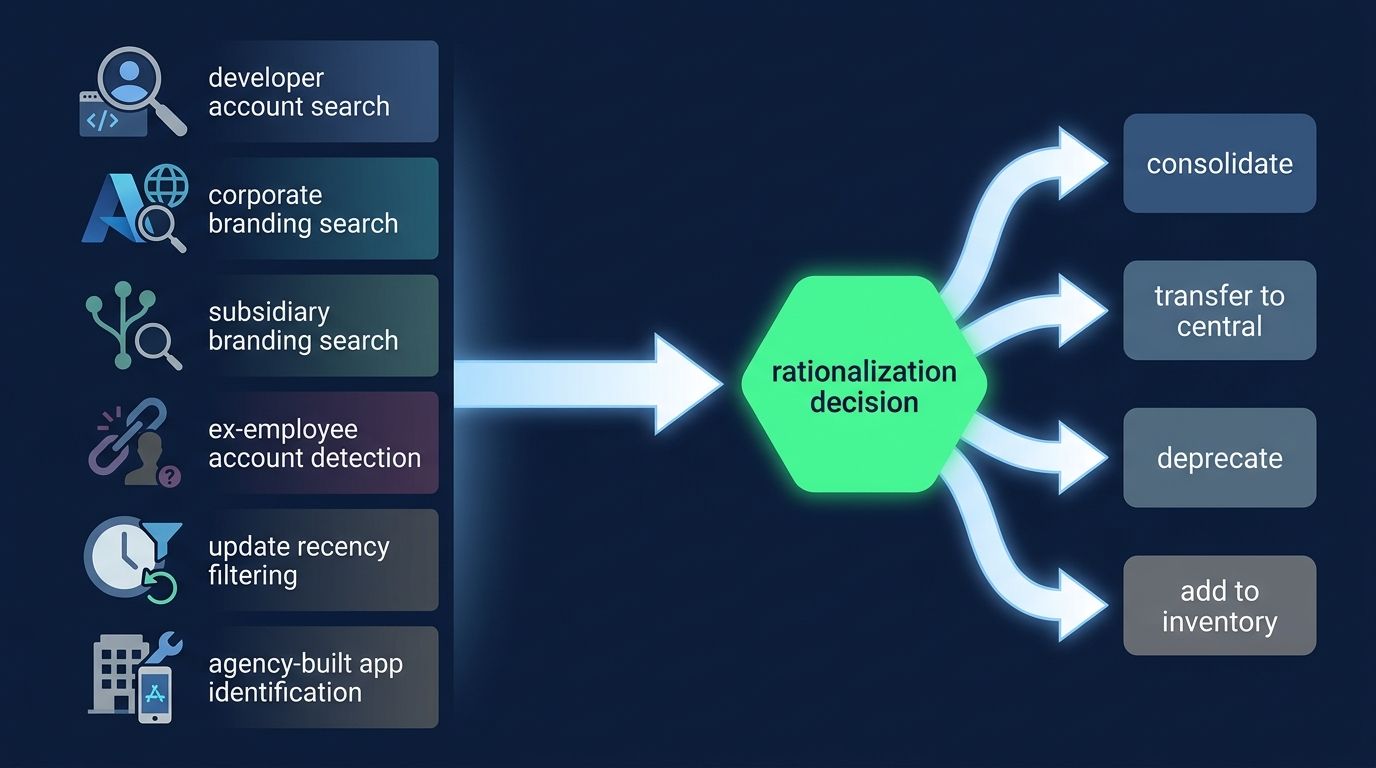
Shadow IT detection for mobile apps uses a set of specific search and analysis mechanisms that work against the public app stores as the primary evidence source. The main detection mechanisms:
Developer account search. The App Store and Google Play both allow searching for apps published under a specific developer account name. Enterprise IT teams can search for apps published under the organisation's official developer account name, then compare the resulting list against the central inventory. Any apps that appear on the developer account but are not in the central inventory are candidate shadow IT apps. Any apps that should be in the inventory but do not appear under the developer account are candidates for verifying which developer account actually owns them.
Corporate branding pattern search. Many shadow IT mobile apps are published under developer accounts that are not the corporation's official account, but the apps still use corporate branding in the app name, description, screenshots, or icon. Searching for apps that use specific brand names, product names, subsidiary names, or trademarks associated with the organisation surfaces apps that appear to belong to the organisation regardless of which developer account they sit under. This mechanism catches ex-employee developer accounts, agency-built apps still live under the agency's account, and apps from acquired subsidiaries that were never migrated to the central developer account.
Subsidiary and regional branding search. Organisations with subsidiaries, acquired brands, or regional operating names often have mobile apps published under those branded identities rather than under the parent corporate branding. Searching for each subsidiary brand, regional brand, or acquired company name surfaces apps that belong to the wider organisation but were commissioned or developed at the subsidiary or regional level. This mechanism is particularly important for organisations that have grown through acquisition or that operate with strong regional autonomy.
Ex-employee developer account identification. When an employee who set up a developer account for a mobile app project leaves the organisation, the developer account often remains active under the ex-employee's personal credentials. The app continues to appear on the app stores under the ex-employee's account name, and the organisation has no administrative control over the app. Identifying these apps requires searching for corporate branding under developer accounts that do not match the organisation's official accounts, then investigating whether each such app was originally commissioned by the organisation.
Update recency and abandonment detection. Mobile apps that have not been updated in extended periods are candidates for abandonment, which is itself a shadow IT risk because abandoned apps continue to serve users without security patches, compliance updates, or platform requirement compliance. Filtering discovery results by last update date surfaces apps that need either active maintenance or formal deprecation and store removal.
Agency-built app identification. Mobile apps commissioned from external agencies often remain live on the app stores after the agency engagement ends, sometimes under the agency's developer account, sometimes under a dedicated project account that was never handed back to the organisation. Identifying these apps requires searching for corporate branding under developer accounts owned by known agency partners, plus investigating any developer accounts that appear to be dedicated project accounts for the organisation's apps.
Each detection mechanism produces a candidate list that requires manual verification to distinguish genuine shadow IT apps from false positives (apps by unrelated organisations that happen to share vocabulary with the corporation, or apps that are formally under the organisation's central inventory but were missed in the initial verification). The discovery process is iterative: candidates from each mechanism get verified, verified shadow IT apps get added to the central inventory or formally deprecated, and the discovery cycle repeats on a defined cadence.
Shadow IT Tools for Mobile App Discovery
The app discovery tools landscape for mobile portfolios splits between SaaS-focused shadow IT tools (Torii, Zylo, Productiv, Josys, BetterCloud, and similar) that focus on unauthorised cloud service discovery, and mobile-app-focused tools that address the specific mechanisms described above. The distinction matters because the two categories work from different data sources and produce different discovery output.
SaaS-focused shadow IT tools do not typically address mobile app discovery. Their data sources (network traffic, expense records, SSO logs, browser telemetry) do not include the app stores as a discovery surface. Enterprise IT teams using SaaS shadow IT tools should not expect those tools to surface mobile app shadow IT.
Mobile app intelligence tools that produce store-surface evidence at scale can perform mobile shadow IT discovery through the mechanisms described above. Tools in the mobile app intelligence category (Sensor Tower, AppMagic, data.ai, Appnalysis, 42matters, MightySignal) each produce different subsets of the evidence needed for mobile shadow IT discovery. Sensor Tower, AppMagic, and data.ai focus primarily on store performance and category rankings and can support developer account searches but do not typically emphasise the shadow IT use case. 42matters and MightySignal focus on SDK-level intelligence that supports agency-built app identification through SDK footprint patterns. Appnalysis produces outside-in evidence across store metadata, developer account activity, release cadence, and SDK footprint, which supports the full set of mobile shadow IT discovery mechanisms named above.
Application portfolio management tools focused on enterprise software (typically covering SaaS, on-premise applications, and infrastructure) sometimes include mobile app inventory features but rarely include mobile app discovery mechanisms. They function as inventory management systems for known apps rather than as discovery tools for unknown apps.
Mobile device management (MDM) and enterprise mobility management (EMM) platforms track apps installed on managed devices but do not discover apps that exist on the app stores under corporate branding. An organisation could have hundreds of shadow IT mobile apps live on the stores while its MDM shows a clean device inventory, because the two data sources answer different questions.
App discovery tools for mobile portfolios are best judged on whether they can run the store-surface mechanisms above rather than on how large their SaaS catalogue is. The Appnalysis platform is built as an app discovery tool of this kind, working from public store evidence rather than network telemetry.
The tool choice for mobile shadow IT discovery depends on the specific discovery mechanisms the enterprise IT team wants to run and the ongoing cadence of the discovery cycle. Teams doing periodic manual discovery work can use a combination of manual store searches and lightweight tools. Teams doing systematic ongoing discovery typically use a mobile app intelligence tool that supports the full set of discovery mechanisms and can integrate with the central IT asset management workflow.
App Rationalization Through Mobile Shadow IT Discovery
App rationalization is the enterprise IT discipline of reviewing the application portfolio to identify redundant, underused, or unmaintained applications and making formal decisions about consolidation, deprecation, or continued investment. For mobile apps specifically, app rationalization requires a complete picture of the portfolio before rationalization decisions can be made. That picture usually requires shadow IT discovery to be complete before rationalization is meaningful.
The typical mobile app rationalization workflow after shadow IT discovery:
Consolidate regional duplicates. Where multiple regional teams have commissioned separate mobile apps for similar functions, rationalization typically favours consolidation to a single app with regional configuration rather than multiple parallel apps. The discovery work identifies which regional apps exist. The rationalization decision determines which stay, which get consolidated, and which get deprecated.
Formally handle ex-employee accounts. Apps discovered under ex-employee developer accounts require formal action: either transfer to the organisation's central developer account (which involves contacting the ex-employee and executing account transfer procedures on Apple's or Google's side), or deprecation and formal removal from the stores if the app is no longer needed.
Address agency-built apps. Apps discovered under agency accounts require either contractual clarification about ownership and continued support, or transfer to central IT ownership, or formal deprecation. Which path applies depends on whether the app is still actively used and whether the original agency contract addressed ownership transfer.
Deprecate abandoned apps. Apps that have not been updated in extended periods and no longer serve active user needs should be formally deprecated and removed from the stores. Leaving abandoned apps live creates ongoing compliance risk (privacy declarations may be stale, platform requirements may be unmet, security patches may be missing) and user experience risk (users continue installing apps that are effectively unsupported).
Update central inventory. All discovered apps that are legitimately part of the organisation's portfolio should be added to the central IT inventory with clear ownership assignment, maintenance responsibility, and formal governance status. This is the operational output of the discovery and rationalization cycle.
App rationalization is genuinely difficult without complete discovery because rationalization decisions made on incomplete portfolio pictures produce partial results. Discovery is the enabling step; rationalization is the follow-through.
Managing Shadow IT for Mobile Apps as Ongoing Discipline
Shadow IT management for mobile apps is not a one-off audit exercise. Mobile portfolios continue to evolve because organisations continue to commission new mobile projects, acquire new subsidiaries, engage new agencies, and lose employees who set up developer accounts. Managing shadow IT for mobile apps effectively requires establishing ongoing discovery cycles rather than treating discovery as a project that completes. This is the same ongoing discipline that IT asset discovery requires for the wider enterprise technology portfolio, applied specifically to the mobile app subset.
The typical ongoing discipline has three components:
Periodic discovery cycles. Most enterprise IT teams run mobile shadow IT discovery on a quarterly or half-yearly cadence, running the discovery mechanisms described in section 3 and comparing results against the current central inventory. New apps that appear between cycles get triaged: legitimate additions get added to the inventory with ownership assigned, shadow IT apps get flagged for rationalization decisions, false positives get documented so they do not re-appear in subsequent cycles.
Event-triggered discovery. Certain organisational events warrant immediate discovery cycles regardless of the periodic schedule. Acquisitions typically require immediate discovery of the acquired organisation's mobile portfolio to integrate with the central inventory. Employee departures from teams that commission or manage mobile projects warrant checking whether the departing employee held developer account credentials for any corporate apps. Agency engagement completions warrant verifying whether all apps built during the engagement have been transferred to central ownership or formally deprecated.
Central inventory maintenance. The central IT inventory needs to be maintained as apps are added, transferred, or deprecated. Without this maintenance discipline, discovery cycles keep re-discovering apps that were already surfaced in previous cycles because the inventory did not get updated. Maintenance also includes tracking ownership changes as employees join or leave, tracking maintenance status as apps move between active development and passive maintenance, and tracking compliance status as regulations change.
For enterprise IT teams new to mobile shadow IT management, the discipline can start small: an initial discovery cycle to establish the baseline portfolio picture, a rationalization pass to address the most urgent findings, then quarterly ongoing cycles to catch new shadow IT before it accumulates. Building the discipline gradually is more sustainable than attempting a comprehensive audit-and-remediate exercise in one large effort.
Shadow IT Risks for Mobile Apps: Compliance and Governance
Mobile shadow IT is a compliance and governance risk beyond the operational risk of unmanaged apps. Apps that exist under corporate branding but outside central IT visibility create specific risks that governance functions need to address.
Compliance declarations depend on complete portfolio visibility. Data Safety and privacy label declarations on Google Play and Apple's App Store are made on a per-app basis by whoever controls the developer account. Apps under ex-employee accounts or agency accounts may have declarations that no longer reflect current corporate compliance positions. Apps discovered through shadow IT work but not addressed leave the organisation vulnerable to compliance findings when regulators or auditors check declaration accuracy.
Data subject access requests (DSARs) under GDPR, CCPA, and equivalent regulations require the organisation to identify all data processing on their systems. A DSAR that discovers apps the organisation did not know existed produces both operational scramble and potential regulatory exposure. Systematic mobile shadow IT discovery reduces this risk by ensuring the organisation knows what apps exist before a DSAR arrives.
Third-party risk management extends to mobile apps that operate under corporate branding regardless of which developer account technically owns them. If an app under an ex-employee account has a security incident, the reputational risk falls on the organisation associated with the branding, not on the ex-employee whose account technically owns the app. Discovery reduces this risk by identifying such apps and either bringing them under central control or formally deprecating them.
The vibe coding shift named in section 1 makes the compliance dimension of mobile shadow IT more urgent specifically. Apps produced through traditional agency workflows typically arrive with at least some compliance discipline built in because agencies factor compliance work into their delivery process. Apps vibe-coded by someone without a formal mobile development background typically ship without a Data Safety declaration that reflects what the app actually collects, without a subprocessor map derived from the SDKs the AI tool bundled, and without verification that GDPR or equivalent regulations are handled for any personal data the app processes. When enterprise IT discovers a shadow IT app that was built through a formal agency engagement, there is a reasonable chance the agency built compliance handling in. When enterprise IT discovers a shadow IT app that was vibe-coded, the compliance gaps are more likely to be significant and to require immediate remediation rather than just inventory reassignment.
There is a counterargument worth acknowledging: the same AI-assisted technology that accelerates app creation could also accelerate discovery and compliance work over time. AI coding agents with MCP configured against knowledge specialists like Appnalysis can support automated shadow IT discovery workflows, running the developer account searches and corporate branding searches on an ongoing basis rather than requiring manual quarterly cycles. Automated compliance analysis of newly discovered apps against Data Safety requirements is technically feasible with the right tooling. The timing is asymmetric in the current window: the tooling for vibe-coding new apps is available today and widely used, while the tooling for AI-assisted shadow IT discovery exists but is not yet widely adopted in enterprise IT functions. Over the medium term this may rebalance. In the short term, enterprise IT teams working on shadow IT discipline should assume the app-creation side is accelerating faster than the discovery side, and structure their discovery cadence accordingly.
The compliance angle connects mobile shadow IT discovery to the wider governance discipline covered elsewhere in the Appnalysis content. For readers interested in the compliance follow-through after discovery, Everyone Talks About Technical Debt. Nobody Talks About Legal Debt covers what accumulated legal and compliance debt looks like in mobile apps. Roadmap: Getting Your Mobile Compliance Right covers how to structure the compliance work once the portfolio is visible.
How Appnalysis Fits Into Mobile Shadow IT Discovery
Appnalysis is Bloomberg for mobile apps. For shadow IT discovery specifically, that means Appnalysis produces the outside-in evidence layer needed to run the discovery mechanisms described in section 3 systematically rather than through manual store searches.
Two categories of Appnalysis output matter for mobile shadow IT discovery.
App Store Intelligence covers the continuous outside-in evidence layer relevant to discovery: developer account search across the App Store and Google Play, publisher and brand pattern searches, release cadence tracking that surfaces abandonment candidates, review sentiment and developer response patterns that suggest ownership and maintenance status, and store standing changes over time. Most shadow IT discovery mechanisms operate at this tier.
App Intelligence covers the deeper package-level evidence that supports specific discovery angles: SDK footprint analysis that can help identify agency-built apps through characteristic SDK patterns, subprocessor mapping that reveals data processing infrastructure, and deeper technical evidence about individual apps discovered through the store-surface mechanisms.
One thing worth naming about what Appnalysis does not do for shadow IT discovery. It does not access private developer account information, private billing records, or corporate SSO logs. The discovery mechanisms it supports are those that operate on publicly available store surface evidence. That evidence is genuinely sufficient for the discovery mechanisms described in this article because the shadow IT apps in question are, by definition, publicly listed on the app stores. Discovery through public evidence is the appropriate mechanism for finding public artefacts.
For teams using AI-assisted workflows (Claude Code, Cursor, or other agents with MCP configured), Appnalysis is available as a knowledge specialist that agents can query directly during discovery work. That pattern is covered in more depth in Your AI Coding Agent Only Sees Half the Picture.
Start Your Mobile Shadow IT Discovery
The fastest way to start mobile shadow IT discovery is to run the developer account search and corporate branding search mechanisms against your organisation's known developer accounts and brand names. That first pass typically surfaces enough candidate shadow IT apps to justify establishing an ongoing discovery discipline.
For continuous outside-in evidence supporting the discovery mechanisms described in this article, the Appnalysis App Store Intelligence tier is designed for this.
Frequently Asked Questions
Related Reading
- Everyone Talks About Technical Debt. Nobody Talks About Legal Debt - what accumulated legal and compliance debt looks like in mobile apps
- Roadmap: Getting Your Mobile Compliance Right - how to structure compliance work once the portfolio is visible
- Technical Due Diligence Checklist: Mobile Apps, No Source - transaction-time due diligence application
- Vendor Risk Assessment for Mobile SDKs Without Waiting on the Vendor - the vendor-facing governance application
- Compliance Comparison: What Mobile App Security Testing Cannot Cover - the security-testing versus compliance-comparison distinction
- Market Intelligence Tools for Mobile Apps: How the Categories Compare - the tools landscape for mobile app intelligence
- Your AI Coding Agent Only Sees Half the Picture - how Appnalysis works with AI-assisted workflows via MCP