The hidden regulation pyramid: app regulatory compliance
No app is governed by one law. A mobile product can sit under broad privacy and consumer rules, territorial law, sector regulation, product-specific requirements and the policies of the platform distributing it. The closer you get to the individual app, the more specific those obligations become. Most teams only see the top layer, the one that got them into the App Store or the Play Store this week. The ones that bite hardest are often lower down. Software teams know the saying that the devil is in the detail. In regulation, the detail usually sits at the lower layers of the pyramid, not the headline ones. This is especially acute for teams building apps for the first time, often with AI-assisted or vibe-coded tools, where the muscle memory established teams have built up around compliance does not yet exist.
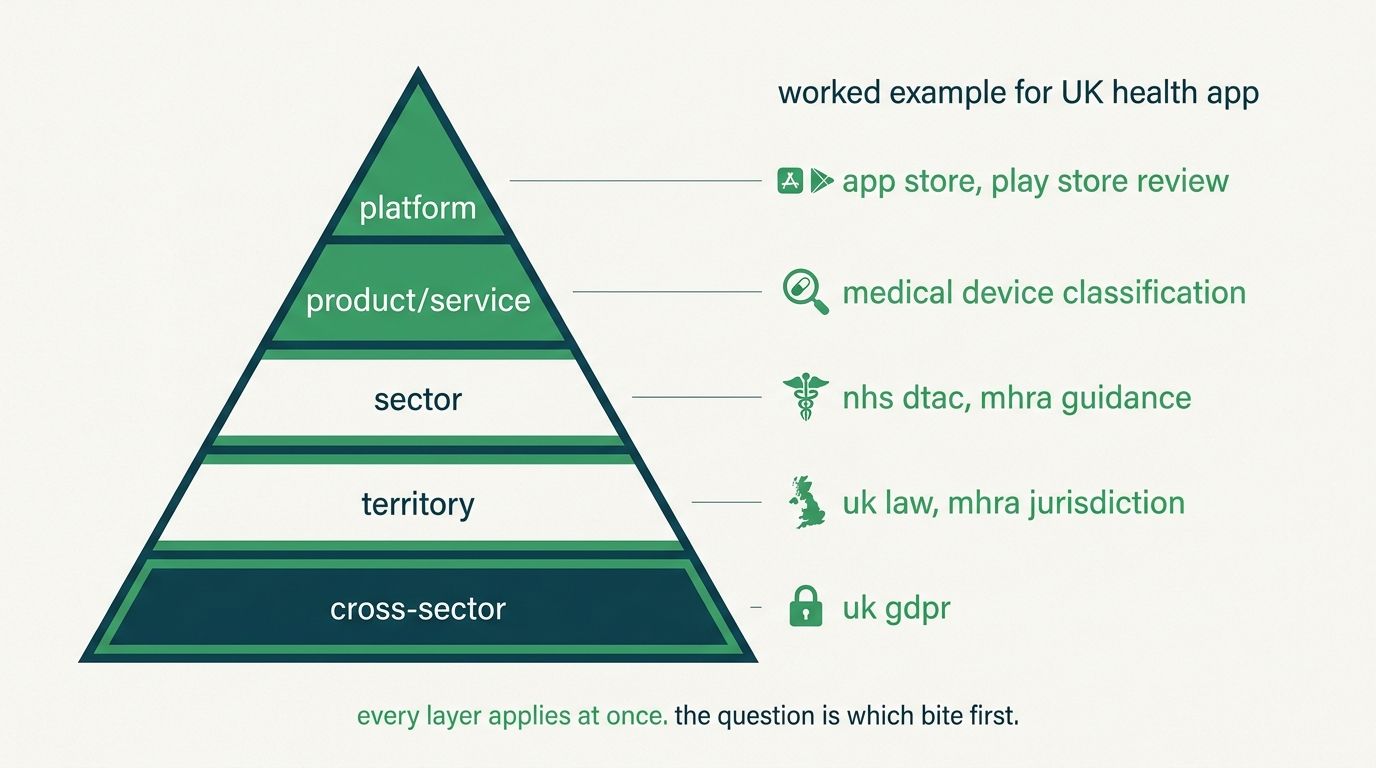
Open a regulated gambling app in the UK and this stops being abstract. UK GDPR affects how personal data is handled. UK law determines the jurisdiction. The Gambling Commission's licence conditions govern the sector. The Remote Gambling and Software Technical Standards reach directly into product behaviour. Apple or Google then add another set of distribution requirements. One app, five layers of rules, every one of them real.
The Gambling Commission's RTS 12 does not merely say operators should encourage responsible gambling. It specifies that financial limit controls must be readily accessible, visible from relevant screens, and designed to minimise the number of steps needed to reach them. Regulation reaching into what a button does, where it sits on the screen, and how many taps away it is. That is the point where "regulation" stops being lawyers and policies and starts being product design.
This article walks through the five layers, uses UK and US examples at each one, and ends with the insight that the search-popularity ranking of regulations and the product-relevance ranking of regulations are not the same list. It is part of the Appnalysis series on how software is growing up, picking up where the institutional context left off.
Key takeaways
- Layer 1, cross-sector regulation: broad rules like UK GDPR, CCPA, COPPA that apply because of what the app does with data and audiences
- Layer 2, jurisdiction and territory: which versions of the other layers apply, by user location (UK, US federal, US state, EU)
- Layer 3, sector regulation: rules that apply because of the business you are in (FCA Consumer Duty, GLBA, Gambling Commission, MHRA, FDA)
- Layer 4, product and service-specific requirements: rules that apply because of what the specific software does (SaMD, RTS 12, PCI DSS, Age Appropriate Design Code)
- Layer 5, platform rules: Apple App Store and Google Play policies, which explicitly do not substitute for legal compliance
What is regulatory compliance for a mobile app?
Regulatory compliance is the practice of meeting the legal, sector and platform rules that apply to an organisation's activities. For a mobile app specifically, that means meeting the rules that apply to what the app does, where its users are, and how it is distributed. It is not one task but a set of overlapping obligations across cross-sector law (privacy, consumer protection, safety, accessibility), territorial jurisdiction, sector regulation, product-specific requirements, and the policies of the distribution platform. Which rules apply depends on what the app is, who uses it and where.
How to read the pyramid
The regulation pyramid is a mental model. Visualised as a shape, each layer narrows the context until it reaches the individual product at the tip.
The pyramid isn't a hierarchy of legal authority. It is a way of showing increasing regulatory specificity. An app can be subject to several rules at every layer. UK GDPR does not disappear because an app is also covered by the FCA Consumer Duty. The Gambling Commission's RTS does not override the App Store review guidelines. The layers coexist, and the number of rules an app has to satisfy accumulates as it moves up the shape.
That is also why most teams only see the top layer. The App Store rejection email arrives in the inbox this afternoon. The ICO's regulatory interest in the SDK you added two years ago arrives on a different timescale. Both are real. Only one of them tends to get called "compliance" in the Monday standup.
Cross-sector regulation: rules that follow almost every app
The widest base of the pyramid is the rules that apply because an app processes personal data, interacts with consumers, or reaches an audience that includes children, not because of the sector the company operates in.
UK GDPR is the headline cross-sector rule in the UK. It sets the lawful bases for processing personal data, the rights of data subjects, the obligations around breach notification, and the regime that the Information Commissioner's Office (ICO) enforces. The ICO publishes its data protection principles as the practical starting point for compliance. Any app that collects personal data from UK users is in scope, which in practice is almost all of them.
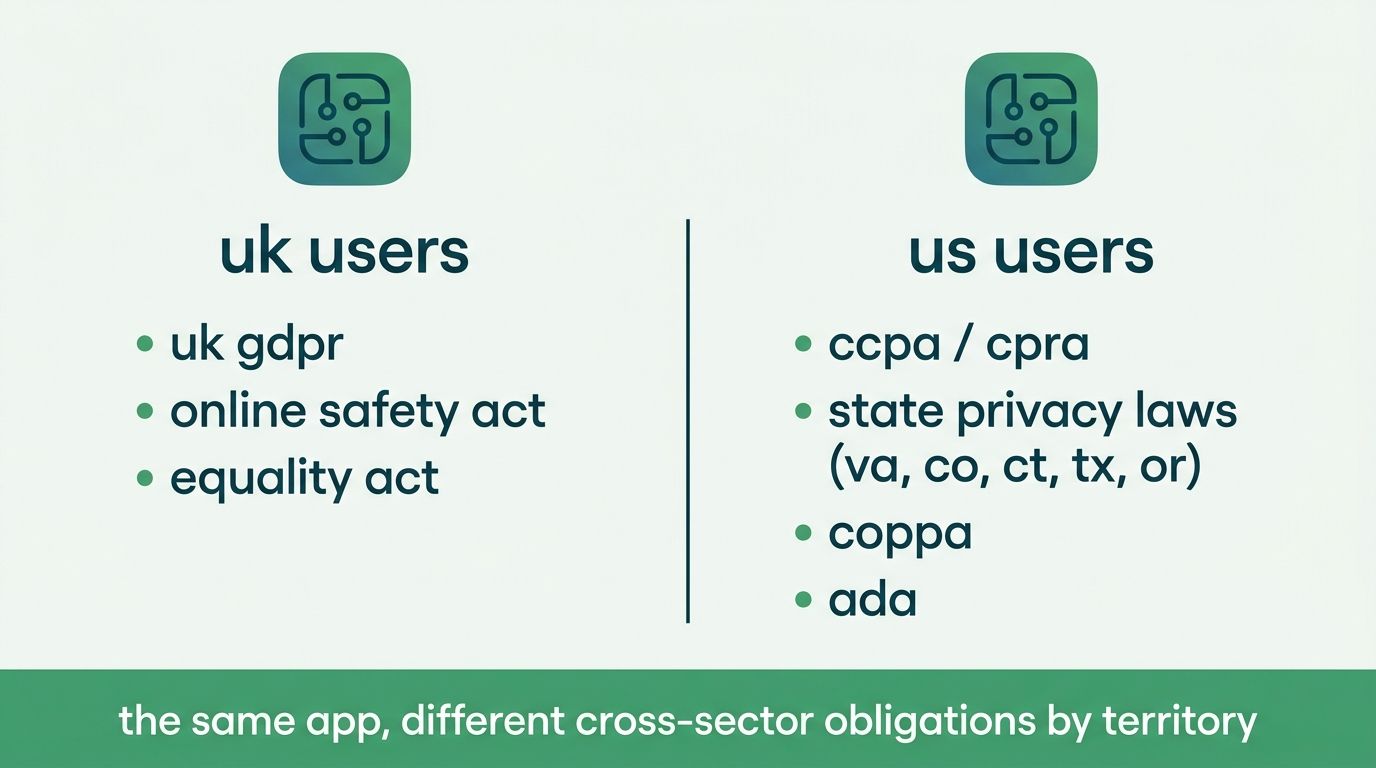
Alongside UK GDPR, several other cross-sector rules routinely apply to mobile apps. The Online Safety Act, enforced by Ofcom, imposes duties on services that host user-generated content, with specific obligations around protecting children. The Equality Act 2010 and its accessibility obligations apply to digital services. In the US, the equivalent cross-sector layer includes CCPA (and its growing patchwork of US state privacy laws), COPPA for apps aimed at children under 13, and the ADA's accessibility expectations as interpreted by federal courts.
None of this is sector-specific. A fitness app (think Strava or MyFitnessPal), a bank (think Monzo or Revolut), a gambling operator (think bet365 or Paddy Power) and a social network (think TikTok or Instagram) all meet this layer in similar ways, differing only in the specific data they process and the audience they reach.
This is the layer most teams recognise as "compliance", because it is the layer the general press writes about, the one the privacy officer worries about, and the one that generates the largest search volume. It is also the layer with the loosest connection to product behaviour. UK GDPR tells you a lot about what you can and cannot do with the data, but relatively little about how the data flows through the app, which SDKs touch it, or what the user sees when consent is sought.
For the governance work that sits around this layer, app compliance covers the operational roadmap. For how compliance obligations accumulate quietly inside a shipped app, compliance debt covers the sibling concept to tech debt.
Jurisdiction and territory: where the app and its users are
The second layer is not really another type of regulation. It determines which versions of the other layers apply. An app available in both London and Austin is subject to different privacy regimes, different consumer protection rules, and different sector regulators depending on which user is opening it at which moment.
In the UK, the jurisdiction stack is relatively compact: UK GDPR, UK regulators (ICO, Ofcom, FCA, Gambling Commission, MHRA), and UK sector regimes. In the US, the picture is harder to draw neatly. Federal rules sit alongside state rules, and the state layer has become a working category of its own with the growth of US state privacy laws. California (CCPA/CPRA), Virginia, Colorado, Connecticut, Utah, Texas, Oregon and others have each produced their own regime, overlapping in principle, differing in detail.
An app that collects personal data from users in multiple US states is now choosing between implementing the strictest common denominator or operating state-by-state. Either is legitimate. Neither is cheap. And both are invisible to a trend forecast or a feature-prioritisation discussion that focuses only on what the app does.
The territory layer is where the "we comply with GDPR" claim earns its scrutiny. GDPR is a European regime. UK GDPR is the UK's own version, which differs in ways that have been diverging further over time. Neither applies in exactly the same form to US users. Compliance claims that are not scoped to a territory are claims without a frame.
The EU adds its own territorial layer with regulations that reach beyond GDPR: the Digital Services Act (DSA), the Digital Markets Act (DMA), the Digital Operational Resilience Act (DORA) for financial services, the EU AI Act coming into force in stages, and the European Accessibility Act applying to digital products from June 2025. Each is a distinct regulation. Together they form the European version of the stack the UK and US each have their own version of.
Sector regulation: what business are you in?
The third layer is often the one software teams miss hardest. Regulation at this layer does not apply because the product collects data or has UK users. It applies because of what the company does, regardless of the shape of the software.
The FCA Consumer Duty is the headline example in UK regulated finance. The duty requires firms to deliver good outcomes for retail customers, with specific attention to products and services, price and value, consumer understanding, and consumer support. In 2026 that includes the design of digital acquisition journeys. The FCA's own good and poor practice review of digital design examined how app and website design affects customer understanding and decisions, with findings on default settings, friction, risk warnings, and the sequence in which information is presented. This is a financial regulator issuing specific guidance on how a product's screens are laid out.
The Gramm-Leach-Bliley Act (GLBA) is the US equivalent in retail finance, imposing privacy and safeguards obligations on financial institutions that reach beyond general privacy law. The FTC enforces GLBA's privacy and safeguards rules, and the specifics apply differently to banks, broker-dealers, and non-bank financial services providers.
Health has its own stack. MHRA regulates medical devices in the UK, with specific guidance on software and apps. The FDA regulates in the US, with the Digital Health Center of Excellence covering device software functions including mobile medical applications. HIPAA sits inside this layer in the US but applies conditionally: a health app is only within HIPAA's scope when the organisation using or providing it is a covered entity or business associate under the law. An over-the-counter wellness app from a company like Fitbit or Whoop usually sits outside HIPAA. A patient-facing app from a hospital network inside it. Not every app that touches health data is a HIPAA app, and claiming otherwise is a common source of overstatement.
Gambling has the Gambling Commission in the UK, with licence conditions and technical standards (RTS) that apply across its licensees. Telecoms has Ofcom, with its own sectoral obligations. Children's services have additional overlays on the cross-sector base.
This is the layer where regulation starts to shape software behaviour directly, not just data handling. The FCA's attention to digital design, the MHRA's definition of what counts as medical device software, and the Gambling Commission's RTS all live here. The rules at this layer are often invisible to teams who do not identify primarily as a regulated-sector operator but who, in practice, are one.
Product and service-specific requirements: when software becomes a medical device (SaMD)
The fourth layer narrows further. It applies not to the whole sector but to what the specific software does.
Software as a medical device (SaMD) is the clearest example. A health app is not automatically a medical device because it deals with health. The question is what the software does. The FDA treats regulation as function-specific rather than platform-specific: its guidance on device software functions covers specific functions running as mobile medical applications, with different categories of regulatory oversight depending on whether the function is diagnostic, therapeutic, administrative, or wellness-oriented. The MHRA takes a similar function-driven approach for UK devices, under the SaMD classification used internationally through IMDRF. A workout tracker like Strava is not a medical device. A continuous glucose monitor companion app from a brand like Dexcom or Abbott Libre usually is. The progression goes:
Health → healthcare product → diagnostic or therapeutic function → potential medical-device regulation.
Each step is a filter, and only software that passes all four lands in the regulated class.
The gambling worked example sits at this layer alongside the medical case. RTS 12 is the specific product-and-service requirement that reaches into financial limit controls. It is not the Gambling Commission's general licence conditions, which belong one layer down. It is the technical standard that specifies what the UI must do and how it must behave. For teams building regulated gambling apps (bet365, Paddy Power, Sky Bet, DraftKings, FanDuel), this is the layer where the regulator effectively becomes a product reviewer, with specific opinions on screens, placements and tap counts.
Other product-specific layers show up across other sectors. In payments, PCI DSS specifies controls that apply to systems handling cardholder data. In children's online services, the UK's Age Appropriate Design Code applies specific obligations to apps likely to be accessed by children (relevant for anything from Roblox to BBC iPlayer Kids). In accessibility, WCAG success criteria operate at the specific-UI level.
The product-specific layer is the one where "we comply with the law" stops being a company-level claim and becomes a feature-level claim. It is also the layer where regulation starts to resemble product specification, which is why engineering teams who have never read it often discover they have been building against it without knowing.
Platform rules: who lets you distribute it?
The fifth layer, at the tip of the pyramid, is Apple and Google. These are not government regulations. They are private platform rules, written by the two companies that between them account for essentially the entire mobile app distribution market in most countries.
Apple's App Store Review Guidelines and Google's Play Store policies impose their own set of requirements, covering content, payments, data use, privacy disclosures, child safety, security practices and more. The specifics change regularly, often with limited notice. For a mobile product team, the practical consequence is that satisfying every legal and regulatory requirement is still not enough if the app also fails Apple or Google's own rules. Breaking a platform rule can restrict or prevent distribution, which for most apps is as consequential as breaking a law.
The platform layer is distinct from the regulatory layers in two useful ways. It is enforced faster, usually by rejection or removal within days rather than regulatory action within quarters. And it is enforced through the shipped app itself, by review processes that inspect the binary and its behaviour. For both reasons, the platform layer is the one teams instinctively prioritise. It is also the layer with the least connection to the harm the other layers exist to prevent. An app can satisfy App Store review and still fail UK GDPR. The platform does not check for that.
For the vendor and SDK evidence layer that cuts across both platform rules and sector regulation, vendor risk assessment covers the outward-facing version of the work. For continuous compliance operations that sit alongside platform submission, compliance automation covers the operational layer.
The muscle-memory gap in the vibe-coding era
Established mobile teams tend to carry scar tissue from previous compliance work. Someone on the team has been through an ICO investigation, a Play Store policy strike, an FCA review, a HIPAA assessment or a legal letter about a tracking SDK that should not have been there. They know which layer bites first in their sector, who to call when it does, and roughly when in the roadmap to raise the question. The pyramid is partly implicit knowledge.
The new wave of app builders in the vibe-coding era does not have that scar tissue yet. The economics have changed. An individual can ship a working app in a weekend, and many are doing exactly that. The question that dominates on Reddit, in indie developer communities and in the AI-assistant transcripts of these new builders is "how do I get Apple to approve my app?" The lower layers of the pyramid rarely come up, because nobody in the conversation has been bitten by them yet.
Apple and Google do not help with this. Both platforms explicitly place compliance with applicable law on the developer, not on themselves. Apple's App Store Review Guidelines state, in the Legal section: "Apps must comply with all legal requirements in any location where you make them available. It's your responsibility to understand and make sure your app complies with all local laws." The Apple Developer Program License Agreement makes the same point as a contractual term. Google's Play Developer Distribution Agreement does the equivalent. Platform approval is explicitly not legal clearance. It never was, but the terms now say so in plain language.
The place a new builder might reasonably turn for help, their AI assistant, usually declines to give specific legal advice. Most modern LLMs, including Claude, add consult-a-professional caveats when asked whether a specific app complies with a specific regulation. That caveat is accurate. It is also not actionable for someone who shipped an app over a weekend and is asking because they do not know a professional.
For a new builder, the pyramid is not an abstract framework. It is a map of the layers that platform approval does not cover, that LLMs cannot advise on, and that nobody is going to find for them. For the broader pattern of what gets shipped when the muscle memory is missing, vibe coding security risks in mobile apps covers the specific angle.
Why the most searched regulation may not matter most to your app
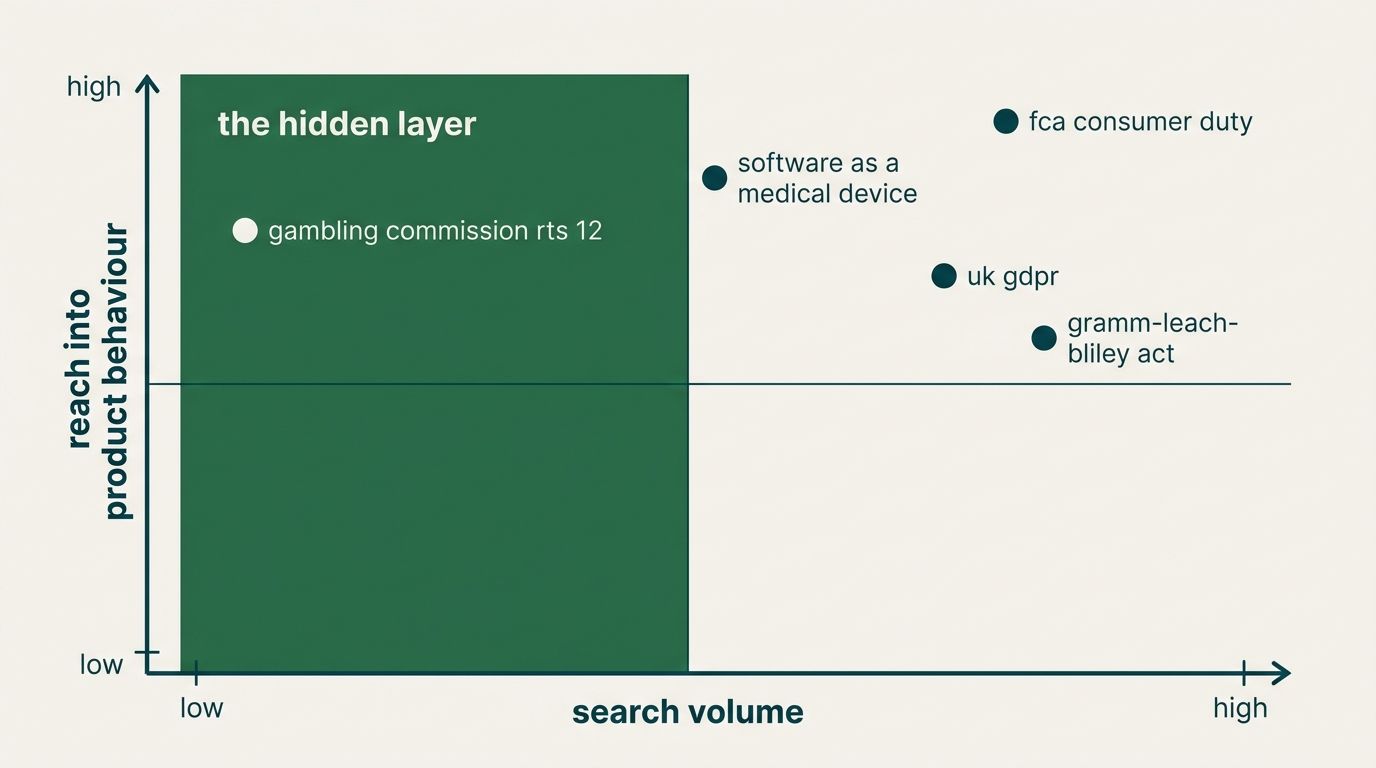
The regulations that get the most search volume are not necessarily the ones that most directly shape mobile apps.
| Regulation | Approximate UK searches per month | Approximate US searches per month | Where it reaches into the shipped app |
|---|---|---|---|
| UK GDPR | ~6,600 | n/a | Mostly through data flows and SDK choices |
| Consumer Duty | ~3,600 | n/a | Directly into digital design and user journeys per FCA review |
| GLBA (Gramm-Leach-Bliley Act) | ~170 to 210 | ~5,400 to 6,600 | Through safeguards obligations on financial app providers |
| SaMD (acronym) | ~720 | ~6,600 | Directly into product function classification |
| Software as a medical device (full phrase) | ~320 | ~720 | Directly into product function classification |
| Gambling Commission RTS | ~20 | n/a | Directly into UI controls and screen layout |
Approximate monthly searches (Semrush, UK / US, October 2026).
The gap is informative. The regulations the industry talks about are not always the regulations that shape the shipped app most directly. UK GDPR has the largest awareness and the largest search demand in the UK. SaMD and GLBA together draw more than 10,000 US searches a month. Gambling RTS has around twenty searches a month and dictates specific UI behaviour down to the button placement.
Search popularity tells you what people know about. It does not tell you which regulation most directly shapes the software being built. For a team working inside a regulated sector, the hidden layers are often where the real product-affecting rules live, not the famous ones.
This connects to the wider story about how software is growing up. Regulators are reaching further into product behaviour than they used to. The FCA is reviewing digital design. The FDA is defining device software functions. The Gambling Commission is specifying UI controls. These are the lower layers of the pyramid becoming more specific, and more visible in the shipped app, over time.
How Appnalysis fits
Some regulatory obligations remain organisational and cannot be observed externally. Whether a company has the right data processing agreements in place, whether its board has reviewed its Consumer Duty implementation, whether its risk register names the relevant obligations. These sit above the shipped app and need their own governance.
Others leave evidence in the shipped product. Permissions, SDKs, disclosures, consent flows, account controls, user journey behaviour, and changes between releases. Appnalysis produces the observable-evidence layer for these: what the shipped app actually contains, does and depends on, measured from the binary rather than the documentation.
Observable evidence is not the same thing as proving compliance. It supports a compliance assessment that someone with the right authority can make. It does not replace that assessment, and it does not cover the organisational layer. For teams working across several of the pyramid's layers at once, it is one input into the compliance picture, not the picture itself.
For teams building with AI-assisted development, Appnalysis can be added as an agent into Claude Code, Codex and other AI coding workflows. The evidence it produces (SDK inventory, runtime behaviour, permission use, disclosure matching) becomes available to the AI assistant during development, so the assistant can reason against what the shipped build actually contains rather than generating code without that context. It is not a substitute for legal advice, and it does not turn the AI into a compliance oracle. It does close one of the gaps the muscle-memory section covered: the ability for a new builder's primary tool to know what their shipped app actually does. For how specialist knowledge gets added to AI coding workflows, Your AI Coding Agent Only Sees Half the Picture covers the pattern.
For how teams already running compliance programmes use the evidence layer in practice, mobile app audit covers the owner-inward version of the work.
The /product and /agencies pages cover how different teams use the platform. The /ask demo is open if you want to try it against a specific app.
Closing
The hidden regulation pyramid is not about hiding anything. It is about naming what has been there all along. Every app sits under a set of overlapping rules that get more specific to the individual product as you move up the shape. Most teams see the top layer because it generates the fastest feedback (platform review) and the layer immediately below it because the general press writes about it (cross-sector privacy).
The layers in between, where sector regulation and product-specific requirements actually shape what the software does, are the ones most often missed. They are also the ones most likely to turn up as a regulator's specific finding on a specific feature in a specific release, long after the standup where someone said the app was "fully compliant".
Frequently asked questions
Further reading
External references (official sources)
- ICO data protection principles
- Ofcom Online Safety Act regulation
- FCA digital design good and poor practice
- Gambling Commission Remote Gambling and Software Technical Standards (including RTS 12 on financial limits)
- MHRA software and apps guidance
- HHS HIPAA and mobile health technology guidance
- FDA device software functions
- IMDRF Software as a Medical Device working group
- FTC Gramm-Leach-Bliley Act
- Apple Developer Program License Agreement
- Apple App Store Review Guidelines, Legal section
- Google Play Developer Distribution Agreement
- EU Digital Services Act
- EU Digital Markets Act
- EU AI Act
- European Accessibility Act
- EU Digital Operational Resilience Act (DORA)
Related reading on the Appnalysis site
- Software Is Growing Up. Now the Institutions Are Arriving.. The institutional backdrop to the regulation pyramid, covering the standards bodies and professional institutions arriving to codify the field.
- App Compliance Roadmap. The operational roadmap for working through app compliance obligations.
- Compliance Debt and Legal Debt in a Mobile App. What accumulates when the shipped app drifts away from the paperwork, and how to find it.
- What Is Actually In Your Own App? A Mobile App Audit Guide. The owner-inward version of the audit work.
- Third-Party Risk Management for Mobile Apps. The outward-facing vendor and SDK layer.
- Compliance Automation Software for Mobile Apps. The operational layer for continuous compliance work.
- Mobile App Development Trends and the AI-Built App: What Actually Ships. The vibe-coding security and MVB-era context the muscle-memory section builds on.