Third-Party Risk Management for Mobile Apps: Guide
Third-party risk management for mobile apps is the practice of identifying, assessing and continuously monitoring the external components inside a shipped app, from SDKs and analytics libraries to backend services and authentication providers, using observable evidence rather than vendor claims alone. It matters because a modern mobile app is mostly not built by the team whose name is on the app store listing. It is assembled from third-party code, and each piece carries its own data collection, network behaviour, platform compliance profile and vendor viability risk.
This guide covers what TPRM means in a mobile context, the framework that structures a vendor risk assessment, the numbered process that runs it, the distinction between self-reported and observable evidence that determines whether the assessment is actually useful, and where continuous monitoring fits. It links out to ten supporting pieces in the Appnalysis /insights cluster and closes with how Appnalysis fits in a mobile TPRM stack.
What third-party risk management means for a mobile app
The buyer landscape for third-party mobile capability has two ends that both deserve serious evaluation, not just the assumption that big is safe and small is risky.
At one end sit the large platform vendors, analytics giants and enterprise SDK providers. They come with visible compliance certifications, audit reports and dedicated legal teams. They also come with heavy data collection defaults, complex terms and a business model that may not align with the buyer's users.
At the other end sit specialist small providers. Focused SDKs built by domain experts, ed-tech firms that understand what a school actually needs, health-tech providers that have thought hard about clinical safety, transport specialists who know low-power radio. Trade bodies exist to give these smaller providers a trust signal. In UK ed-tech, BESA (the British Educational Suppliers Association) vets its members against a code of practice and gives schools a credible starting point for supplier evaluation.
Neither end is automatically the right answer. Both need verifying. And in sectors that spend public money, the buyer carries a compliance duty on top of the risk management question. A school procuring an ed-tech app is not just doing vendor risk management. It is spending public funds under DfE frameworks, meeting KCSIE online safety duties, processing children's data under the Age Appropriate Design Code, and building an audit trail for value-for-money reviews. BESA membership tells the school that the supplier is reputable. It does not tell the school what the SDK inside the app actually collects when a Year 4 pupil opens it on a school iPad.
The same pattern repeats across regulated sectors. Financial services carries FCA operational resilience obligations for third-party outsourcing. Health carries NHS DSPT and DTAC requirements. Local government carries LGA cyber and public procurement rules. Each layer of sector compliance sits on top of, not instead of, the buyer's risk management duty.
Which is where the mobile-specific problem starts. Traditional TPRM was built for enterprise software procurement, where the vendor is a company you can visit, audit and put on a contract. A mobile app is different. The third parties sit inside a shipped binary that updates weekly, runs on a device you do not control, and communicates over networks you cannot always inspect. The vendor's answer about data collection is a claim. What the SDK does when the app actually runs is the evidence. The two are not always the same thing.
There is also a fourth-party risk layer that mobile apps expose more clearly than most enterprise procurement. A single SDK a buyer chooses to embed will often pull in its own dependencies: crash reporters that use their own analytics libraries, ad networks that call out to attribution partners, authentication SDKs that embed device fingerprinting components. Those fourth parties inherit the trust the buyer extended to the third party, but the buyer never assessed them. In a mobile app they are visible in the shipped binary the same way the third party is, which makes fourth-party risk something a mobile TPRM programme can actually see, if it looks.
For the underlying pattern of why mobile app evidence gets harder to generate as apps grow, What Is Product Intelligence for Mobile Apps covers the observable-evidence layer this article builds on. For why specialist knowledge matters in AI-assisted assessment, Your AI Coding Agent Only Sees Half the Picture covers what LLMs cannot produce from training data alone.
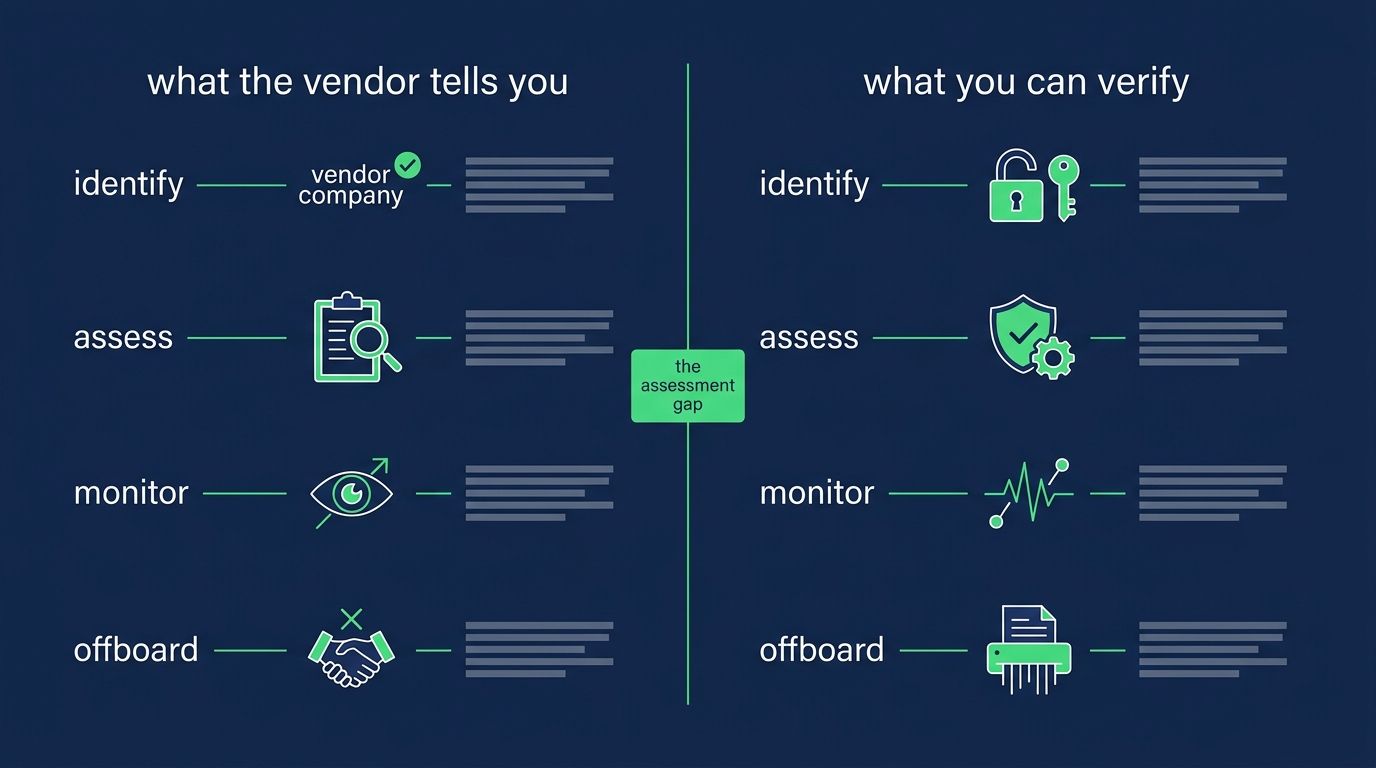
The framework: identify, assess, monitor, offboard
A third party risk management framework for mobile apps runs the same four stages that TPRM has always run, but the evidence at each stage is different from enterprise software procurement.
| Stage | Questionnaire evidence | Observable evidence for a mobile app | Where the evidence comes from |
|---|---|---|---|
| Identify | Vendor's list of SDKs and services they claim to embed | Actual SDK inventory extracted from the shipped binary, including SDKs the vendor may not have declared | Static analysis of the app bundle |
| Assess | Vendor's stated data collection, retention and transfer practices | What the app actually collects at runtime, which network endpoints it contacts, which permissions it requests and when | Dynamic analysis, network capture, permission audit |
| Monitor | Annual reassessment or contract renewal check | Behaviour delta between app versions, SDK version changes, new endpoints appearing, permission additions | Continuous version-over-version comparison |
| Offboard | Contract termination and data deletion attestation | Evidence the SDK is genuinely removed from subsequent app builds, not just disabled by a feature flag | Post-removal binary verification |
This is the shape of a workable third party risk management framework for a mobile buyer. The left column is what the vendor tells you. The middle column is what you can verify. The right column is how you verify it. A serious assessment uses both columns. A claim-only assessment uses only the left, which is why so many TPRM programmes generate paperwork without generating assurance.
For how the assessment side connects to broader compliance automation, Compliance Automation Software for Mobile Apps covers the operational layer that keeps this framework running continuously rather than once a year.
Vendor risk assessment for a mobile app: a numbered process
A vendor risk assessment for a mobile-embedded third party runs as a numbered process. It works for a single SDK, for a vendor providing multiple SDKs, and for a full app under acquisition due diligence.
- Inventory the third parties actually in the shipped app. Do not rely on the vendor's declared list. Extract the SDK and library inventory from the app bundle directly. Undeclared SDKs are common and are often the highest-risk items in the assessment. This inventory step also surfaces the fourth-party dependencies the third-party SDK brings in.
- Map data collection at runtime. For each identified SDK, capture what data it collects when the app runs, which network endpoints it contacts, which device identifiers it accesses, and which permissions it triggers. This is the mobile app security assessment that sits underneath the vendor risk assessment: without it, the questionnaire answers cannot be verified.
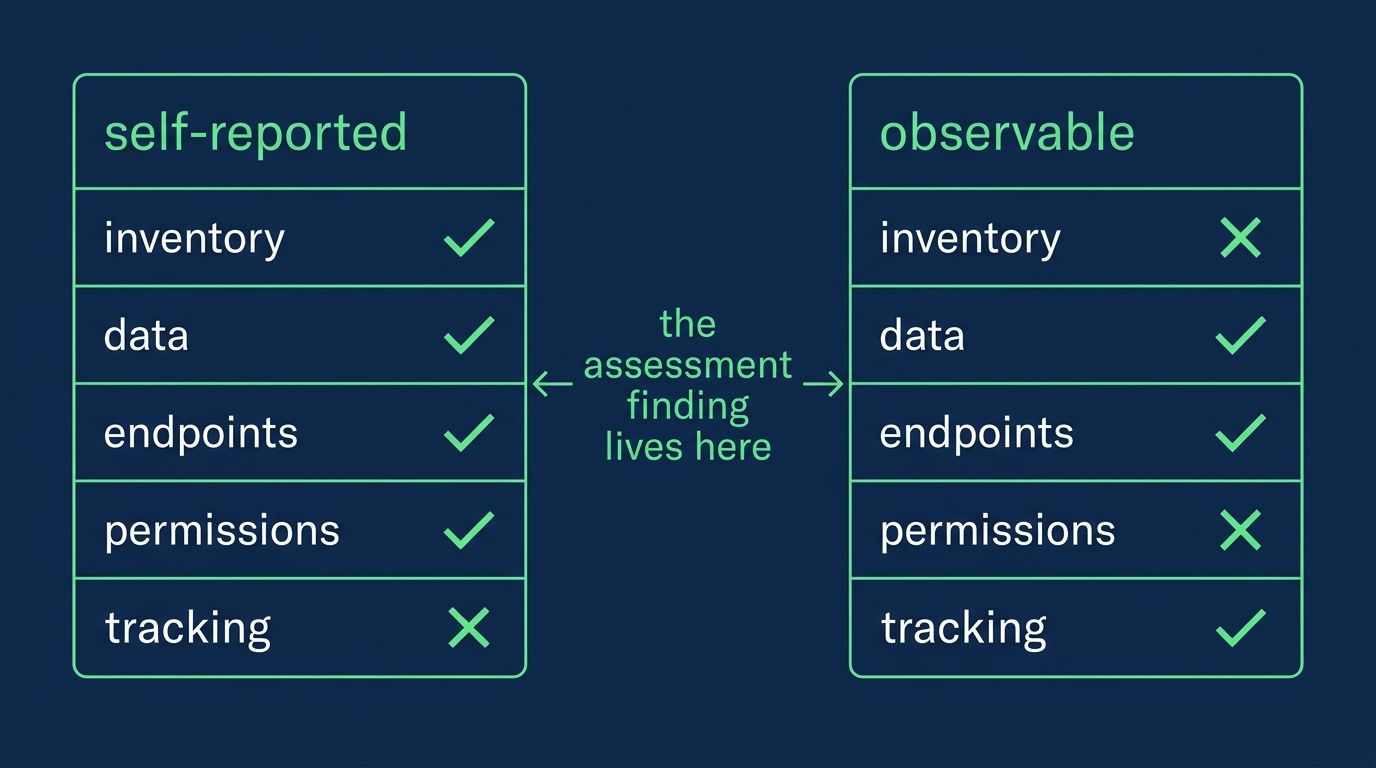
- Compare against the vendor's declared behaviour. Where the observable behaviour matches what the vendor stated, the vendor is credible. Where it does not, the gap is the assessment finding.
- Check platform and sector compliance. Apple's App Store review and Google Play's Data Safety declarations impose one layer. Sector rules (GDPR, HIPAA, PCI, FCA operational resilience, KCSIE, NHS DTAC) impose another. Verify the SDK's actual behaviour against both.
- Assess vendor viability. Small specialist vendors can be excellent. They can also disappear. Check funding, commit velocity, support responsiveness, and whether the SDK has a plausible maintenance future.
- Record the assessment and its evidence base. For public-money buyers, the audit trail is not optional. For commercial buyers, it is what defends the decision when something goes wrong.
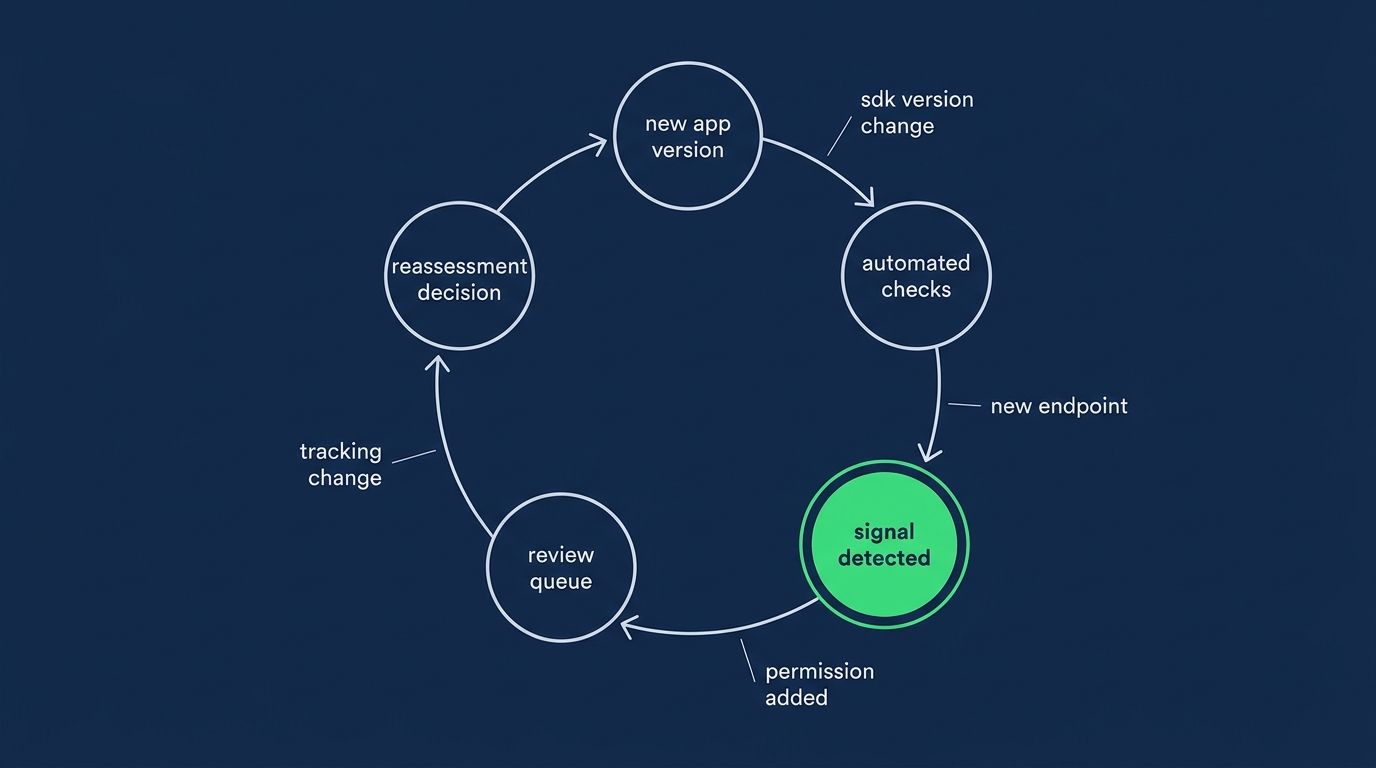
- Set the monitoring cadence. Point-in-time assessment ages fast. Decide what triggers a reassessment: SDK version change, new endpoint detected, permission added, vendor incident, or scheduled interval.
For how this process compares to competitor benchmarking work using the same evidence layer, Competitor App Analysis: A Practical Mobile Guide covers the same evidence base applied to a different question.
Self-reported versus observable evidence
This is the distinct angle a specialist mobile TPRM assessment brings, and the section most vendor risk assessments miss.
Every SDK vendor produces a self-reported description of what the SDK does. It describes what the vendor intends the SDK to do, what data the vendor believes it collects, and which regulations the vendor believes it complies with. It is written by the vendor's compliance team, reviewed by the vendor's legal team, and shaped by the vendor's business need to keep customers. Sometimes it takes the form of a questionnaire response, sometimes a security whitepaper, sometimes a compliance attestation, but the underlying category is the same: a claim.
Observable evidence is different. It is what the SDK actually does when the app it is embedded in runs on a real device. It is produced by inspection of the shipped binary, capture of network traffic, and audit of runtime permission use.
| Assessment area | Self-reported (vendor claim) | Observable (evidence from the shipped app) |
|---|---|---|
| SDK inventory | Vendor's declared list of components | Actual list extracted from the app bundle, including undeclared components |
| Data collection | Vendor's stated fields collected and purposes | Fields actually transmitted at runtime and their destinations |
| Network endpoints | Vendor's declared endpoints and geographies | Endpoints the app actually contacts and where those endpoints resolve |
| Permission use | Vendor's stated permission requirements | Permissions actually requested and when they are triggered |
| Cryptographic implementation | Vendor's stated algorithms and key management | What is actually observable in the binary and on the wire |
| Tracking behaviour | Vendor's declared tracking or ATT compliance | Actual tracking calls and identifier access at runtime |
Neither column is dispensable. The vendor's stated position captures the commitments the contract will hold them to. The observable evidence captures what actually ships, which is what your users experience and what a regulator will find if they look. A serious vendor risk assessment reconciles the two.
For how this evidence base changes what agencies and clients bring to pitch conversations, The New Agency Pitch covers the shift from asymmetric research to shared evidence. For how the same observable-evidence approach applies to market intelligence, Mobile App Market Intelligence Tools: A Buyer's Guide covers the tool landscape.
Vendor compliance and vendor risk management for mobile apps
Vendor risk management for mobile apps has to answer two overlapping questions. Can the third party meet the buyer's security preferences (the risk side)? Can it meet the buyer's regulatory obligations (the compliance side)? Vendor compliance is the second of these, and for a mobile app it covers several overlapping layers.
Platform compliance sits with Apple's App Store review and Google Play's policies. Regional privacy law sits with GDPR, UK GDPR, CCPA and the growing patchwork of state-level US laws. Sector rules sit on top: HIPAA for US health, PCI DSS for payments, FCA operational resilience for UK financial services, DTAC for NHS-adjacent apps, KCSIE for school-facing apps, GDPR-K and the Age Appropriate Design Code for anything that reaches children.
The vendor's stated position will say the SDK meets all of these. The observable evidence will show whether it actually does. In most cases the gap is small and administrative. Sometimes the gap is a specific runtime behaviour that violates one of the sector rules and would be a finding if a regulator looked. Public-money buyers and regulated-sector buyers cannot rely on the vendor's claim alone here, because the buyer's compliance duty is not discharged by the vendor's word. It is discharged by evidence.
The wider frame around this is software supply chain security, which The New Agency Pitch covers as the pitch-and-evidence layer agencies now bring to clients. Software composition analysis and SBOM (software bill of materials) work sit inside that wider category, and are relevant to mobile TPRM as the component-inventory input to the vendor risk assessment, not as its output.
Continuous vendor monitoring
Continuous vendor monitoring is the part of TPRM that recognises that point-in-time assessment ages quickly, especially for mobile.
SDKs release weekly. Vendors add features, change endpoints, adjust data collection defaults, and sometimes make silent behaviour changes that never appear in a release note. An assessment from six months ago is a starting point, not a current state. Continuous monitoring closes that gap by watching for the changes that matter.
For a mobile app, the observable signals worth continuous monitoring are limited but specific. SDK version changes. New network endpoints appearing in traffic. Permission additions in the manifest. New device identifiers being accessed. Cryptographic changes on the wire. Data Safety declaration changes in Play Store or Privacy Nutrition Label changes on the App Store. Each of these is a trigger for reassessment, not a full reassessment in itself.
The pattern that works is small, cheap, automated checks running against every new app version, feeding into a queue that the risk team reviews. Large, expensive full assessments run only when a trigger fires. This inverts the traditional TPRM model where the assessment is scheduled and everything else is optional.
For the wider institutional context around continuous accountability in software, Software Is Growing Up. Now the Institutions Are Arriving. covers how the emerging accountability layer supports this shift.
Vendor and technical due diligence
Two situations concentrate all of the above into a short, high-stakes assessment window: buying an app or app company (where technical due diligence sits alongside financial and legal due diligence), and signing a substantial vendor contract for an SDK you will embed in your own app (where vendor due diligence has to cover both the vendor as a business and the SDK as a shipped artefact).
Buying an app or app company. Financial due diligence tells the buyer what the revenue is. Legal due diligence tells the buyer what the contracts and liabilities are. Technical due diligence tells the buyer what is actually inside the app they are acquiring. Undeclared SDKs, aggressive tracking, non-compliant data collection, expiring cryptographic implementations, licence violations on open-source components, and vendor dependencies that may not survive the acquisition are all technical due diligence findings that can move the deal price or kill the deal entirely. A technical due diligence exercise on a mobile app that only reads the seller's documentation is not technical due diligence.
Signing a substantial vendor contract for an SDK. Vendor due diligence here has to cover the vendor's viability as a business (funding, roadmap, support, longevity) and the SDK's behaviour as a shipped artefact (inventory, data flows, permissions, fourth-party dependencies). Once the SDK is embedded, its behaviour becomes your compliance profile and its data collection becomes your data collection. A pre-signature vendor due diligence that captures observable behaviour before the SDK is embedded is the cheapest version of the exercise. After it is embedded, the same vendor due diligence costs more and takes longer.
For the wider frame on when to research competitors and when the exercise is not worth it, The Case for Not Looking at Your Competitors covers the same evidence base applied to competitive research.
The institutional context
Third-party risk management does not sit in isolation. It sits inside a growing set of institutional standards and regulatory frameworks that shape what a defensible programme looks like.
NIST publishes SP 800-161 on supply chain risk management, which frames the identify-assess-monitor-offboard lifecycle used in this guide. The OCC provides regulatory guidance for banks on third-party relationships, referenced across financial services. ISO/IEC 27001 covers information security management, which vendor risk sits inside. DORA (the EU Digital Operational Resilience Act) hardens third-party ICT risk requirements for financial services. HITRUST provides a certifiable framework common in US health. For mobile specifically, the OWASP Mobile Application Security Verification Standard and the emerging mobile industry bodies covered in Software Is Growing Up are shaping the observable-evidence layer.
None of these frameworks tells a mobile buyer what a specific SDK actually does. They tell the buyer that verifying it is required, defensible and increasingly non-optional.
How Appnalysis fits in the mobile TPRM stack
Appnalysis produces the observable-evidence layer described throughout this guide. What the shipped app actually contains, what its embedded SDKs actually do at runtime, which endpoints it contacts, which permissions it uses, and how those things change across versions.
For an in-house risk team, this is the evidence that sits alongside vendor questionnaires and other self-reported inputs, and closes the assessment gap. For an agency running a vendor or technical due diligence exercise for a client, it is the evidence that turns an opinion into a defensible finding. For a buyer assessing an app or app company for acquisition, it is the evidence that reveals what the deal actually includes.
What Appnalysis does not replace is the risk team's judgment, the legal and contractual work that surrounds a vendor relationship, or the questionnaire process where regulators or contracts specifically require one. The observable-evidence layer sits alongside the self-reported layer, and the two together make a TPRM assessment that holds up. The specialist judgment of what the evidence means, and what to do about it, stays with the risk team.
For teams already running compliance programmes, Compliance Automation Software for Mobile Apps covers the operational layer. For teams that also need product intelligence for competitive or strategic work, What Is Product Intelligence for Mobile Apps covers the wider evidence layer that TPRM sits inside. The /product and /agencies pages cover how the platform is used by in-house teams and by agencies respectively.
Closing
The mobile TPRM stack is moving from self-reported vendor answers to observable evidence. Not because vendor questionnaires are going away (they are not) but because the assessment gap they leave is becoming visible to regulators, buyers and users at the same time.
The operational advantage sits with teams that build the observable-evidence layer before they need it, monitor it continuously rather than annually, and treat vendor risk management as a live process rather than a paperwork exercise. Small specialist vendors and large platform vendors both benefit from being assessed on what they actually do rather than what they claim, and both sides of the buyer-vendor relationship benefit when the evidence base is shared.